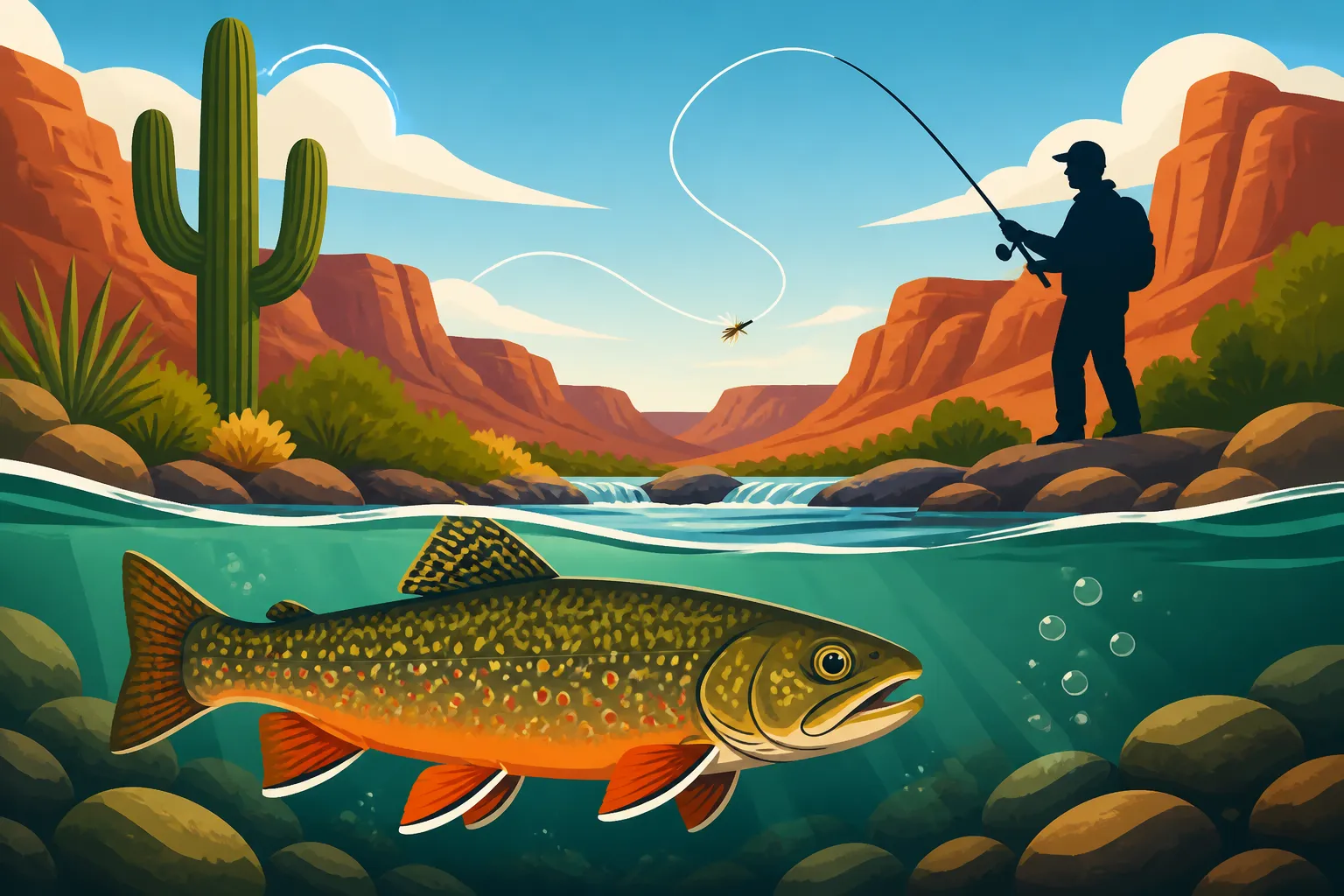
Brook Trout Presence in Arizona Streams
It’s easy to picture Arizona as an endless expanse of saguaro cacti, scorching deserts, and perhaps a vast, warm lake or two. When you mention trout fishing, many folks immediately think of distant mountain states or the mighty rivers out west. But what about the surprising presence of brook trout in Arizona streams? Many anglers are genuinely puzzled, or even skeptical, when they hear about these cold-water beauties gracing our high-country waters. This guide is here to unravel that mystery, confirming that these vibrant, speckled fish do indeed call some of Arizona's most pristine and often overlooked streams home, and will help you understand where to find them and what makes them so special.
The Unexpected Home: Brook Trout in Arizona's High Country
Brook trout, with their distinctive worm-like markings (vermiform patterns) on their backs, red spots encircled by blue halos on their sides, and striking white leading edges on their fins, are truly a sight to behold. They are technically char, not true trout, but everyone calls them brook trout. Native to eastern North America, their presence in Arizona often comes as a delightful surprise, as Arizona is generally perceived as a hot, arid state. The reality, however, is that Arizona boasts incredible ecological diversity, including significant mountain ranges that receive ample snowfall and create the perfect cold-water habitats for these fish.
The story of brook trout in Arizona is one of introduction, primarily for sport fishing purposes decades ago. They thrive in very specific conditions: extremely cold, clear, well-oxygenated water, often in high-elevation streams and small lakes that are fed by snowmelt or perennial springs. These aren't your typical desert fishing holes. We're talking about places where you might need a four-wheel drive to get close, or even a good pair of hiking boots to reach the most secluded pockets of water. It's a testament to Arizona's varied landscape that such a cold-loving species can exist here, albeit in limited, specialized environments. Finding them is less about luck and more about understanding these unique habitat requirements and being willing to seek out untouched wilderness.
Historical Context and Introduction
The introduction of non-native fish species into Arizona's waters has a long and complex history, often dating back to the late 19th and early 20th centuries. Brook trout were no exception. The idea was to enhance angling opportunities in waters that, while cold, might not have supported robust populations of native fish or were simply deemed suitable for a new game species. These efforts often involved transporting fish or eggs from other regions where brook trout were abundant, and then releasing them into Arizona's pristine high-elevation streams.
While some introductions were incredibly successful in establishing self-sustaining populations, others struggled to take hold due to unsuitable habitat or competition. The brook trout found a niche in some of Arizona's colder, higher-elevation streams where water temperatures rarely rise above their comfort zone, even in the height of summer. These isolated populations, often in remote reaches of the state's national forests and wilderness areas, have since maintained themselves, offering a unique angling experience for those willing to put in the effort. It’s a delicate balance, as these introduced species can sometimes impact native fish populations, but the brook trout have largely coexisted in their specific, cooler niches.
Ideal Habitats in Arizona
So, what exactly defines an "ideal" brook trout habitat in Arizona? Think high-elevation mountain streams, typically above 7,000 feet, often nestled in dense coniferous forests. These streams are characterized by:
- Cold Water Temperatures: This is paramount. Brook trout require water that stays consistently cold, ideally below 68°F (20°C) and thriving in much colder ranges. Snowmelt and spring-fed sources are crucial here.
- High Oxygen Content: Fast-flowing sections, riffles, and small waterfalls churn the water, ensuring it's rich in oxygen, which brook trout need to thrive.
- Clear, Clean Water: Sedimentation and pollution are detrimental. These fish prefer pristine conditions, indicating a healthy ecosystem.
- Abundant Cover: Overhanging vegetation, undercut banks, submerged logs, and rock structures provide crucial hiding spots from predators and strong currents.
- Gravely Substrate: Essential for spawning, brook trout need clean gravel beds to lay their eggs.
In Arizona, these conditions are predominantly found in the White Mountains, the Mogollon Rim country, and some of the higher peaks in the central and northern parts of the state. These aren't the broad, easily accessible rivers you might find elsewhere; they are often narrow, winding creeks that demand a more adventurous spirit to explore. Understanding Cool-Water Trout Streams in Northern Arizona can give you a better idea of what to look for.
Pinpointing Brook Trout Waters in the Grand Canyon State
When you're trying to find brook trout in Arizona, you really need to shift your mental map away from the typical desert fishing spots. Forget the wide open spaces and think dense forests, high altitudes, and crystal-clear mountain runoff. These fish aren't going to be in your average community lake. They're tucked away in some of the most beautiful, often challenging-to-reach, parts of our state. It’s an adventure just getting to them, which for many, is a huge part of the appeal.
The challenge isn't just knowing where to go, but also understanding the microclimates and specific characteristics of these streams. Many of these waters are small, sometimes barely more than a trickle in late summer, requiring delicate presentations and stealthy approaches. This is where a good Fishing Gear Checklist for Desert Lakes might not cover everything, as you'll also need specialized gear for mountain stream angling.
White Mountains Region
The White Mountains, located in eastern Arizona, are perhaps the most well-known stronghold for brook trout. This region boasts some of the highest elevations in the state, with numerous spring-fed streams and small lakes that maintain consistently cold temperatures year-round. Think of areas within the Apache-Sitgreaves National Forests.
- Sunrise Park and Nearby Areas: While many lakes in this area are stocked with rainbow trout, some of the smaller, higher elevation streams that feed into or flow out of these lakes can hold brook trout. You'll need to do some exploring and probably some bushwhacking to find the more isolated pockets.
- Remote Forest Service Streams: Many unnamed or lesser-known creeks winding through the thick pine and spruce forests are prime brook trout territory. These often require significant hiking, but the reward is often pristine water and less pressured fish. Anglers often keep these spots a secret, and for good reason—they are fragile ecosystems.
When fishing these areas, especially the smaller streams, you'll want to pack light. A compact fly rod, a few essential dry flies and nymphs, and a pair of sturdy wading boots are often all you need. Consider checking out gear on Amazon to find lightweight, durable equipment that can handle the trek.
Mogollon Rim Country
The Mogollon Rim, a towering escarpment that stretches across much of central Arizona, also harbors some potential brook trout waters, especially in its higher, eastern reaches. While it's more famous for its larger trout lakes and streams that primarily hold rainbows and browns, certain secluded tributaries or headwater springs can provide the chilly conditions that brook trout love.
- Specific Tributaries: It's usually the smaller, higher-gradient tributaries that flow into larger rivers or reservoirs along the Rim that might surprise you. These are typically spring-fed and shaded by dense forest canopy, keeping them cool. Again, detailed maps and a willingness to explore off the beaten path are your best friends.
- Limited Access Areas: Often, the best brook trout spots are those that require effort to reach. This means traversing uneven terrain, navigating through thick underbrush, and possibly dealing with limited trail access. These are not typically the "drive up and fish" locations, which is precisely why they remain special.
Always be sure to check current Arizona Fishing Regulations Explained for any specific rules that might apply to these particular waters, as catch limits and tackle restrictions can vary, especially in areas with sensitive fish populations.
Northern Arizona Highlands
Beyond the White Mountains and the Rim, some scattered high-elevation areas in northern Arizona, particularly around the San Francisco Peaks and other sky islands, might also contain brook trout. These populations are usually even more localized and often found in very small, fragile stream systems.
- Alpine Creek Systems: Imagine tiny creeks fed by melting snowpack that trickle down high mountain slopes. These are the kinds of places that might hold a small, self-sustaining population of brook trout. They are often less about quantity and more about the unique experience of finding these fish in such an unexpected environment.
- Wilderness Area Streams: Certain wilderness areas, protected from extensive human development, offer the pristine conditions these fish need. These spots require adherence to wilderness ethics, including Leave No Trace principles, to ensure these delicate habitats remain untouched.
It's truly a unique challenge to find these fish in Arizona, but the satisfaction of catching a vividly colored brook trout, native to the distant Appalachians, against a backdrop of Arizona's pine-clad mountains, is an unforgettable experience.
| Habitat Feature | Brook Trout Preference | Common Arizona Landscape (General) |
|---|---|---|
| Water Temperature | Extremely cold (optimally below 60°F/15°C) | Predominantly warm to hot |
| Water Clarity | Crystal clear, pristine | Can vary greatly; often clear in mountains, turbid in desert lakes |
| Oxygenation | High, swift-flowing sections, riffles | Varies; stagnant in some desert ponds, turbulent in rivers |
| Stream Size | Small to medium-sized mountain streams, headwaters | Large rivers, vast reservoirs, small desert washes |
| Cover/Structure | Undercut banks, fallen trees, large rocks, deep pools | Rocky shores, submerged timber, open water |
| Spawning Substrate | Clean gravel beds | Various substrates depending on water body |
| Elevation | High elevation (typically above 7,000 feet in Arizona) | Low to high; vast majority at lower elevations |
The Thrill of the Chase: Catching Arizona Brook Trout
Catching brook trout in Arizona is a different game entirely than pursuing largemouth bass in our desert lakes or even rainbow trout in a heavily stocked urban pond. These fish are often smaller, warier, and live in environments that demand a more nuanced approach. It’s less about brute strength and more about finesse, stealth, and respecting their fragile habitat. For many, the true reward isn't the size of the fish, but the beauty of the surroundings and the challenge of finding these elusive gems.
Successfully targeting brook trout in Arizona requires an understanding of their behavior in these unique, often remote, high-altitude streams. It means adapting your gear, your approach, and your expectations.
Essential Gear and Techniques
When you're heading out for brook trout, leave the heavy baitcasting setups at home. This is primarily a light tackle or fly-fishing endeavor.
- Ultra-Light Spinning Gear: A light or ultra-light spinning rod (4-5 feet long) paired with a small reel spooled with 2-4 lb test monofilament or fluorocarbon line is ideal. Small spinners, tiny spoons, or micro-jigs are very effective. Think about brands like Rooster Tail or Panther Martin for spinners, which you can often find easily on Amazon before your trip.
- Fly Fishing Gear: For the fly angler, a 2-4 weight fly rod (6-8 feet long) is perfect. Small dry flies (like an Adams, Parachute Adams, or Elk Hair Caddis) in sizes 14-20 are deadly, especially if you can match the local hatch. Small nymphs (like a Hare's Ear or Pheasant Tail) fished under a strike indicator or drifted are also highly effective. Terrestrial patterns like ant or beetle imitations can also work wonders, especially in late summer when bugs are falling into the water. Fly Fishing Techniques for Trout will give you more insights.
- Stealth and Presentation: Brook trout in these small streams are incredibly spooky. Approach the water slowly, stay low, and try to avoid casting a shadow over the water. Accurate, delicate casts are key. Often, your first cast into a promising pocket or under an undercut bank is your best shot.
Remember, these fish are often small, so handling them gently and releasing them quickly is crucial for their survival and the health of the population.
Best Times and Conditions
While brook trout primarily inhabit cold waters, even in Arizona, certain times of year and conditions are more favorable.
- Late Spring to Early Fall: This is generally the sweet spot. As snow melts in late spring, stream flows are good, and water temperatures are ideal. Summer can be good in the highest, most shaded streams, but lower elevations might get too warm. Fall offers stunning scenery and active fish preparing for winter.
- Cooler Parts of the Day: Even in the mountains, midday sun can make fish less active. Early mornings and late afternoons are often the most productive. Overcast days can also be excellent, as they reduce shadows and make the fish less wary.
- After a Light Rain: A gentle rain can sometimes invigorate the fish, wash terrestrial insects into the stream, and slightly muddy the water, making them less cautious. Avoid fishing immediately after heavy monsoon rains, as the water can become too high and muddy. How to Fish During Arizona's Monsoon Season can help you navigate these tricky times.
It's important to understand that brook trout don't have a specific "season" in the way some other species do with spawning closures. However, access to their high-elevation habitats can be limited by snowpack during winter and early spring. Always check forest service road conditions before planning a trip.
Conservation and Ethical Angling
Catching brook trout in Arizona comes with a responsibility to protect these unique populations and their fragile habitats.
- Catch and Release: Many anglers choose to practice catch and release for brook trout, especially in these isolated populations. Their small size makes them less desirable for the table, and releasing them ensures the population remains healthy for future generations. If you do keep fish, always know your Fishing Bag and Possession Limits Explained.
- Barbless Hooks: Using barbless hooks (or crimping down the barb on your existing hooks) makes it much easier to release fish without causing undue harm.
- Minimize Handling: If you must handle a fish, do so with wet hands, keep it in the water as much as possible, and return it quickly. Their delicate slime coat is vital for their health.
- Leave No Trace: These remote stream environments are pristine. Pack out everything you pack in, and leave the area cleaner than you found it. This includes fishing line, bait containers, and any other trash.
- Respect Private Property and Tribal Lands: Always be aware of land ownership. Some of the most beautiful streams might run through private land or tribal lands, requiring specific permits or permission. For tribal lands, you'll almost always need a separate permit, so be sure to investigate Tribal Land Fishing Permits in Arizona if you plan to explore those areas.
By fishing responsibly, you contribute to the longevity of these remarkable brook trout populations and preserve the wild beauty of Arizona's high country. Finding that perfect pair of polarized sunglasses on Amazon can also help you spot fish without disturbing the water, making ethical angling easier.
The Future of Brook Trout in Arizona
The presence of brook trout in Arizona streams is a testament to the state's incredible ecological diversity, but it also highlights the delicate balance of introduced species and native ecosystems. As climate change continues to impact weather patterns, the future of cold-water species like brook trout in already marginal habitats will always be a topic of discussion among fisheries biologists and conservationists.
Threats and Challenges
Brook trout face several threats in Arizona, primarily due to their specialized habitat requirements:
- Climate Change: Rising average temperatures and prolonged droughts are significant concerns. Even a slight increase in water temperature can make a stream unsuitable for brook trout, pushing them further up into headwaters or entirely out of a system. Reduced snowpack also means less consistent cold-water flow.
- Habitat Degradation: Wildfires, overgrazing, logging, and infrastructure development can all lead to increased sedimentation, loss of riparian vegetation, and altered stream flows, directly impacting brook trout habitat.
- Competition with Other Species: In some cases, brook trout can face competition from other introduced trout species, such as brown trout, which are often more tolerant of slightly warmer water and can outcompete brook trout for food and space.
- Isolation: The very nature of their isolated, high-elevation habitats means these populations are often small and genetically distinct, making them vulnerable to localized events like disease outbreaks or catastrophic fires.
These challenges underscore the importance of ongoing monitoring and habitat protection efforts by organizations like the Arizona Game and Fish Department and various conservation groups.
Conservation Efforts and Management
The Arizona Game and Fish Department, along with partners, plays a crucial role in managing and conserving Arizona's aquatic resources, including brook trout. Their work often involves:
- Habitat Restoration: Efforts to restore riparian areas, stabilize stream banks, and improve water quality can help existing brook trout populations thrive.
- Monitoring Populations: Regular surveys help biologists understand the health and distribution of brook trout populations, allowing for informed management decisions.
- Angler Education: Educating anglers about the importance of catch and release, proper fish handling, and respecting regulations is key to sustainable fishing.
- Strategic Stocking (Limited): While not widely stocked, some strategic stocking might occur to bolster existing populations or introduce them to suitable new (isolated) waters, always with careful consideration of native fish. You can learn more about Trout Stocking Season in Arizona generally.
For those who cherish the quiet solitude and the challenge of seeking out these beautiful fish, being an informed and responsible angler is the best way to ensure that brook trout remain a part of Arizona's surprising aquatic tapestry for years to come. Remember, a responsible angler always checks local regulations and makes sure their gear, like a good pair of waders from Amazon, is ready for the remote adventure.
Disclaimer
This article is for general informational purposes only and does not constitute professional advice. Laws, prices and regulations vary by location and change over time. Consult a qualified professional for guidance on your specific situation.