Arizona Fishing Regulations Explained
You finally get a free Saturday, load the truck, drive two hours to a lake under the Mogollon Rim, and then freeze at the boat ramp because you are not sure whether your license covers trout, whether you can fish two rods, or whether the minnows in your bucket are even legal here. Arizona’s fishing rules are not complicated once you see how they fit together, but nobody hands you that map. This guide lays out how the regulations are organized, what they cover and how to stay legal everywhere from a Phoenix community pond to the Colorado River.
How Arizona Fishing Regulations Are Organized
Arizona’s fishing rules come from the Arizona Game and Fish Commission and are carried out by the Arizona Game and Fish Department. The department publishes a fishing regulations booklet for each regulation cycle, and that booklet is the document you should treat as the final word. If you have never tracked it down, Arizona Fishing Regulations Booklet Where to Find It explains where to get the current edition.
Statewide Rules Versus Water-Specific Rules
The booklet follows a simple logic that confuses people only because they read it out of order.
- Statewide rules apply everywhere unless something more specific says otherwise. These include license requirements, legal methods, general bag limits and rules about bait.
- Community fishing waters, mostly urban lakes and ponds, have their own set of lower limits and specific rules.
- Special regulation waters override statewide rules for a particular lake, stream or stretch of river. These might set different bag limits, size limits, gear restrictions or seasons.
- Tribal lands follow tribal rules, not state rules, and require their own permits.
- Waters shared with other states, especially the Colorado River, carry extra rules tied to agreements with California and Nevada.
Read the booklet in that order. Start with statewide rules, then check whether your water is a community water, then look it up in the special regulations section. That habit alone prevents most mistakes.
Why the Rules Change
Arizona’s fisheries change constantly. Drought shrinks reservoirs, wildfire runoff damages trout streams, stocking schedules shift, and native fish recovery efforts change what anglers can keep. The commission adjusts rules to match. This is why a limit you remember from five years ago may no longer apply, and why it pays to check the booklet before every new season rather than relying on memory or what a buddy told you at the ramp.
Who Enforces the Rules
Game and Fish wildlife managers patrol lakes, streams and boat ramps. They check licenses, count fish in coolers, inspect bait buckets and look at boats for invasive species. Officers on federal land, tribal rangers and county sheriff’s boat patrols also show up at busy waters. Being polite, keeping your license handy and having your fish easy to count makes any check go quickly.
Licenses and Who Needs One
Most of the questions anglers ask about Arizona regulations start with licensing. The full breakdown is in Arizona Fishing License Guide, but here is how the system works in practical terms.
The Basic License Requirement
In Arizona, anyone ten years of age or older needs a valid fishing license to take fish, with a few exceptions. Kids under ten fish without a license, but the youth section of the booklet explains how their catch is counted, so read it before a family trip. Families often have questions about how this works on a group trip, and Do Kids Need a Fishing License in Arizona? walks through common scenarios.
Arizona simplified its license structure years ago. A general fishing license now covers trout and lets you fish with two lines, so there is no separate trout stamp or two-pole stamp to buy on top of it. Older guides and websites still mention those stamps, which causes confusion. If you see them in a blog post, it is out of date.
License Types
| License | Who It Is For | Notes |
|---|---|---|
| General fishing license | Residents and nonresidents | Covers most waters, includes trout and two lines |
| Combination hunt and fish license | Anglers who also hunt | Bundles hunting and fishing privileges |
| Short-term license | Visitors and occasional anglers | Valid for a set number of days |
| Youth combination license | Young anglers who need a license | Discounted rate for youth |
| Pioneer license | Long-time senior residents | Free lifetime license if eligibility is met |
| Disabled veteran license | Qualifying veterans | Free or reduced, based on service-connected disability |
Licenses are valid for a year from the date of purchase rather than expiring on a fixed calendar date. That means you can buy one in May and use it into the following May. Residents and nonresidents pay different amounts, and the department posts current fees on its license pages.
Discounts and Special Licenses
The Pioneer license is one of the most generous programs in the West. It provides a free lifetime license to residents who meet age and long-term residency requirements, and Arizona Pioneer License Eligibility Requirements lays out exactly who qualifies. Qualifying disabled veterans can also get a license at no cost or a reduced cost. Active-duty military, college students and other groups sometimes have special residency or discount rules, which are covered in the booklet’s license section.
Free Fishing Day
Once a year, usually in early June, Arizona holds a Free Fishing Day when anyone can fish public waters without a license. All other rules still apply on that day, including bag limits, gear rules and special regulations. The booklet spells out what is and is not relaxed, and the day is a great way to introduce friends to fishing before they commit to buying a license.
Visiting Anglers and Nonresidents
Nonresidents fish under the same rules as residents once they hold the right license. The difference is mostly in price and in which license makes sense for the trip. A visitor coming for a long weekend at Lake Havasu might buy a short-term license, while a winter visitor who spends three months near Yuma usually comes out ahead with a full annual license. If you plan to hunt as well, compare the combination license against two separate purchases before you buy.
Residency for license purposes has its own definition, tied to how long you have lived in the state, so new arrivals should check whether they qualify yet before buying a resident license. Buying the wrong type can be treated as a violation even when it was an honest mistake.
Carrying Proof of License
Arizona accepts digital licenses on your phone, but dead batteries and missing cell signal are common at remote lakes. Many anglers keep a printed copy in a waterproof sleeve in their tackle box. A cheap waterproof pouch or license holder from Amazon or a local sporting goods store is a small purchase that saves a lot of hassle during a check at a ramp with no service.
Bag Limits, Possession Limits and Size Limits
Limits are where most honest anglers get into trouble, usually because they do not know which set of limits applies to the water in front of them. Fishing Bag and Possession Limits Explained goes deeper, but these are the basics.
Daily Bag Limits
A daily bag limit is the number of fish of a given species or group that one angler can take in a single day. Arizona sets statewide limits for trout, bass, catfish, crappie, sunfish, walleye, striped bass and other species, with some species grouped together into combined limits. Some species, such as many nongame fish, have no limit at all in most waters.
Once you keep your limit, you are done keeping that species for the day. Arizona does not allow you to catch a limit, give it to a friend and keep fishing to fill another one. Culling, or swapping a smaller fish in your livewell for a bigger one you just caught, is restricted for certain species and situations, so check the booklet before you try it.
Possession Limits
The possession limit is the total number of fish you can have at any one time, including fish in your cooler at camp, in your freezer at home and in your truck on the drive back. In Arizona, the possession limit is generally the same as the daily bag limit for most species, which surprises anglers from states that allow two or three days’ worth. If you fish three days at a lake, you cannot leave with three daily limits of trout.
This is a common problem on multi-day camping trips. A family that keeps a limit of trout on Friday, eats half on Saturday morning and keeps fishing has to count the fish still in the cooler against the limit. The easiest way to stay legal is to eat or release fish rather than build up a pile.
Size Limits and Slot Limits
Some waters have minimum size limits, maximum size limits or protected slot limits. A minimum limit means you can only keep fish longer than a set length. A protected slot means fish within a certain range must be released, while fish above or below can be kept. Bass limits at some reservoirs, trout limits on certain streams and walleye rules at some lakes fall into these categories.
Measure fish from the tip of the closed mouth to the tip of the tail, with the tail pinched together. A simple measuring board or bump board is worth having on any boat. Many anglers order one from Amazon along with a pair of long-nose pliers and a fish gripper so they can measure quickly and release short fish with less handling.
Comparing How Limits Apply
| Situation | Which Limit Applies | What to Check |
|---|---|---|
| Statewide water with no special rules | Statewide daily and possession limits | Species groups and combined limits |
| Community fishing water | Lower community water limits | Posted signs and the community section |
| Special regulation water | The special rule for that water | Size limits, gear rules, seasons |
| Tribal water | Tribal regulations | Tribal permit and posted rules |
| Colorado River shared water | Arizona rules plus any agreement rules | Stamp or validation requirements |
Keeping Fish You Plan to Eat
Once you keep a fish, it counts against your limit, even if it later goes back into the water dead or ends up in a friend’s cooler. Decide early whether you are keeping fish that day, and keep them separate from anyone else’s catch so a wildlife manager can count each angler’s fish at a glance. On long drives home, pack fish so they can still be counted. If you clean them at the lake, follow any rules in the booklet about how fish must be kept until you reach your home.
Community Fishing Waters
Arizona’s community fishing program puts stocked fishing within a short drive of most people in Phoenix, Tucson, Flagstaff, Yuma and other cities. These urban lakes and ponds are fantastic for kids and new anglers, but they come with their own set of rules.
What Makes a Water a Community Water
Community waters are typically city parks, urban lakes and small ponds that Game and Fish stocks regularly with catfish in warm months and trout in cool months. Some also have bass, sunfish and other species. They are listed in the booklet, and signs at most locations identify them. Arizona Community Fishing Program Rules covers the details.
Lower Limits and Special Rules
Because so many people fish these small waters, the daily limits for trout, catfish, sunfish and bass are lower than statewide limits. Some community waters also have size limits for bass, and some have rules about the number of lines you can fish. These limits keep the stocked fish spread among more anglers rather than going home with the first few people who show up after a stocking truck.
City rules also apply. Parks may close at night, ban glass containers, restrict where you can stand or prohibit wading and boats. A few parks have their own fishing hours. Read the posted signs before you set up.
A Typical Community Water Trip
Picture a parent and two kids, ages eight and twelve, heading to a Phoenix-area park lake on a winter morning after a trout stocking. The parent buys a general license. The twelve-year-old needs a license too, while the eight-year-old does not. They fish with small spinners and worms under a bobber, and each licensed angler keeps track of their own trout limit. When they reach the community limit, they switch to catch and release or call it a day.
That simple outing touches almost every core rule in the booklet: license age, limits, legal bait and posted city rules. Getting it right with kids is a great way to build good habits.
Methods, Gear and Bait Rules
Arizona’s method rules decide how you are allowed to catch fish. Most anglers fishing with a rod and reel and ordinary lures will never bump into them, but bait, extra lines and specialty methods have specific rules.
Rods and Lines
A general fishing license lets you fish with up to two lines at a time in most waters. Each line must be attended, meaning you are close enough to watch it and respond. Some special regulation waters and community waters limit you to one line, so check before you put out a second rod. Two-Rod Fishing Rule in Arizona explains how this works on lakes, rivers and community ponds.
Live Bait and Baitfish
Arizona’s live bait rules are among the most important to understand because they protect native fish and prevent the spread of unwanted species. In general:
- Live baitfish are legal only in certain areas of the state and only for certain species.
- Waterdogs, the larval form of tiger salamanders, are legal bait in some areas but not others.
- Live crayfish can be used only in the water where they were caught and cannot be transported alive away from that water.
- Moving live fish from one water to another is illegal.
- Using game fish as bait is restricted.
The booklet includes a map and list showing where each type of live bait is legal. Live Bait Rules for Arizona Lakes goes into more detail. When in doubt, use dead bait, artificial lures, worms or dough baits, which are legal almost everywhere except artificial-only waters.
Artificial-Only and Barbless Waters
Some special regulation waters require artificial lures and flies only, and some require barbless hooks. Lees Ferry on the Colorado River below Glen Canyon Dam and several trout streams and small lakes in the White Mountains and along the Rim fall into these categories. You can make a barbed hook legal by pinching the barb flat with pliers. Many fly anglers buy barbless hooks in bulk online, including from Amazon, so they never have to think about it.
Specialty Methods
Arizona allows some methods beyond rod and reel for certain species. Bowfishing and spearfishing are legal for some nongame species in certain waters, with specific rules about where and when. The booklet explains which license and which waters apply. Snagging, nets and set lines have their own restrictions. If you plan to try anything beyond normal rod and reel fishing, read the method section of the booklet carefully before you go.
Special Regulation Waters and Native Fish
What Special Regulation Waters Are
Special regulation waters are lakes, streams or stretches of river with rules that override statewide rules. They might have lower limits, size restrictions, artificial-only rules, catch-and-release sections or seasonal closures. The goal is usually to protect a trophy fishery, a native fish population or a water that gets heavy pressure. Special Regulation Waters in Arizona explains the categories.
Examples include certain White Mountain trout lakes, stretches of Oak Creek, Lees Ferry, and some lakes with special bass or walleye rules. The list changes over time, which is why you should check the booklet for each trip.
Native and Protected Fish
Arizona is home to native fish found nowhere else, including Apache trout and Gila trout, and big-river natives such as humpback chub, razorback sucker, bonytail and Colorado pikeminnow. Many of these species are protected. If you catch one where it is not legal to keep, you must release it immediately and unharmed. Native Fish Protection Rules in Arizona explains which species are protected and how to recognize them.
Some streams open to fishing for native trout under special rules, such as catch and release or single-hook artificial lures. Others are closed to protect recovery efforts. Learning to identify these fish is part of being an ethical Arizona angler.
Seasonal Closures
A few waters close during certain parts of the year to protect spawning fish or recovering populations. Some high-country lakes are also inaccessible in winter because of snow and road closures. Check the booklet and posted signs before planning a trip to a remote lake or stream.
Tribal Lands and Shared Waters
Fishing on Tribal Land
Large parts of Arizona belong to sovereign tribal nations, and many of the state’s best lakes and streams sit on tribal land. The White Mountain Apache Tribe, San Carlos Apache Tribe, Navajo Nation, Hualapai Tribe and others manage their own fisheries and issue their own permits. An Arizona state fishing license does not cover fishing on tribal land unless the tribe specifically says so.
Before you fish, buy the correct tribal permit and read the tribe’s rules, which may differ from state rules on limits, gear and access. Some areas are closed to non-members. Tribal Land Fishing Permits in Arizona covers how to find permits and rules for the main tribal fisheries.
The Colorado River and Lake Mead
The Colorado River forms the border between Arizona and California and between Arizona and Nevada. Arizona has reciprocal agreements with both states that allow licensed anglers to fish shared waters under certain conditions. Often, an Arizona license holder fishing from a boat on the other state’s side, or from that state’s shore, needs a special use stamp or validation from the neighboring state. Arizona License Coverage on the Nevada Side of Lake Mead explains how this works on Lake Mead and Lake Mohave.
Rules and limits on the Colorado River can differ from inland Arizona waters, and certain stretches have their own special regulations. Lake Powell, which straddles the Utah line, has its own set of agreements and rules as well.
Interstate Comparison
| Water | States Involved | What to Check |
|---|---|---|
| Lake Mead | Arizona and Nevada | Use stamp rules for fishing Nevada waters |
| Lake Mohave | Arizona and Nevada | Same reciprocal rules as Lake Mead |
| Lake Havasu and lower river | Arizona and California | California validation for California waters |
| Lake Powell | Arizona and Utah | Which side you fish and that state’s rules |
Boating, Invasive Species and Staying Legal
Aquatic Invasive Species Rules
Quagga mussels and other invasive species have spread to several Arizona waters, including Lake Mead, Lake Havasu and Lake Pleasant. Arizona requires boaters to clean, drain and dry their boats when leaving infested waters and before launching elsewhere. Boats must be free of attached mussels, and drain plugs must be removed during transport. Some waters have inspection stations.
These rules apply to anglers in kayaks and float tubes too. Rinse and dry your gear, empty bait buckets away from the water and never move water from one lake to another.
Boating Rules That Affect Anglers
Boat registration, life jackets, navigation lights and other safety equipment fall under boating rules that apply alongside fishing rules. Many lakes also have speed limits, no-wake zones and restricted areas near dams. Fishing near swim areas or boat ramps may be restricted. Check local rules for the specific lake.
Common Violations and How to Avoid Them
| Common Mistake | Why It Happens | How to Avoid It |
|---|---|---|
| Fishing without a license | Assuming a short trip or a kid does not need one | Check age rules and buy a license first |
| Over the possession limit | Keeping fish over several days | Count everything in the cooler |
| Illegal live bait | Bringing bait from another area | Use the bait map or switch to dead bait |
| Wrong rules on tribal water | Assuming a state license works | Buy a tribal permit |
| Two lines where one is allowed | Not reading special rules | Check community and special regulations |
| Keeping a protected native fish | Misidentifying the species | Learn the key features and release when unsure |
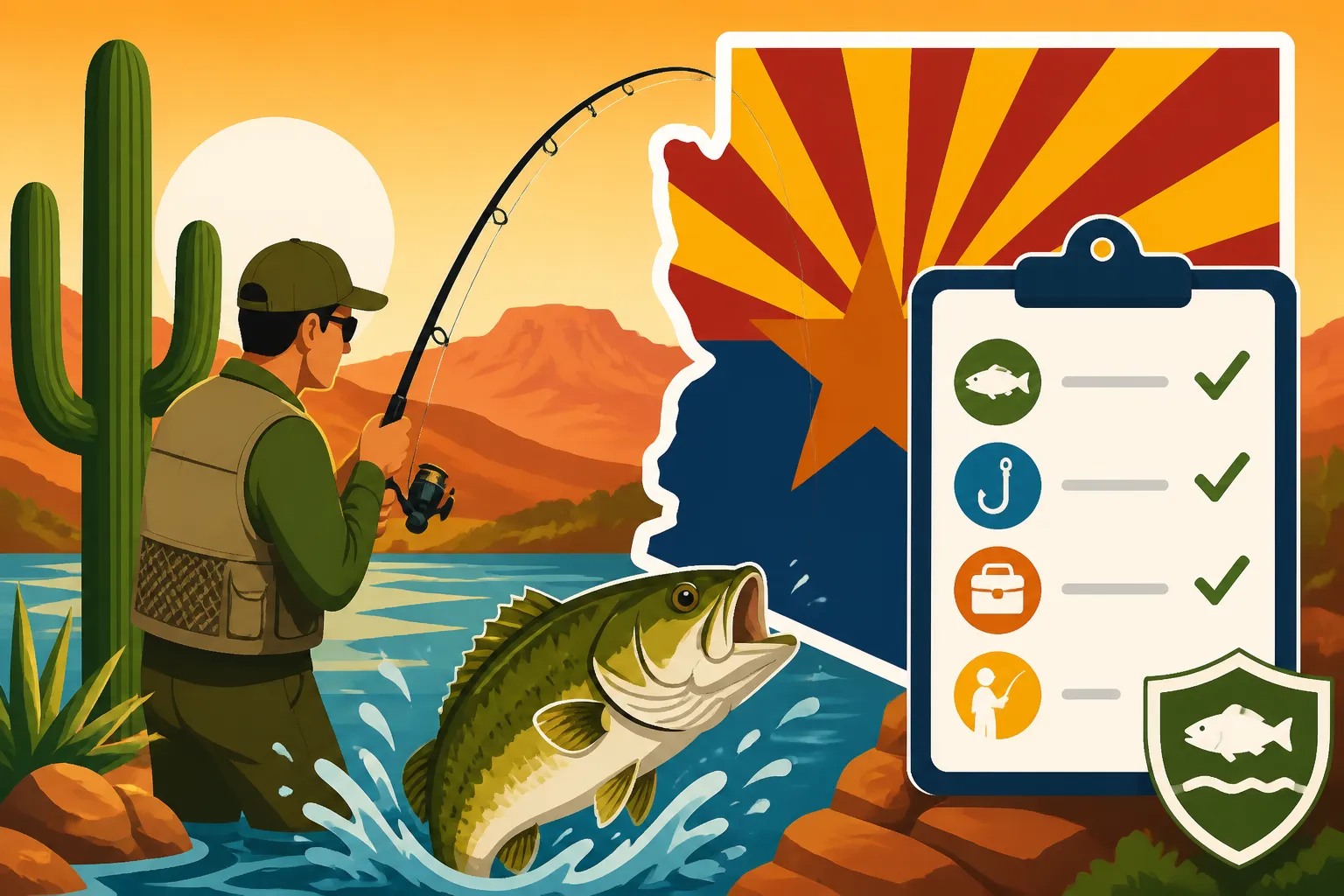
A Simple Pre-Trip Checklist
- Confirm your license is current and carry proof of it.
- Look up your water in the booklet’s special regulations section.
- Check whether it is a community water with lower limits.
- Confirm whether you are on tribal land or a shared water.
- Check live bait rules for that area.
- Clean, drain and dry your boat and gear.
- Pack a measuring board and pliers for quick, legal releases.
Following these steps takes ten minutes and saves you from fines, wasted trips and harm to fisheries everyone depends on. Arizona’s fishing rules exist to keep stocked lakes productive, protect native species and share fish fairly. Learn the structure once, check the booklet each season, and you can fish anywhere in the state with confidence.
Disclaimer
This article is for general informational purposes only and does not constitute professional advice. Laws, prices and regulations vary by location and change over time. Consult a qualified professional for guidance on your specific situation.