Threadfin Shad as Forage for Striped Bass
If you've spent any time on Arizona's big reservoirs, chasing after those hard-fighting striped bass, you've probably heard the term "shad" thrown around a lot. It's almost gospel among striper anglers: find the shad, find the stripers. But for a lot of folks, especially those newer to the Arizona fishing scene, the exact connection between these small, silvery baitfish and the mighty striped bass can feel a bit mysterious. It's a key piece of the puzzle that, once understood, can dramatically change your fishing success. This guide is all about pulling back the curtain on that relationship, helping you truly grasp why threadfin shad are such a crucial forage species for striped bass in our unique desert waters, and how you can use this knowledge to your advantage.
The Life and Times of Threadfin Shad in Arizona Waters
Understanding the threadfin shad is really the first step in understanding striped bass fishing in Arizona. They're not just some generic baitfish; they are the foundation of the food chain for many of our most sought-after predatory species, none more so than the striped bass.
What are Threadfin Shad and Why Are They Here?
Threadfin shad (scientific name: Dorosoma petenense) are these incredibly delicate, silvery, fast-swimming schooling fish that are easily mistaken for other small baitfish at a glance. They have a distinctive, elongated last ray on their dorsal fin, which gives them their "threadfin" name. These little guys typically range from about 3 to 7 inches long, though you'll see plenty smaller than that, especially the younger-of-the-year fish that make up a huge portion of the forage base. They're built for speed and schooling, constantly on the move in tight formations, which is a defensive mechanism against predators.
Now, it's important to know that threadfin shad aren't native to Arizona's desert lakes and rivers. They were actually introduced decades ago by fisheries managers. The thinking was, and proved to be correct, that our vast, warm-water reservoirs needed a robust, prolific forage fish that could reproduce quickly and provide a constant food source for game fish like largemouth bass, crappie, and, crucially, striped bass. They fill a niche as primary consumers, mostly feeding on plankton and tiny invertebrates, efficiently converting these microscopic food sources into biomass that bigger fish can then consume. Their short lifespan and incredibly high reproductive rate mean they can bounce back quickly even after heavy predation, ensuring a continuous buffet for the hungry predators.
Where Do Threadfin Shad Live and Thrive?
Threadfin shad are true warm-water specialists. You won't find them happily swimming in frigid mountain streams. They absolutely thrive in the expansive, sun-drenched impoundments that define much of Arizona's premier fishing. Think of lakes like Lake Powell Arizona Fishing Guide, Roosevelt Lake Arizona Fishing Guide, Lake Pleasant Arizona Fishing Guide, and Lake Havasu along the Colorado River – these are prime threadfin shad territories. They prefer open water, often suspending in the water column, but they'll also relate to submerged structures, channel bends, and main lake points, especially during certain times of the year or when seeking shelter.
Their distribution within a lake is heavily influenced by water temperature and oxygen levels. While they love warm water, they can be sensitive to extreme heat or low oxygen conditions that sometimes occur in the deepest parts of reservoirs during late summer. You'll often find them congregating in specific thermoclines – those layers of water where temperature changes rapidly – or near the surface during cooler parts of the day. Their seasonal movements are quite pronounced: in spring, they spread out and reproduce, and in summer, they often form massive schools near the surface or in the upper water column. As fall and winter approach, they might move into deeper, more stable water, though in Arizona's mild winters, they can still be active closer to the surface on sunny days. Understanding these movements is critical because, as we'll explore, the stripers are never far behind.
The Essential Role of Threadfin Shad in the Striped Bass Diet
When you talk about striped bass in Arizona, you're talking about a fish that is a pure, unadulterated predator, built for speed and designed to consume vast quantities of schooling baitfish. And when it comes to their preferred meal, threadfin shad reign supreme.
Why Striped Bass Love Threadfin Shad
It's not just a casual preference; it's an evolutionary match made in angler heaven. Striped bass find threadfin shad absolutely irresistible for several compelling reasons. Firstly, their nutritional value is off the charts for a rapidly growing, energetic predator. Shad are packed with essential fats and proteins that fuel the incredible growth rates we see in Arizona's striped bass populations. These aren't just empty calories; they're the building blocks for those powerful shoulders and broad tails that make stripers such formidable fighters.
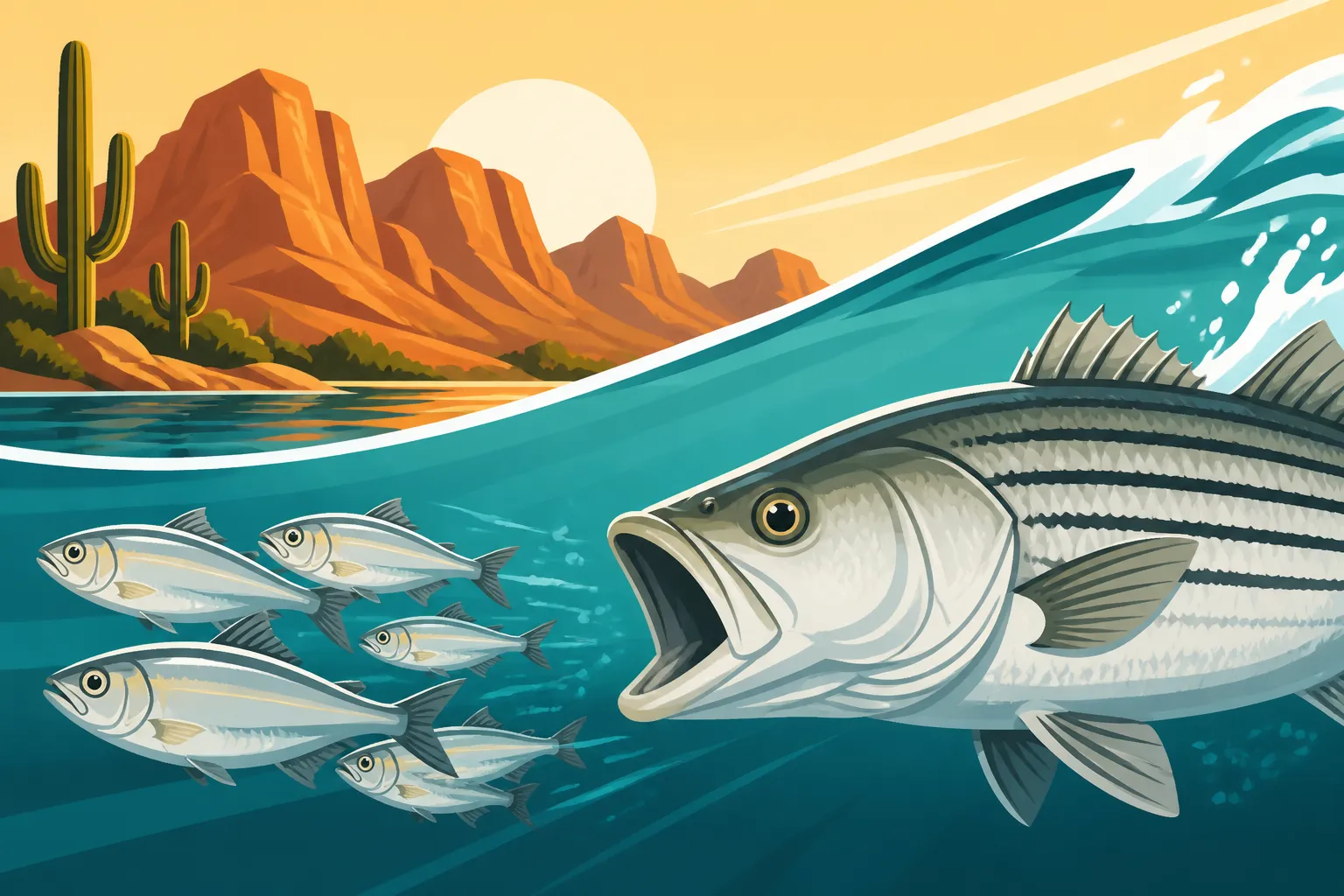
Secondly, the schooling behavior of threadfin shad plays right into the striped bass's hunting strategy. Stripers are pelagic hunters, meaning they cruise open water, relying on their keen senses and sheer numbers to overwhelm schools of baitfish. Imagine a massive, tightly packed ball of thousands of shad. To a lone striper, that's like a floating buffet, easy to corral and pick off. The sheer abundance and concentration of shad make them incredibly efficient targets, allowing stripers to expend less energy per meal. From tiny "schoolie" stripers to the true trophy fish, the size of threadfin shad is also perfectly convenient – they're bite-sized meals that can be gulped down with minimal effort. This combination of high nutritional content, easy availability in schools, and convenient size makes shad the ultimate forage fish. This dynamic is a huge part of what makes Striped Bass Fishing Guide for Arizona so thrilling.
How Shad Availability Influences Striped Bass Behavior
The presence and behavior of threadfin shad are perhaps the single biggest factors dictating where and how striped bass feed. Seriously, if you want to find stripers, you must find the shad. This relationship completely dictates the stripers' location and feeding patterns throughout the year. For instance, if the shad are holding in a particular depth range or congregating in a specific cove, you can bet the stripers won't be far behind, shadowing their food source. Anglers who learn to "read the water" for signs of shad, whether visually or with electronics, are consistently more successful than those who don't.
One of the most exciting manifestations of this relationship is the legendary "boil" or "blitz." This is when vast schools of striped bass work together to push threadfin shad to the surface, creating a chaotic explosion of feeding fish. It's an incredible sight and often happens during the warmer months, especially in the mornings or evenings. The sheer abundance and accessibility of shad directly translate to impressive growth rates and larger average sizes for striped bass in Arizona. Lakes with thriving threadfin populations consistently produce healthier, heavier stripers. It's a direct correlation: more shad equals bigger, stronger, more numerous stripers. This intricate dance between predator and prey is why understanding the threadfin shad is so fundamental to mastering the art of catching striped bass here in the desert.
Angling Strategies: Leveraging Shad Knowledge for Striped Bass Success
Now that we've established just how critical threadfin shad are to the striped bass, the next step is putting that knowledge into practice. This isn't just academic information; it's actionable intelligence that can drastically improve your odds of landing that trophy striper.
Finding the Shad to Find the Stripers
This is the golden rule for striped bass fishing in Arizona: find the bait, find the fish. So, how do you go about finding these elusive little silver bullets?
First and foremost, your electronics are your best friend. A good fish finder is invaluable for locating schools of shad. You're not necessarily looking for individual fish, but rather large, dense "bait balls" that show up as thick, often crescent-shaped clouds on your sonar screen. These schools can be suspended anywhere from just below the surface down to significant depths, depending on the time of day, water temperature, and sunlight penetration. Scan open water areas, especially over submerged points, humps, and along channel edges. Learning How to Read a Fish Finder for Bass can give you a significant edge, as the principles apply directly to locating baitfish and predatory stripers.
Beyond electronics, keep an eye out for visual cues. One of the most exhilarating sights in Arizona fishing is witnessing a full-blown striper boil. This happens when stripers aggressively drive shad to the surface, causing the water to erupt with splashing fish. Look for circling or diving birds, especially gulls, which are often indicators of surface feeding activity by game fish. Pay attention to subtle disturbances on the water – ripples or splashes that aren't caused by wind. These can be early signs of shad being pushed around. The time of day and season also play a role; early mornings and late evenings often see shad pushed closer to the surface, making them more vulnerable and easier to spot. During the warmer months, shad activity increases, leading to more frequent boils. If you're fishing Lake Powell Arizona Fishing Guide, knowing How to Find Striper Boils on Lake Powell is half the battle.
| Shad Characteristic | Why it Attracts Stripers | Angler's Takeaway |
|---|---|---|
| Small, Silvery Body | High visibility, mimics natural prey. | Use silver, white, chrome lures. |
| Schooling Behavior | Easy for stripers to ambush and consume efficiently. | Look for bait balls on sonar; cast into surface boils. |
| High Nutritional Value | Fuels rapid growth and energy for powerful fish. | Stripers will actively hunt shad over less nutritious options. |
| Fragile, Easy to Catch | Stripers can consume large quantities with minimal effort. | Lures that mimic erratic, fleeing shad are highly effective. |
| Warm Water Preference | Stripers follow shad into warmer, shallower water in spring/fall. | Focus on warmer water areas, especially during seasonal transitions. |
Best Baits and Lures that Mimic Threadfin Shad
Once you've located the shad (and hopefully the stripers!), the next step is presenting something that looks, acts, and feels like their favorite meal. The market is absolutely flooded with shad-imitating baits, and for good reason!
Soft plastic swimbaits are a fantastic choice. Look for realistic profiles, often with a paddle tail that creates an enticing thumping action. Colors like silver, white, pearl, light blue, or chartreuse are excellent choices to mimic the natural coloration of a shad. You can find many effective options on Amazon, often in multi-packs, making it easy to experiment. Swimbait Techniques for Striped Bass are incredibly effective when fish are scattered or holding at specific depths. Crankbaits, particularly those with a tight wobble, can also be highly productive. Choose crankbaits that dive to the depth where you're seeing shad and stripers on your fish finder. Colors should again lean towards silver, chrome, or shad patterns.
For those exciting surface boils, topwater lures are a must-have. Poppers, walk-the-dog baits, and even prop baits can generate explosive strikes. The key here is to cast quickly and accurately into the melee, then work your lure with erratic movements to simulate a panicked shad. Metal spoons, like Kastmasters or similar flutter spoons, are incredibly versatile. They can be cast long distances into boils or vertically jigged down into deeper schools of shad you've marked on your electronics. Just remember to match the hatch – if the shad are small, use smaller spoons; if they're larger, upsize your lure. And of course, if regulations allow and you have access, live threadfin shad are hands-down the most effective bait. However, catching and keeping them can be a challenge, so realistic artificials are often the more practical choice for many anglers. When thinking about Best Lures for Largemouth Bass in Arizona Lakes, many of those principles, especially regarding shad imitations, carry over to striped bass.
Techniques for Fishing Shad-Driven Stripers
Knowing what baits to use is only half the battle; how you present them is equally important. When stripers are actively chasing shad, they're often aggressive, but you still need to present your lure in a way that triggers a strike.
Trolling is an incredibly effective strategy, especially on large bodies of water like Lake Pleasant, to cover a lot of ground and locate scattered schools of stripers that might be following shad. Using planer boards or downriggers (if you have them) can help you present your shad-imitating swimbaits or crankbaits at precise depths where the bait is holding. Trolling Techniques for Striped Bass allow you to systematically search for active fish. When you encounter a striper boil, rapid casting is essential. Speed and accuracy are key; get your lure into the feeding frenzy as quickly as possible. Work your topwater or swimbait erratically, making it look like a distressed shad trying to escape.
If you're marking deep schools of shad with stripers lurking below on your fish finder, vertical jigging is the way to go. Drop metal spoons or heavy jigs right into the thick of the bait ball. Let it hit bottom, then rip it up sharply, letting it flutter back down. This often triggers a reaction strike from stripers positioned below the shad, waiting for an easy meal. Some anglers, where permitted, will also use cut shad as chum to draw stripers closer to the boat before casting live baits or lures. This can be especially effective when fish are holding deep. Understanding the seasonal movements and daily habits of threadfin shad, combined with these strategic techniques, will significantly increase your success rate and make your Arizona striped bass fishing adventures far more rewarding. Remember, even during the heat of summer, stripers will be active if they're keyed into shad, so knowing Best Time of Day to Fish in Arizona Heat around these baitfish can be crucial.
Disclaimer
This article is for general informational purposes only and does not constitute professional advice. Laws, prices and regulations vary by location and change over time. Consult a qualified professional for guidance on your specific situation.