Best Rod Action for Jig Fishing
There are few things more frustrating in fishing than feeling a subtle "thump" on your jig, only to set the hook and come up empty, or struggling to impart the right action to your lure. Many anglers overlook a critical piece of the puzzle that often leads to these woes: rod action. This guide will dive deep into understanding what rod action is, why it's so vital for effective jig fishing, and how to choose the absolute best rod action to maximize your success on Arizona's diverse lakes and rivers.
Understanding Rod Action: The Bend in Your Blade
Before we dive into the nitty-gritty of selecting the perfect jigging rod, it's crucial to understand what "rod action" actually means. It's not about how strong the rod is – that's "power." Instead, rod action refers to where on the blank a fishing rod bends when pressure is applied, and how quickly it returns to its original straight position. This characteristic dictates so much about how your jig feels, moves, and how effectively you can set the hook.
Defining Rod Action: Where the Bend Begins
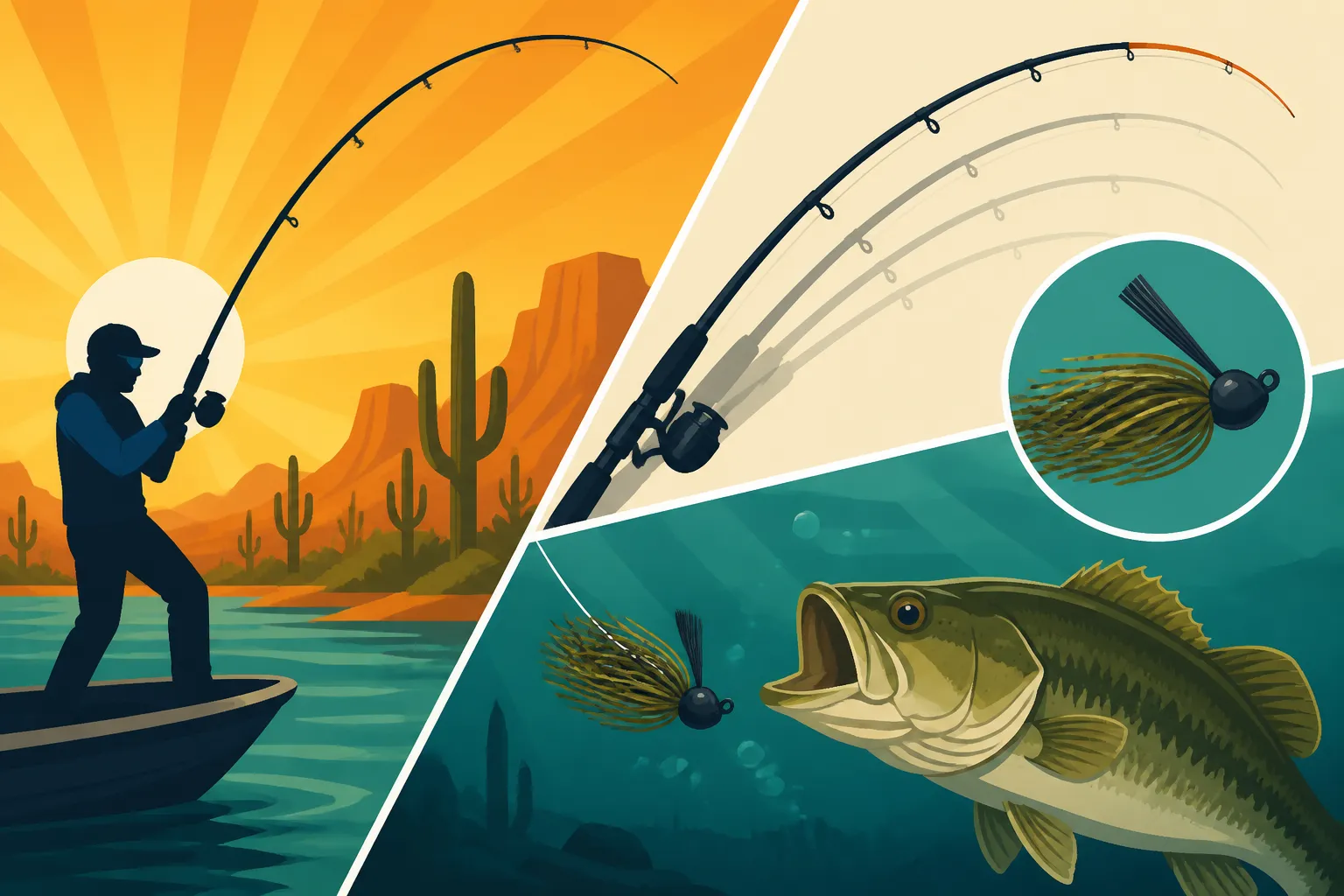
Imagine holding a fishing rod perfectly still, and then pulling on the tip. A rod with a "fast action" will primarily bend in the upper third or quarter of its length. It's like a spring that flexes mostly at its end. Conversely, a "moderate action" rod will bend much further down the blank, closer to the middle, distributing the flex more evenly throughout its body. Then you have "extra-fast" actions, which bend only in the very tip, and "moderate-fast" which lands somewhere between fast and moderate. This bending profile is engineered into the rod's taper and material, and it's absolutely paramount for jig fishing.
The way a rod bends directly impacts two key aspects of jig fishing: sensitivity and hookset power. A rod that flexes primarily in the tip transmits subtle vibrations better, allowing you to feel even the lightest tap from a finicky bass or crappie. However, that same tip needs to transition into a strong backbone for a solid hookset. Getting this balance right for jigging can make all the difference between a productive day and a frustrating one.
The "Feel" Factor and Its Impact on Jigging
Beyond the purely mechanical aspect of where a rod bends, there's the subjective "feel" that action imparts. A fast or extra-fast action rod will feel crisp and responsive in your hand, almost like an extension of your arm. This is particularly important for jigging, where you're often trying to mimic a crawfish scuttling on the bottom or a baitfish darting through cover. The ability to precisely control the jig's movement, feel every rock, stump, or even a blade of grass, is directly tied to the rod's action.
Conversely, a rod with a slower action might feel "noodly" or less direct, making it harder to distinguish between a structure bump and a subtle bite. While slower actions have their place in other techniques, for the precise, often aggressive movements required in jigging, that direct connection to your lure is invaluable. Many seasoned anglers on Arizona's diverse waters, from the deep canyons of Lake Powell to the brush-filled coves of Roosevelt Lake, will tell you that the right rod action is like having an extra pair of eyes and ears underwater.
Why Rod Action is Crucial for Effective Jig Fishing
Jig fishing is a highly interactive technique. You're not just casting and reeling; you're actively working the lure, feeling for bites, and setting the hook with precision. Each of these stages is profoundly influenced by your rod's action. The right action can turn a barely perceptible nibble into a landed fish, and transform sloppy lure presentation into enticing movements.
The Critical Connection: Bite Detection and Hookset Power
When a fish bites a jig, especially a wary bass or a light-biting crappie, it often feels like a slight tick, a spongy weight, or sometimes just the absence of tension. An extra-fast or fast action rod excels at telegraphing these subtle sensations up the line and into your hand. Because only the very tip flexes easily, any contact with the lure is magnified. This heightened sensitivity means you detect more bites, especially the ones that might otherwise go unnoticed.
However, sensitivity is only half the battle. Once you feel that bite, you need to drive the hook home, often through tough mouth cartilage or the bone of a fish's jaw. This is where the "backbone" of the rod comes into play. A fast action rod, while having a flexible tip for sensitivity, quickly transitions into a powerful mid-section that provides the leverage needed for a strong, instant hookset. A rod that bends too much too soon would absorb too much of your hookset energy, leading to missed fish. This is why you rarely see serious jig fishermen using slow action rods; they simply don't have the rapid power delivery required.
Mastering Lure Presentation with the Right Action
Jig fishing is all about making that lure dance. Whether you're hopping a jig along the bottom, swimming it through the water column, or snapping it free from cover, the rod's action dictates how effectively you can impart these movements. A fast action rod allows for quick, sharp twitches and hops. The stiff mid-section gives you immediate control over the jig's movement, making it easier to mimic the erratic behavior of prey.
Consider fishing for smallmouth bass in the clear, rocky waters of Lake Havasu or the Colorado River. You want to snap that jig off the bottom or a ledge, letting it fall naturally. An extra-fast action rod gives you the crispness to make those precise snaps and then immediately feel the jig as it falls, detecting any "slack line" bites. For crappie fishing around brush piles at a lake like Alamo Lake, a fast action allows you to gently lift and drop a small jig with precision, feeling every branch and maintaining control without getting snagged constantly. Crappie Spawning Season Tactics can be even more effective with the right rod action.
Different Rod Actions and Their Jigging Applications
While there's a broad spectrum of rod actions, for jig fishing, we primarily focus on faster actions due to the technique's demands for sensitivity and hookset power. Let's break down the most common and effective actions for jigging in Arizona.
Extra-Fast Action: Precision and Power
An extra-fast action rod bends only in the very tip section. This means it offers the absolute maximum in sensitivity. Every little tap, every slight change in bottom composition, and even the lightest breath of a fish will be transmitted directly to your hand. When it comes to finesse jigging – tiny jigs for finicky crappie, or light presentations for pressured bass – this action is a dream.
The advantage of an extra-fast tip is its responsiveness for pinpoint accurate casts and delicate lure manipulations. However, as soon as you apply pressure for a hookset, the rod's strong backbone kicks in almost immediately. This combination is lethal for quick, powerful hooksets on fish that might just be "mouthing" the jig. Think about fishing for deep smallmouth bass at Lake Powell, dropping a small jig down to 30-40 feet. An extra-fast action rod helps you feel the subtle bites and get a solid hookset over a long line. How to Fish for Smallmouth Bass benefits greatly from this action. You can find excellent choices for these types of rods at Bass Pro Shops or by browsing options on Amazon.
Fast Action: The All-Around Jigger's Friend
Fast action rods bend in the top one-third to one-quarter of the blank. This is arguably the most versatile and popular action for general jig fishing, especially for bass. It strikes an excellent balance between sensitivity and power. You still get fantastic bite detection through the flexible tip, but the bending profile is a bit more forgiving than an extra-fast action, which can sometimes be too stiff for certain presentations.
For pitching jigs into heavy cover for largemouth bass at places like Saguaro Lake or Apache Lake, a fast action rod is ideal. It allows for accurate casts, the sensitivity to feel when the jig hits a branch or a rock, and the power to rip the fish out of that cover once hooked. Best Bass Fishing Lakes in Arizona are often fished with jigs, making this action a staple. Whether you're throwing a football jig on a main lake point or flipping a creature bait into a submerged tree, a fast action rod provides the necessary feel and leverage.
Moderate-Fast Action: Versatility for Varied Techniques
A moderate-fast action rod bends from the tip down to about the halfway point of the blank. While not as common for pure vertical jigging or flipping heavy jigs, it offers more versatility for techniques that involve a bit more casting distance or where a slightly more parabolic bend can be beneficial. It still provides decent sensitivity and a good backbone for hooksets, but the initial flex is softer and more gradual than a fast or extra-fast rod.
For certain swimming jig presentations, spinnerbaits, or even some lighter bladed jigs where the rod needs to load up a bit more on the cast, a moderate-fast action can shine. It’s also a good choice if you find faster actions too unforgiving or if you're fishing with lighter lines and need a bit more shock absorption to prevent breaking off on hard-fighting fish. You might find this action useful for lighter jigs fished on open water, or for techniques like small swimbait jig heads. It can be a good transition rod if you're moving from a purely crankbait setup to something that requires a bit more feel, but still offers a good casting arc.
Choosing the Right Rod Action for Your Arizona Jig Fishing
Selecting the perfect rod action isn't a one-size-fits-all decision, especially with the incredible variety of fishing scenarios Arizona offers. From the high desert lakes to the cool mountain streams, different environments and target species demand specific considerations.
Matching Action to Jig Weight and Size
The weight and size of the jig you're throwing is a primary factor in determining the optimal rod action. A small, lightweight jig (like a 1/16 oz crappie jig or a small finesse jig for bass) needs a rod with a very responsive tip – an extra-fast or fast action – to load properly on the cast, impart subtle action, and detect delicate bites. A heavy, bulky jig (like a 1 oz football jig or a large swim jig) demands a much stiffer tip section to handle the weight without feeling like a noodle.
For instance, if you're vertical jigging with a 1/8 oz spoon for trout at a stocked urban lake like Tempe Town Lake, an extra-fast or light fast action rod would be ideal for feeling those sensitive strikes and maintaining control of the light lure. But if you're flipping a 1/2 oz jig into heavy cover at Roosevelt Lake, you'll want a medium-heavy power fast action rod. This combination gives you the ability to pitch the heavy jig accurately, feel the cover, and pull a big bass out of the thick stuff with authority. Best Lures for Largemouth Bass in Arizona Lakes often includes jigs that need varying rod actions.
Considering Target Species and Habitat
Different fish species behave and bite in unique ways, and the habitats they frequent also play a significant role in rod action selection.
-
Bass (Largemouth & Smallmouth): For largemouth in heavy cover (wood, grass, docks) at lakes like Lake Pleasant or Canyon Lake, a fast action rod with medium-heavy to heavy power is the standard. This allows for powerful hooksets and quick extraction from cover. For smallmouth bass, particularly in the deep, clear, rocky environments of Lake Powell, a fast or extra-fast action in medium-light to medium power is often preferred. This enhances sensitivity for subtle bites and handling lighter finesse jigs or drop shots. Best Tackle for Desert Lake Fishing will often list various rods for these scenarios.
-
Crappie: Crappie are notorious for their light bites and papery mouths. An extra-fast or fast action rod with light to ultra-light power is generally best. This allows for maximum sensitivity to feel those almost imperceptible "takes" and has enough give in the tip to prevent tearing the hook out of their delicate mouths during the fight. Think about fishing for crappie in the timber of Roosevelt Lake or Alamo Lake; a sensitive tip is a game-changer.
-
Trout: When jigging for stocked rainbow trout in Arizona's cooler waters like those in the White Mountains or the Lower Salt River, a light power, fast to moderate-fast action rod is excellent. It provides the sensitivity to detect soft bites and enough flexibility to absorb head shakes from these feisty fish without pulling the small hooks. Best Trout Fishing Techniques for Arizona Waters definitely call for a sensitive rod.
Here's a quick comparison table to help you visualize common rod actions for jig fishing in Arizona:
| Rod Action | Bends Primarily At | Sensitivity | Hookset Power | Ideal Jig Weights | Best For | Arizona Application Example |
|---|---|---|---|---|---|---|
| Extra-Fast | Very Tip (Top 10-15%) | Max | Immediate | 1/32 – 1/4 oz | Finesse jigging, light lures, subtle bites | Deep smallmouth on Lake Powell; crappie on tiny jigs |
| Fast | Top 1/3 – 1/4 | Excellent | Strong | 1/8 – 3/4 oz | All-around jigging, flipping, pitching | Largemouth in cover (Roosevelt); general bass jigs |
| Moderate-Fast | Top 1/2 | Good | Solid | 1/4 – 1 oz | Swimming jigs, lipless cranks (some), reaction | Jigging spoons, lighter bladed jigs in open water |
| Moderate | Deeper (Middle 1/2) | Fair | Soft/Delayed | Not ideal for most jigs | Crankbaits, topwaters, moving baits | Generally not recommended for dedicated jig fishing |
Personal Preference and Fishing Style
Ultimately, while there are guidelines, personal preference and fishing style play a significant role. Some anglers prefer a slightly softer tip on a fast action rod for a more forgiving feel, while others want the absolute stiffest, most responsive extra-fast tip they can get. Spend some time feeling different rods at your local Bass Pro Shops, or read detailed reviews of rods available on Amazon to get a sense of how they're described. What feels "right" in your hands will contribute to your confidence and, in turn, your success.
Your specific jigging technique also matters. Are you a subtle bottom dragger? An aggressive snapper? Do you prefer a slow, methodical retrieve, or a fast, erratic one? Each style can be enhanced or hindered by the rod's action. Don't be afraid to experiment, and remember that having a few rods with different actions can be a huge asset as you tackle the varied fishing opportunities across Arizona. Best Rod and Reel Combo for Bass will typically offer different actions to choose from.
Advanced Considerations for Jig Fishing Rod Actions
Once you've got a grasp of the basics, there are some more nuanced factors that can help you dial in your jig fishing rod choice even further. These often come into play as you gain experience and start to fine-tune your approach for specific conditions or species in Arizona.
Line Type and Its Interaction with Rod Action
The type of fishing line you use greatly influences how a rod's action feels and performs.
- Braided Line: Braided line has virtually no stretch, meaning it transmits every vibration directly to the rod tip. When paired with a fast or extra-fast action rod, this combination creates an incredibly sensitive setup. For deep jigging or fishing in heavy cover where maximum feel and power are needed, braid on a fast action rod is a common choice. However, the lack of stretch also means you need a rod with a bit more give in the tip to prevent pulling hooks, especially on light-mouthed fish. Best Line for Bass Fishing often recommends braid for jigging.
- Fluorocarbon Line: Fluorocarbon has very low stretch and is nearly invisible underwater, making it another excellent choice for jigging. Its characteristics allow it to transmit vibrations well, almost mimicking braid but with a bit more shock absorption. A fast action rod pairs beautifully with fluorocarbon, offering a good balance of sensitivity and a slightly more forgiving feel than braid.
- Monofilament Line: Monofilament has significant stretch, which can dampen sensitivity and absorb some of your hookset power. While it's great for topwater or reaction baits where stretch is desired, it's generally less ideal for critical jig fishing where direct feel is paramount. If you must use mono for jigging, leaning towards a faster action rod will help compensate for some of that stretch.
Understanding how your line choice interacts with your rod's action is key to building a balanced and effective jigging setup.
The Role of Rod Power in Combination with Action
It's critical not to confuse rod action with rod power. Rod power refers to the rod's lifting strength or stiffness (e.g., Ultra-Light, Light, Medium, Medium-Heavy, Heavy). Rod action is where it bends. Both are important, and they work in tandem.
For jig fishing, you typically want a fast or extra-fast action combined with a power appropriate for your jig weight and target species.
- Light jigs for crappie or finesse bass: Pair an extra-fast or fast action with an ultra-light to medium-light power rod. This allows you to cast small lures and maintain sensitivity.
- General bass jigs (1/4 to 3/4 oz): A fast action, medium-heavy power rod is a go-to. It has the backbone to handle decent-sized jigs and pull fish out of cover.
- Heavy jigs for big bass or deep water: A fast action, heavy power rod provides the necessary strength to move heavy jigs and battle large fish.
Having the right combination of action and power is what makes a jig rod truly effective. For example, a "medium-heavy fast action" rod means it's powerful enough for heavier lures and fish, but still bends only in the upper portion for sensitivity and quick hooksets. Best Fishing Rods for Bass in Arizona will often detail these power and action combinations.
How Different Jigging Techniques Influence Action Choice
The specific way you present your jig also helps determine the best rod action.
- Flipping and Pitching: When you're dropping a jig into tight spots like submerged timber or docks, you need accuracy and instant power. An extra-fast or fast action, medium-heavy to heavy power rod is perfect. The stiff tip allows for precise presentations, and the rapid transition to backbone ensures immediate hooksets and control over big fish. Fishing Around Submerged Timber is a prime example where this setup shines.
- Casting and Retrieving (Swimming Jigs): For jigs that you cast out and retrieve, like a swim jig or a bladed jig, a fast action rod with medium power can be very effective. It offers a good balance for casting distance, feeling the lure, and setting the hook on fish that often hit a moving bait. Some anglers even prefer a moderate-fast action for these techniques if they want a slightly more parabolic bend for casting distance and a softer feel.
- Vertical Jigging (Spoons, Ice Jigs): When fishing directly below the boat, common in deeper sections of lakes like Pleasant or Roosevelt, maximum sensitivity is key. An extra-fast action rod is ideal here, as you're primarily detecting bites through subtle weight changes or taps. The quick tip allows you to impart minimal movement to the lure while still feeling everything. Deep Water Structure Fishing Techniques is a technique where an extra-fast rod can be invaluable.
By considering these advanced factors, you can move beyond simply knowing what rod action means to truly optimizing your jig fishing arsenal for any situation Arizona throws your way.
Disclaimer
This article is for general informational purposes only and does not constitute professional advice. Laws, prices and regulations vary by location and change over time. Consult a qualified professional for guidance on your specific situation.