Best Anchor Type for a Fishing Kayak
There's nothing quite as frustrating as finding that perfect fishing spot from your kayak, making that ideal cast, and then feeling a sudden gust of wind or the subtle pull of a current slowly drag you away from the fish. It's a common struggle for Arizona kayak anglers navigating our diverse and often breezy waters. This guide will dive deep into the world of kayak anchors, helping you understand the best types and systems to keep you firmly in place, allowing you to focus on landing that next big catch.
The Unique Demands of Anchoring a Fishing Kayak in Arizona
Fishing from a kayak offers an unparalleled sense of connection to the water, granting access to nooks and crannies that bigger boats can't reach. However, this intimacy comes with its own set of challenges, especially when it comes to staying put. Arizona's landscapes, from vast open reservoirs to winding rivers and urban ponds, present a unique combination of environmental factors that demand a thoughtful approach to anchoring.
Grappling with Gusty Winds and Shifting Currents
If you've spent any time on Arizona's larger lakes like Lake Pleasant, Roosevelt Lake, or even the wider stretches of the Colorado River, you know how quickly the weather can change. A calm morning can turn into a breezy, chop-filled afternoon in a flash. Kayaks, being lightweight and having a relatively high profile above the water, are particularly susceptible to being pushed around by strong winds. It's not just the big lakes either; even smaller reservoirs and rivers can have surprising gusts channeling through canyons or sudden changes in current, especially after heavy rains during monsoon season.
Imagine you're targeting a school of bass tucked into a submerged brush pile at Bartlett Lake. You manage to paddle into position, make a precise cast, and then a crosswind hits, spinning your kayak and pulling your line out of the strike zone. This isn't just annoying; it disrupts your presentation and reduces your chances of a bite. A reliable anchor isn't just about convenience; it's about maintaining control and giving you the best opportunity to fish effectively, even when the elements aren't cooperating. Without a good anchoring system, you might spend more time battling the wind and current than actually fishing.
Navigating Arizona's Diverse Lakebed Terrain
Arizona's fishing waters boast incredibly varied bottom compositions, and what works beautifully as an anchor in one lake might be completely useless, or even a liability, in another. Consider the deep, rocky canyons and sheer cliff faces of Lake Powell, where the bottom is often a mixture of rock, rubble, and sometimes deep silt. A traditional fluke anchor designed for soft, sandy bottoms would struggle to get a purchase here, potentially dragging endlessly. Conversely, at a shallower, muddier urban community lake, a heavy grapple anchor designed for rock might just sink into the muck without actually holding firm.
Then there are waters like Alamo Lake, famous for its excellent bass fishing, which often features submerged timber and brush piles – a dream for fish, but a nightmare for anchors prone to snagging. Understanding these bottom variations is crucial. Are you fishing over smooth sand, loose gravel, sticky mud, or jagged rock? Your anchor needs to be able to dig in effectively and, equally important, be retrievable. There's nothing worse than having to cut your anchor line and leave your gear at the bottom of the lake, especially when you've invested in quality equipment. Being aware of the terrain before you even drop your line can save you a lot of headache and potentially lost gear.
Prioritizing Portability and Space on Your Kayak
Unlike a large bass boat with ample storage and a powerful trolling motor to hold position, a fishing kayak demands efficiency in every piece of gear you carry. Space is at a premium, and every ounce of weight matters. A heavy, bulky anchor that works great on a bigger vessel simply isn't practical for a kayak. Not only does it take up valuable space that could be used for tackle, a cooler, or other essentials, but excessive weight can also affect your kayak's stability, maneuverability, and overall performance on the water.
You want an anchor that is compact, relatively lightweight, and easy to deploy and retrieve without causing your kayak to become unbalanced. Think about how you'll store it when not in use – will it fit neatly in a tank well, a hatch, or clip securely to your deck? Accessibility is also key; fumbling for an anchor while drifting towards hazards or away from a hot bite is not ideal. The best anchor for a kayak strikes a perfect balance: it's effective for holding your position, but it doesn't burden you or your vessel with unnecessary bulk or weight. It's about smart packing and making every item you bring aboard serve a clear, efficient purpose.
Exploring the Top Anchor Types for Kayak Anglers
With the unique challenges of Arizona kayak fishing in mind, let's break down the most effective anchor types you can consider. Each has its strengths and weaknesses, making some better suited for specific scenarios than others.
The Versatility of Folding Grapple Anchors
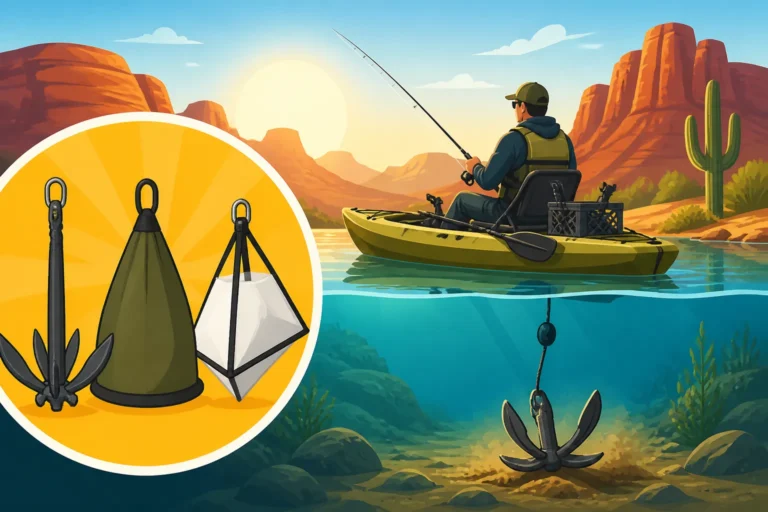
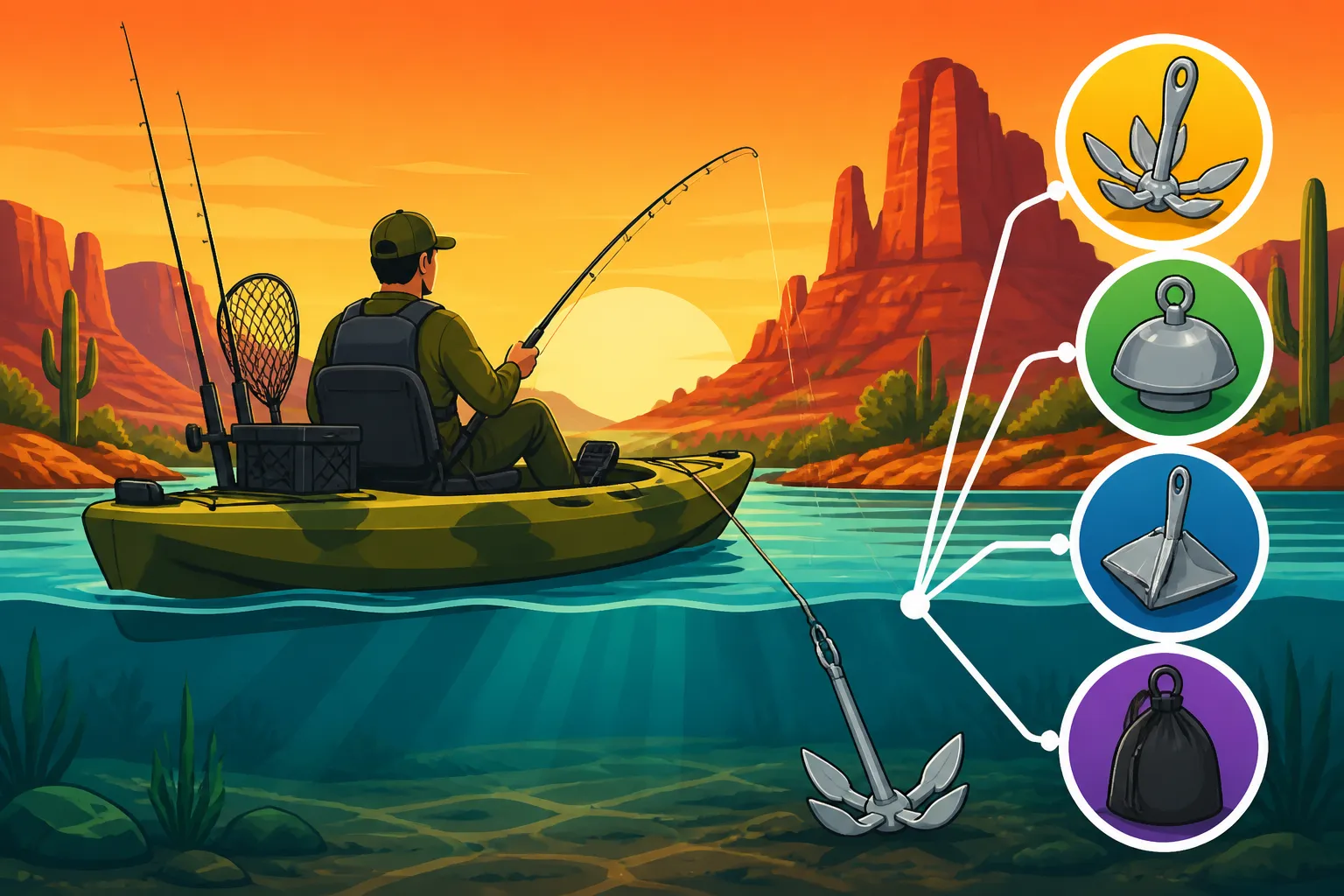
Folding grapple anchors, sometimes just called grapnel anchors, are hands down one of the most popular choices for kayak anglers, and for good reason. Their design features four "flukes" or arms that fold in, making them incredibly compact for storage. When deployed, these arms fan out, designed to grab onto rocky bottoms, submerged timber, or even thick vegetation.
A typical kayak-sized grapple anchor weighs anywhere from 1.5 to 3.5 pounds. While that might not sound like much, combined with the right amount of anchor line and a short length of chain, it can provide surprising holding power for a lightweight kayak. Imagine you're fishing a rocky cove on Canyon Lake, known for its steep, rocky banks and submerged boulders. A grapple anchor is perfectly designed to hook onto those underwater structures, keeping you precisely where you want to be. They are a fantastic all-around option, especially for the varied bottom structures found in many of Arizona's larger reservoirs. You can find a wide selection of these, often bundled with rope and a storage bag, at Bass Pro Shops or online through retailers like Amazon, offering great value for beginners.
However, their very strength can sometimes be their weakness. Those flukes, while excellent for grabbing, can also get seriously snagged in thick brush or intricate rock formations. Having a retrieval system or knowing how to use an anchor trip line (a line attached to the bottom of the anchor) is vital to avoid losing your gear.
Mushroom Anchors and River Anchors: Ideal for Specific Conditions
For anglers primarily targeting softer, muddier, or silty bottoms, like those often found in the shallower areas of Roosevelt Lake or many urban community fishing ponds, a mushroom anchor can be a great choice. These anchors are designed with a cup-shaped bottom that creates suction in soft sediment, providing a surprisingly strong hold. They typically weigh a bit more than a grapple, often in the 5-10 pound range for effective kayak use, to ensure they sink and dig in properly. Their smooth, bell-like shape makes them less prone to snagging on scattered debris, which is a big plus in lakes with softer, less rocky bottoms.
Another specialized option, often looking like a pyramid or a box with flat sides, is a river anchor. These are designed specifically to dig into the substrate and hold fast in moving water, making them ideal for sections of the Salt River or other flowing waterways where current is a primary concern. The flat, broad surfaces help them settle quickly and resist dragging. They tend to be heavier, often 10-15 pounds or more, to counteract the force of the current. While not as versatile as a grapple for all bottom types, if your primary fishing involves these specific conditions, a mushroom or river anchor can be incredibly effective. Just make sure your kayak's carrying capacity is suitable for the added weight, especially if you plan on paddling significant distances.
Stakeout Poles and Shallow Water Anchors: Precision in the Flats
When you're fishing in truly shallow water, say less than 8-10 feet, especially if you're sight fishing for cruising bass in clear water or exploring a reedy flat, a stakeout pole or shallow water anchor system is an absolute game-changer. These aren't traditional anchors that rely on digging into the bottom; instead, they are long, sturdy poles (often fiberglass or aluminum) that you manually push into the lakebed.
The beauty of a stakeout pole is its silent operation and minimal disturbance. There's no splash, no clanging of chains, just a quiet insertion into the bottom. This is fantastic when you're trying not to spook wary fish in calm, clear conditions. They typically range from 6 to 10 feet in length and are designed to float if accidentally dropped. Some popular systems even have a quick-release mounting bracket that allows you to deploy and retrieve them with ease, right from your seated position.
For instance, if you're spending a lot of time fishing the coves and submerged islands of Lake Havasu, where shallow flats are common, a stakeout pole could be your best friend. They're lightweight, simple, and incredibly effective for holding your position in minimal depths. Many anglers will clip them to the side of their kayak when not in use. You might also find these referred to as "anchor pins" or "manual shallow water anchors." They require some physical effort to deploy, but the stealth and precision they offer in shallow environments are unmatched.
Drag Chains and Drift Anchors: For Controlled Movement
Sometimes, staying perfectly still isn't your goal. Instead, you want to slow down your drift, covering a larger area more effectively without having to paddle constantly. This is where drag chains and drift anchors (also known as sea anchors or drift socks) come into play.
A drag chain is simply a length of heavy chain, often 5-10 feet long, sometimes with a small anchor attached, that you drag along the bottom. It provides just enough resistance to slow your kayak's speed in windy conditions or a gentle current, allowing you to thoroughly fish a stretch of water. They're fantastic for covering long points, extended weed lines, or vast flats where fish might be scattered. The main advantage is that they are less likely to snag and are easy to retrieve by simply pulling them in.
Drift anchors, on the other hand, work by creating drag in the water column, not on the bottom. They look like a parachute or cone that fills with water and deploys behind or beside your kayak, slowing your wind-driven drift significantly. This is especially useful on large, open bodies of water like Lake Powell or Lake Mead, where winds can push you along too quickly for effective fishing. They allow you to maintain boat control and keep your lure in the strike zone longer. While not traditional anchors for holding position, they are invaluable tools for many kayak fishing strategies, especially for techniques like Trolling Techniques for Striped Bass or covering water when searching for active fish.
Essential Gear and Techniques for Effective Kayak Anchoring
Having the right anchor is only half the battle. To truly master kayak anchoring, you need to understand the supplementary gear and techniques that make the process safe, efficient, and effective in the varied Arizona fishing environments. This includes not just the ropes and chains, but crucial systems that improve your control over the anchor itself.
The Indispensable Anchor Trolley System
If there's one piece of accessory gear that every kayak angler should consider investing in for anchoring, it's an anchor trolley system. This isn't an anchor itself, but a simple yet revolutionary system of pulleys and a rope loop that runs along one or both sides of your kayak, typically from bow to stern. It allows you to deploy your anchor from a fixed point on your kayak, and then, using the trolley, slide the anchor line attachment point all the way to the bow or stern without having to reach awkwardly or dangerously.
Imagine this scenario: you've deployed your grapple anchor from the middle of your kayak, and the wind is coming directly from your bow. Your kayak will naturally want to weathervane and turn broadside to the wind, making it difficult to cast effectively and presenting a large surface area for the wind to push against. With an anchor trolley, you can slide the anchor line connection all the way to your bow, causing your kayak to face directly into the wind, stabilizing it for easier casting and reduced drift. Similarly, if you want to fish with the wind at your back, you can slide the line to the stern. This control is critical for precision fishing and ensures your kayak is always positioned optimally. Installing one is a fairly straightforward DIY project, and many models can be found at outdoor recreation stores or online. It truly transforms your ability to How to Anchor a Kayak for Still Fishing and fish comfortably, regardless of wind or current direction.
Anchor Line, Quick Releases, and Buoys for Safety
Beyond the anchor itself, the anchor line is a critical component. You'll typically want at least 50-75 feet of good quality nylon rope for kayak fishing, but often more for deeper lakes like Lake Mead or Lake Powell. Nylon rope has some stretch, which helps absorb shock from waves and prevent the anchor from breaking loose. A good rule of thumb for anchor line length is a 7:1 scope – meaning for every 1 foot of water depth, you need 7 feet of anchor line out to ensure the anchor sets properly at a low angle. So, in 10 feet of water, you'd ideally have 70 feet of rope deployed.
Adding a short length of chain (3-5 feet) between your anchor and the rope is highly recommended. The chain helps the anchor dig in better by keeping it lying flat on the bottom, and its weight provides an additional horizontal drag force. It also protects your rope from abrasion on sharp rocks or rough bottoms.
Safety is paramount, especially on windy Arizona lakes. A quick-release system is non-negotiable. This is often a simple cam cleat or similar device that allows you to instantly detach or slacken your anchor line in an emergency, like if your anchor gets hopelessly snagged and you need to move quickly, or if a storm suddenly rolls in. You don't want to be tethered to a fixed point if you need to maneuver away from danger. Additionally, an anchor buoy (a small float attached to the end of your anchor line) is incredibly useful. If you need to quickly cut away from a snagged anchor, you can tie off your line to the buoy and leave it, allowing you to return later to retrieve your anchor when conditions are safer or you have more time to work it free. This saves your anchor and prevents you from having to abandon it permanently.
Weighting Your Line and Preventing Snags
We touched on adding a length of chain to your anchor line, and it's worth reiterating its importance. That short section of chain not only helps the anchor set, but it also provides a bit more weight on the bottom, which can be particularly useful in slightly stronger currents or when trying to achieve a better angle for the anchor to dig into the substrate. The heavier chain section helps the anchor maintain that horizontal pull, rather than lifting off the bottom.
To further prevent snags, especially in Arizona's timber-laden lakes or rocky river sections, consider attaching your anchor line to the bottom of your grapple anchor, rather than the top. Then, use a heavy-duty zip tie or a weak piece of string to secure the chain or rope to the top of the anchor (the normal attachment point). If your anchor gets snagged, simply pull hard. The zip tie or string will break, allowing you to pull the anchor out "backwards" from its flukes. This "breakaway" or "trip line" method drastically reduces the chances of losing your anchor to a stubborn snag. It's a clever trick that many experienced anglers rely on to save their gear from the hidden dangers below the surface, particularly when fishing around areas prone to Fishing Around Submerged Timber.
Choosing the Right Anchor for Your Arizona Adventures
Selecting the perfect anchor isn't a one-size-fits-all decision. It's about matching your gear to your fishing style, your target waterways, and your personal preferences. Thinking through these elements will ensure you're well-equipped for any Arizona angling expedition.
Matching Your Anchor to Specific Arizona Waterways
As we've discussed, Arizona's diverse waters call for different solutions. For instance, if your go-to spots are the rugged, rocky shores of Lake Powell or the equally dramatic Canyon Lake, a folding grapple anchor is likely your best bet. Its ability to latch onto rocks and submerged structures will keep you stable. Remember to use a short length of chain and consider the breakaway rigging method to avoid permanent snags in these often-deep and craggy environments.
On the other hand, if you spend most of your time on the urban community fishing lakes or shallower, more silty sections of larger reservoirs like Alamo Lake or Roosevelt Lake, a mushroom anchor or a heavier pyramid anchor will likely serve you better. These excel at digging into soft mud and sand, providing a reliable hold without the risk of getting flukes wedged in unseen crevices. For very shallow water sight fishing, perhaps in the calmer coves of Lake Havasu or some of the clear mountain lakes, a stakeout pole offers silent, precise positioning that won't spook fish.
Consider your primary fishing locations. Do you mostly fish one type of water, or do you frequent a variety? Having a versatile anchor or even different anchors for different kayaks or trips might be the ultimate solution. For those adventurous souls exploring a wide range of Arizona's aquatic gems, from the high mountain lakes to the desert reservoirs, packing a small, compact grapple for rocky areas and a stakeout pole for the shallows offers maximum flexibility.
| Anchor Type | Best for Bottom Type | Best for Water Conditions | Pros | Cons |
|---|---|---|---|---|
| Folding Grapple | Rock, Gravel, Light Weeds | Lakes, Moderate Wind/Current | Compact, Versatile, Good hold | Can snag easily in heavy cover |
| Mushroom Anchor | Mud, Silt, Sand | Lakes, Light Current | Excellent suction in soft bottom | Less effective on rock, bulky |
| River/Pyramid Anchor | Gravel, Hard Sand, Mud | Rivers, Stronger Current | Digs in well, holds in current | Heavier, less versatile for rock |
| Stakeout Pole | Soft Mud, Sand, Shallow | Very Shallow, Calm Water | Silent, Non-intrusive, Lightweight | Only for shallow water, requires manual push |
| Drag Chain | Any (drags over top) | Wind, Mild Current | Slows drift, rarely snags | Doesn't hold position, provides minimal resistance |
| Drift Anchor (Sock) | Open water (in water column) | Wind, Strong Current | Slows drift effectively | Doesn't hold position, can be bulky to store |
Balancing Cost, Portability, and Effectiveness
When you're outfitting your fishing kayak, every dollar counts, and so does every cubic inch of storage. Thankfully, kayak anchors are generally quite affordable, especially compared to their counterparts for larger boats. You can often find a good quality folding grapple anchor kit with rope and a storage bag for a reasonable price at sporting goods stores like Bass Pro Shops or online platforms such as Amazon. These ready-to-go kits are fantastic for beginners, providing a complete solution without much fuss.
The "best" anchor for you will involve a personal balance. Is ultimate portability your main concern, even if it means slightly less holding power in extreme conditions? Or are you willing to carry a bit more weight for guaranteed stability? For someone primarily fishing small, calm urban ponds, a lighter mushroom anchor might be perfect. For someone frequently battling winds on Lake Pleasant, a slightly heavier grapple with a robust anchor trolley system is a worthwhile investment. Don't cheap out on the rope, though; a good quality, durable anchor line is crucial for longevity and safety.
Consider the long-term value. An anchor system that prevents you from losing lures to drift, allows you to consistently hit your target zones, and keeps you safe from drifting into hazards is an investment that pays dividends in enjoyable fishing trips and more catches. While a simple concrete block might work in a pinch, purpose-built kayak anchors are designed for efficiency, reliability, and ease of use on the water, making them a much better choice for dedicated anglers.
My Personal Recommendations for Different Scenarios
Based on years of fishing Arizona's waters, I lean towards versatility and preparedness.
For the all-around Arizona kayak angler who fishes a mix of big reservoirs, rivers, and smaller lakes, I highly recommend a 3.5 lb folding grapple anchor, paired with at least 75 feet of good nylon rope, 5 feet of chain, and rigged with the breakaway zip-tie method. Crucially, combine this with a well-installed anchor trolley system. This setup offers the best balance of holding power across varied bottoms, portability, and safety. It allows you to tackle the rocky depths of Lake Havasu or the varied terrain of the Verde River with confidence. This combo is robust enough for most situations you'll encounter.
If you know you'll be spending most of your time in shallow, calm waters or sight fishing – perhaps in the back coves of Roosevelt or targeting carp in the shallows of some community lakes – then adding an 8-foot stakeout pole to your arsenal is a brilliant move. It's quiet, effective, and gives you incredible control without disturbing the water. You can often carry both a grapple and a stakeout pole on your kayak, giving you options for diverse conditions that you might encounter even on the same body of water.
For those who love to drift fish for species like striped bass or crappie over large flats or along lengthy contours, especially when it's windy, a high-quality drift sock is invaluable. While it won't hold you still, it will slow your drift to a manageable speed, extending your time in the strike zone. You might deploy this alongside your grapple anchor, using the grapple to hold a precise spot, and the drift sock if you decide to change tactics and cover water.
Ultimately, the goal is to equip yourself so you can fish more effectively, comfortably, and safely. Experiment with different types, understand their limitations, and never underestimate the power of a well-rigged anchoring system to transform your kayak fishing experience in Arizona.
Disclaimer
This article is for general informational purposes only and does not constitute professional advice. Laws, prices and regulations vary by location and change over time. Consult a qualified professional for guidance on your specific situation.