Best Crankbait Depth for Deep Structure
Trying to dial in the perfect crankbait for those elusive bass holding tight to deep structure in Arizona's vast reservoirs can feel like a guessing game sometimes, can't it? You know the fish are down there, hunkering down on a submerged point, a rocky ledge, or a deep brush pile, but getting your lure to consistently tick that sweet spot without constantly hanging up or blowing past them is a real challenge. This guide is all about demystifying crankbait depth, helping you understand how to select and deploy the right lures to effectively target those deep-water giants, and ultimately, put more fish in your boat or on the bank.
Understanding Deep Structure in Arizona Lakes
Arizona's desert lakes aren't your typical shallow, weedy ponds. They are often vast, deep, and filled with incredible underwater terrain that provides crucial cover and ambush points for a variety of fish species, especially bass. Successfully fishing these waters means understanding what constitutes "deep structure" and why fish gravitate towards it.
What Qualifies as Deep Structure?
When we talk about deep structure, we're referring to any significant underwater feature that stands out from the surrounding bottom, typically in depths greater than 15-20 feet, though this can vary depending on the lake and time of year. Think about those massive reservoirs like Lake Pleasant, Roosevelt Lake, or Lake Powell – they are literally underwater mountain ranges and valleys.
Some common examples of deep structure you'll encounter in Arizona include:
- Submerged Points and Humps: These are underwater extensions of land that drop off into deeper water. Bass often stage on the sides or tops of these points, especially where there are transitions from soft to hard bottom, or where baitfish congregate.
- Deep Ledges and Drop-offs: Vertical changes in depth, often created by old creek channels or natural erosion, offer a clear demarcation line where fish can suspend or hide. These are classic ambush points.
- Brush Piles and Standing Timber: Often found in lakes that were once forested areas before being flooded, these provide incredible vertical cover. Bass will suspend within the branches or hold tight to the trunks. Lakes like Roosevelt Lake are famous for their standing timber.
- Roadbeds and Foundations: Believe it or not, many of Arizona's lakes flooded old towns or farmlands. Old roadbeds, building foundations, or even fence lines can become fantastic deep structure, offering a unique profile that fish relate to.
- Rock Piles and Boulders: Just like on land, rocks offer excellent cover underwater. Large isolated boulders or extensive rock piles can hold significant numbers of fish, providing both shelter and hunting grounds. Best Bass Fishing Lakes in Arizona often have these features.
The key is that these aren't just flat, featureless bottoms. They are irregularities, changes in contour, or objects that break up the monotony of the lakebed, providing a sense of security and a strategic advantage for predatory fish.
Why Fish Hold to Deep Structure
Fish, particularly bass, are creatures of habit and efficiency. They relate to deep structure for several critical reasons, especially in the challenging Arizona environment:
- Thermal Refuge: During the scorching Arizona summers, the surface water can become uncomfortably hot for many species. Deep structure provides access to cooler, more stable water temperatures where fish can find comfort and conserve energy. This is a huge factor when you're out on a 100-degree day!
- Oxygen Levels: While deep water can sometimes be anoxic, many of Arizona's larger, well-oxygenated reservoirs maintain good oxygen levels even at depth. Fish will seek out these zones if surface waters become depleted, which can happen in stagnant areas during extreme heat.
- Baitfish Concentration: Deep structure often acts as a magnet for baitfish like shad or sunfish, which are drawn to the cooler water, plankton, or the cover itself. Where the bait goes, the predators follow. A good fish finder will show you schools of baitfish suspended around deep points or ledges.
- Ambush Points: A ledge, a brush pile, or the edge of a submerged road offers a perfect vantage point for a bass to hide and ambush unsuspecting prey. They can dart out from cover, grab a meal, and quickly retreat.
- Seasonal Transitions: As seasons change, fish will often move along deep structure to transition between their summer, fall, winter, and spring holding areas. A deep point can be a highway from the main lake basin to shallower spawning coves. Understanding Seasonal Movement Patterns of Arizona Bass is key here.
It's this combination of cover, food, and environmental stability that makes deep structure so vital for anglers. Your job is to present a lure, like a crankbait, that perfectly mimics natural prey and can reach these specific depths where fish are actively feeding or resting.
Matching Crankbaits to Target Depths
The world of crankbaits is vast, with countless shapes, sizes, and diving capabilities. The trick to effectively fishing deep structure in Arizona is to know how to select a crankbait that will consistently reach your desired depth zone without constantly digging into the bottom or, conversely, cruising far above the fish.
Reading Crankbait Depth Ratings
Every crankbait worth its salt comes with a manufacturer's suggested diving depth. You'll often see numbers like "10-15 ft" or "Dives to 20 ft" right on the package or in product descriptions. These ratings are a good starting point, but they are not absolute guarantees. Think of them as ideal conditions maximums.
For instance, a crankbait rated for 15 feet might achieve that depth under specific conditions:
- Line Type: Typically, these ratings are based on monofilament line, often in the 10-12 lb test range.
- Casting Distance: A long cast allows the lure more time to dive.
- Retrieval Speed: A consistent, moderate retrieve often gets the bait to its maximum depth.
- Rod Angle: Keeping your rod tip down usually helps a crankbait dig deeper.
What does this mean for you, the angler? If you're using heavier fluorocarbon line, a shorter cast, or a faster retrieve, that "15-foot" crankbait might only hit 12-13 feet. Conversely, with lighter line, an extra-long cast, and a slow retrieve, you might eke out an extra foot or two. This is where experimentation comes in. Start with the rating, but always be ready to adjust. Best Lures for Largemouth Bass in Arizona Lakes often includes various crankbait types.
When you're browsing for deep divers, whether at Bass Pro Shops or online at Amazon, look at the bills. Generally, the longer and wider the bill, the deeper the crankbait is designed to dive. Some modern crankbaits even have internal weight transfer systems to aid in casting distance, which in turn helps them reach their maximum advertised depth.
Factors Affecting a Crankbait's Running Depth
Beyond the manufacturer's rating, several crucial factors influence how deep your crankbait will actually run. Understanding these allows you to manipulate your lure to hit precise depths.
-
Line Diameter and Type: This is perhaps the biggest factor. Thinner line (lower pound test) creates less resistance in the water, allowing the crankbait to dive deeper.
- Monofilament: Stretchy and buoyant, mono will reduce a crankbait's maximum depth compared to fluorocarbon. Good for absorbing shock, but not for maximum depth.
- Fluorocarbon: Less stretch and denser than mono, fluorocarbon sinks, which helps crankbaits achieve greater depths. It's also less visible underwater. Often preferred for deep crankbaiting.
- Braided Line: Extremely thin for its strength and has no stretch. While it doesn't sink like fluoro, its thin diameter allows crankbaits to dive very deep. However, its lack of stretch means every hit is jarring, and you need a good soft-tipped rod to compensate.
To illustrate the difference: a crankbait that dives 15 feet on 12 lb mono might hit 18 feet on 10 lb fluorocarbon and potentially 20 feet on 20 lb braid (with a fluorocarbon leader, of course). Best Line for Bass Fishing will guide you through choices.
-
Casting Distance: It's simple physics: the longer your cast, the more line is out, and the more time the crankbait has to swim down to its maximum depth. Short casts mean less dive. If you're trying to hit a deep structure feature, you need to launch that bait a country mile.
-
Retrieval Speed: A moderate, consistent retrieve is usually best for achieving maximum depth. Too fast, and the bait can "blow out" or run shallower due to hydrodynamics. Too slow, and it won't have enough forward momentum to engage its bill and dive effectively. Finding that sweet spot often involves listening to the bait — you want it ticking or scraping the bottom/structure for optimal presentation.
-
Rod Angle: Pointing your rod tip down towards the water and even into the water can help the crankbait dig deeper by directing the line's pull downwards. Conversely, holding your rod tip high will shallow out the retrieve.
-
Water Current: While less of a factor in still desert lakes, current can affect depth. Fishing upstream against a current can make a bait run shallower, while fishing downstream with the current might help it get deeper or at least stay at depth longer.
-
Crankbait Bill Design: As mentioned, longer and wider bills create more water resistance and force the bait down. Some bills are designed for very specific actions and dive curves. Pay attention to whether the bill is flat or slightly angled.
By understanding and manipulating these factors, you gain far more control over your crankbait's depth, allowing you to effectively "tune" it to the specific depth of that deep structure you're targeting.
Techniques for Hitting Specific Deep Structure Depths
Simply throwing a deep-diving crankbait out there isn't enough; you need a strategic approach to ensure it reaches the desired depth and triggers a strike. This involves choosing the right lure and employing specific tactics to make it work.
The "Deep Diving" Crankbait Approach
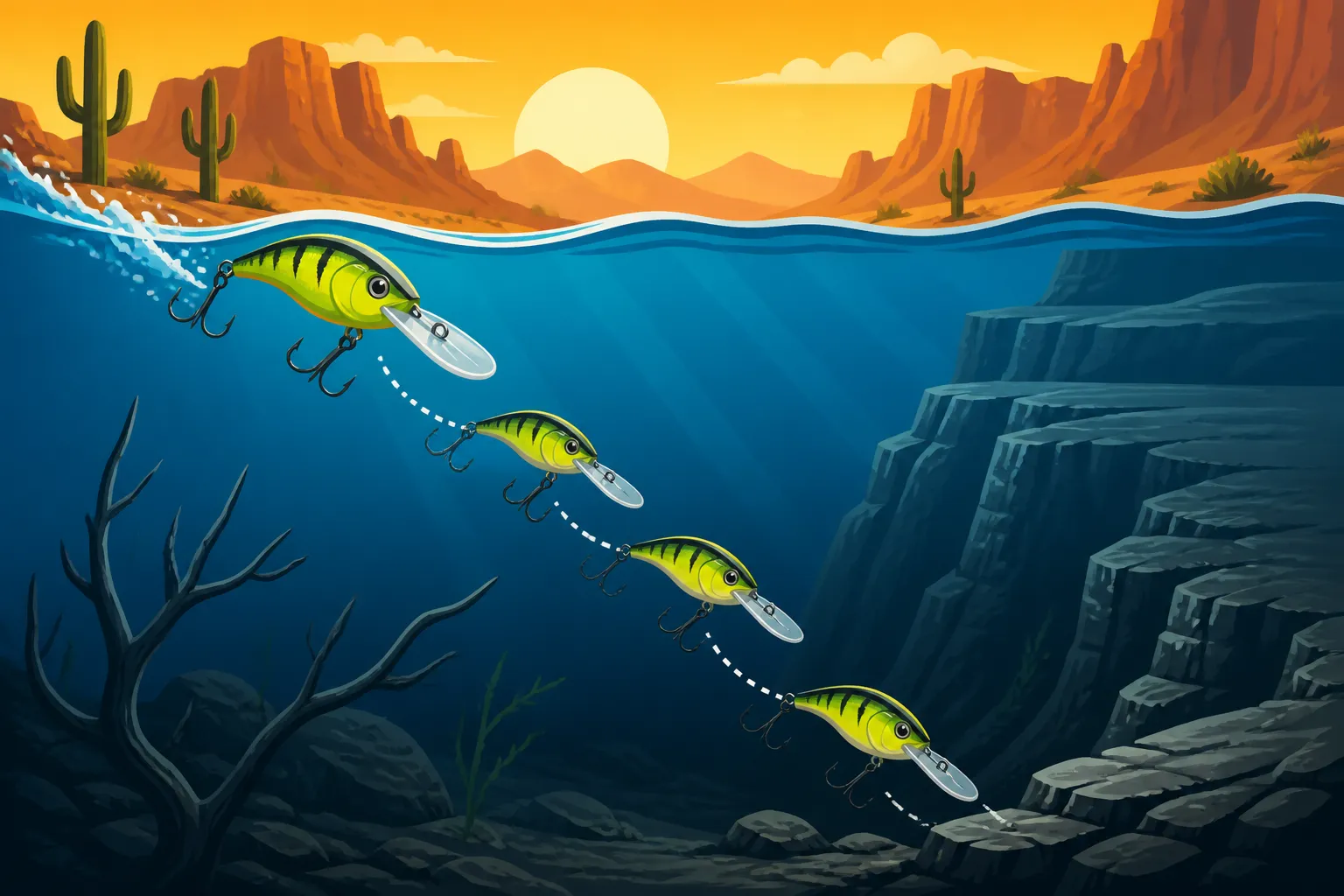
This is your bread and butter for hitting those depths of 15-25 feet, sometimes even deeper. These crankbaits are specifically engineered to get down quickly and stay down.
- Choosing the Right Bait: Look for crankbaits with long, often rounded bills. Brands like Strike King's 6XD or 10XD, Norman's DD22, or Bagley's DB3 are classic examples, readily available at fishing tackle stores like Bass Pro Shops or online through Amazon. Their diving depths are generally well-advertised. Select a bait that's rated to exceed your target depth slightly, allowing for those factors that might shallow it out (line, retrieve, etc.). If you want to hit 20 feet, choose one rated for 22-25 feet.
- The Long Cast is Paramount: As discussed, a long cast gives the bait time to get down. Use a longer rod (7' to 7'11") designed for crankbaiting, which helps load up and launch the lure.
- Low Rod Angle, Steady Retrieve: Once your bait hits the water, immediately drop your rod tip towards the water, sometimes even getting it wet. This helps the bill dig. Then, start a steady, moderate retrieve. You want to feel that crankbait digging, vibrating, and hopefully, occasionally ticking the bottom or the structure you're targeting.
- Making Contact: The magic happens when the crankbait makes contact with the deep structure. When it hits, pause for a split second, allowing the bait to float up slightly, then continue your retrieve. This erratic action often triggers a reaction strike from bass that were hiding nearby. It's mimicking a fleeing baitfish hitting an obstruction. Sometimes, a hard pull followed by a pause can make the lure "ricochet" off the structure, creating a more dramatic action.
- Feel for the Sweet Spot: Learn to feel the difference between digging into mud, scraping rock, or deflecting off a piece of timber. Each contact point is a potential strike zone. Your rod, reel, and line choices are critical here, as they transmit these subtle vibrations. For more on this, check out Deep Water Structure Fishing Techniques.
| Crankbait Type | Typical Depth Range (feet) | Bill Characteristics | Primary Use Case |
|---|---|---|---|
| Shallow Runner | 0-6 | Short, often rounded or square | Cover shallow flats, submerged grass, docks |
| Medium Diver | 6-12 | Medium length, often rounded | Mid-range points, ledges, submerged timber |
| Deep Diver | 12-25+ | Long, wide, often rounded | Deep points, creek channels, vertical ledges |
| Magnum Deep Diver | 25-35+ | Extra-long, extra-wide | Very deep offshore structures, larger fish |
Finessing Crankbaits for Deeper Zones
While dedicated deep divers handle much of the work, there are times you need to finesse a crankbait into a very specific deep zone, or even get a medium diver a little deeper than its rating.
- Line Choice is King: This goes back to line diameter. If you're trying to push a crankbait to its absolute maximum depth, opt for the lightest fluorocarbon line you can get away with, usually 8-10 lb test. The reduced drag will let that lure get an extra few feet deeper. Best Line Weight for Smallmouth Bass is a good resource for understanding these nuances.
- Slow Roll and Suspend: Sometimes, a fish on deep structure isn't aggressively chasing. In these scenarios, a slower retrieve can be more effective. Experiment with crankbaits that have a slightly slower retrieve speed to achieve depth, or even those that suspend rather than float when paused. This allows you to crank it down to depth, then pause, letting it hang enticingly in the strike zone directly in front of a bass that might be a bit lethargic.
- The "Rip and Pause" Technique: For very deep timber or brush piles, you can rip the crankbait through the cover, then pause. This aggressive action can trigger a reaction strike, and the pause allows the bait to flutter or float up slightly, preventing snags. This is especially effective when you know fish are suspended within the cover, rather than just on the bottom.
- Tuning Your Bait: Believe it or not, you can subtly tune the running depth of some crankbaits. If a bait consistently runs off to one side, you can gently bend the eye-tie (the small wire loop where you tie your line) in the opposite direction using needle-nose pliers. This can sometimes affect its dive curve, though it's more often done to correct its tracking. Always check how a bait runs right next to the boat before making these adjustments in the field.
- Follow the Contour: When fishing a deep ledge or point, try to keep your boat positioned so you can cast parallel to the contour line. This allows your crankbait to stay in the target depth zone for a longer portion of the retrieve, maximizing its time in front of fish. If you cast straight at the bank, your bait will quickly run out of its effective depth range.
Mastering these techniques will give you the confidence to tackle any deep structure you encounter, transforming those frustrating "where are they?" moments into successful hooksets.
Essential Gear for Deep Crankbait Fishing
Hitting deep structure effectively with crankbaits isn't just about the lure; it's a symphony of rod, reel, line, and electronics working together. Having the right tools makes a significant difference in your ability to feel those subtle bites and successfully land fish.
Rod, Reel, and Line Choices
Your fishing setup needs to be optimized for casting heavy lures, feeling light bites at extended depths, and fighting powerful fish.
- Rods: For deep cranking, a longer rod is your best friend. Look for rods in the 7-foot to 7-foot-11-inch range. The extra length provides several advantages:
- Increased Casting Distance: A longer rod loads up more efficiently, allowing you to launch heavy crankbaits further, which is crucial for achieving maximum depth.
- Better Line Control: More rod length means you can pick up slack line faster and maintain a lower rod angle more easily.
- Shock Absorption: Deep diving crankbaits have a lot of resistance, and when a fish strikes, the hit can be brutal. A medium-heavy or heavy power rod with a moderate or moderate-fast action will have enough backbone to handle the lure and the fish, but enough flex to absorb the shock of a strike without ripping the hooks out. Glass or composite (fiberglass/graphite blend) rods are often preferred for crankbaiting due to their parabolic bend, which acts like a shock absorber. You can find excellent options at Bass Pro Shops.
- Reels: A baitcasting reel is almost universally preferred for deep crankbaiting. The key feature to look for is the gear ratio.
- Lower Gear Ratios (5.1:1 to 6.4:1): These are ideal for deep cranking. They provide more torque, making it easier to retrieve large, high-resistance crankbaits all day long without fatiguing your arms. A slower retrieve also helps keep the bait in the strike zone longer and can often get it a little deeper.
- High Line Capacity: You need a reel that can hold a significant amount of line, given the long casts required.
Make sure your reel has a smooth, reliable drag system, as you'll be fighting fish that can make powerful runs. Best Reel Gear Ratio for Crankbaits provides more detail.
- Line: As discussed, line choice is critical for depth.
- Fluorocarbon (10-14 lb test): This is the most popular choice for deep cranking. Its low stretch, abrasion resistance, and sinking properties help crankbaits reach and maintain maximum depth while still offering good sensitivity.
- Braided Line (20-30 lb test with a fluorocarbon leader): Braid offers incredible casting distance due to its thin diameter and no stretch, which provides extreme sensitivity. However, the lack of stretch can make it easier to pull hooks out of a fish's mouth. Pairing it with a 10-15 foot fluorocarbon leader (10-14 lb test) can mitigate this, adding some stretch and invisibility near the lure.
Electronics for Locating Deep Structure
You can't effectively fish deep structure if you can't find it! This is where modern fishing electronics, specifically fish finders, become indispensable.
- 2D Sonar: This is the foundational technology. It shows you what's directly beneath your boat, including bottom contours, depth, and suspended fish. Learn to interpret the arches and lines to identify ledges, humps, and even brush piles.
- Down Imaging/DownScan: Provides a photographic-like view directly below your boat, making it much easier to identify specific features like individual logs, rock piles, or brush. It's fantastic for confirming what you're seeing on 2D sonar.
- Side Imaging/SideScan: This is a game-changer for finding deep structure, especially on large Arizona lakes. It allows you to scan wide swaths of water (hundreds of feet to either side of your boat) to locate submerged points, creek channels, and isolated brush piles that you might otherwise motor right over. Once you spot something interesting on Side Imaging, you can then navigate directly over it to get a detailed look with your 2D and Down Imaging. Many popular brands offer robust side imaging units. Check out How to Read a Fish Finder for Structure for more in-depth guidance.
- GPS and Mapping: Integrated GPS with detailed lake maps (often called "contour maps" or "fishing charts") is crucial. These maps show you the underwater topography, including depth changes, creek channels, and points, before you even get there. You can mark waypoints on your unit for identified structure, creating a virtual breadcrumb trail to return to productive spots. This helps you understand the layout of the lake bottom and strategize your casting angles.
- Interpreting the Data: Learning to read your fish finder takes practice. Look for sudden changes in depth, hard returns that indicate rock, fuzzy returns that indicate brush or baitfish, and distinct arches that signify game fish. Don't just look for fish; look for the habitat that holds the fish. A good unit will pay for itself in saved time and increased catch rates. Best Fish Finders for Bass Fishing in Arizona delves into specific models and features.
Equipping yourself with the right gear and knowledge of your electronics transforms deep cranking from a blind hope into a precise and highly effective technique for targeting those bigger, deeper-holding fish in Arizona's stunning lakes.
Disclaimer
This article is for general informational purposes only and does not constitute professional advice. Laws, prices and regulations vary by location and change over time. Consult a qualified professional for guidance on your specific situation.