Best Fish Finder for Shore Fishing
There’s nothing quite as frustrating as standing on the shoreline of a beautiful Arizona lake or river, casting your line out into the unknown, and just hoping for the best. You stare at the water, wondering if there are any fish out there, if you’re casting over a prime piece of submerged structure, or if you’re just feeding the ducks. It’s like trying to find a needle in a haystack blindfolded! This guide is for every shore angler who's ever felt that exact frustration, and we’re going to explore how a fish finder can transform your shore fishing experience from a guessing game into a strategic hunt.
Why a Fish Finder is a Game Changer for Shore Anglers
For years, many of us shore anglers assumed fish finders were just for fancy boats. We'd watch those guys out on Lake Pleasant or Roosevelt Lake, staring at their screens, and think, "Must be nice to know what's down there." But the truth is, technology has advanced so much that shore anglers no longer have to feel left out. A good fish finder can be your secret weapon, bringing a new level of insight and success to your bank fishing excursions.
Overcoming the Shore Fishing Blind Spot
The biggest challenge with shore fishing is, without a doubt, the blind spot. You can only see so far into the water, and once your bait sinks, you're relying entirely on instinct and past experience. This can be especially tough on unfamiliar lakes or when the fish patterns change. Imagine casting out and being able to instantly see the depth, the bottom contour, and even individual fish arches – that’s what a fish finder provides. It turns the unknown into a known, allowing you to make informed decisions about where to cast, what lure to use, and how deep to fish. This insight can drastically reduce wasted casts and increase your chances of finding those elusive Arizona bass or catfish.
Beyond just seeing fish, a portable fish finder can help you understand the entire underwater landscape. Are you casting into a shallow flat that drops off sharply, or is it a gradual slope? Is there a submerged rock pile, a brush bed, or a creek channel? These are crucial details that a shore angler usually misses, leading to endless trial and error. With a fish finder, you gain an immediate advantage, putting you on a more equal footing with anglers fishing from boats. It’s about working smarter, not just harder, and making every cast count.
Locating Structure and Cover from Afar
Fish, especially the larger, more sought-after species like Largemouth Bass Fishing Guide for Arizona or Catfish Fishing Guide for Arizona, are almost always associated with structure and cover. This could be anything from a fallen tree, a rock pile, a submerged hump, or even a sudden depth change. From the shore, identifying these hotspots can be incredibly difficult, if not impossible. You might be casting over barren bottom all day, just feet away from a honey hole you can't see.
A fish finder allows you to scan the water directly in front of you, or even cast a transducer out to explore areas far beyond your visual range. This capability is invaluable for uncovering hidden ambush points where predatory fish lie in wait. By identifying these structures, you can precisely target your casts, presenting your bait or lure right where the fish are most likely to be holding. It shifts your approach from random searching to pinpoint targeting, greatly improving your efficiency and success rate.
Understanding Water Depth and Temperature
Depth and temperature are two environmental factors that heavily influence fish behavior, especially in Arizona's diverse waters. Different species prefer specific depths and temperature ranges. For instance, trout often favor cooler, deeper waters, while bass might move into shallower, warmer areas during spawning season. Knowing the exact depth you’re fishing and the water temperature can help you adjust your presentation and bait choice to match the fish's preferences.
Many modern fish finders provide both depth readings and water temperature. This information, combined with your knowledge of fish behavior, empowers you to target the right zones. If you’re fishing a deep reservoir like Lake Powell from a rocky point, knowing the water temperature at different depths can tell you where the thermocline is, which is often a key holding area for fish. This precision eliminates guesswork and helps you present your bait where it's most likely to get a bite, rather than just blindly hoping.
Types of Fish Finders Best Suited for Shore Fishing
The market for fish finders has expanded dramatically, offering solutions for every type of angler and budget. For shore fishing, the key considerations are portability, ease of use, and effective sonar range from the bank. While some traditional boat-mounted units could be adapted, certain types are inherently better designed for the bankside angler.
Castable/Portable Fish Finders
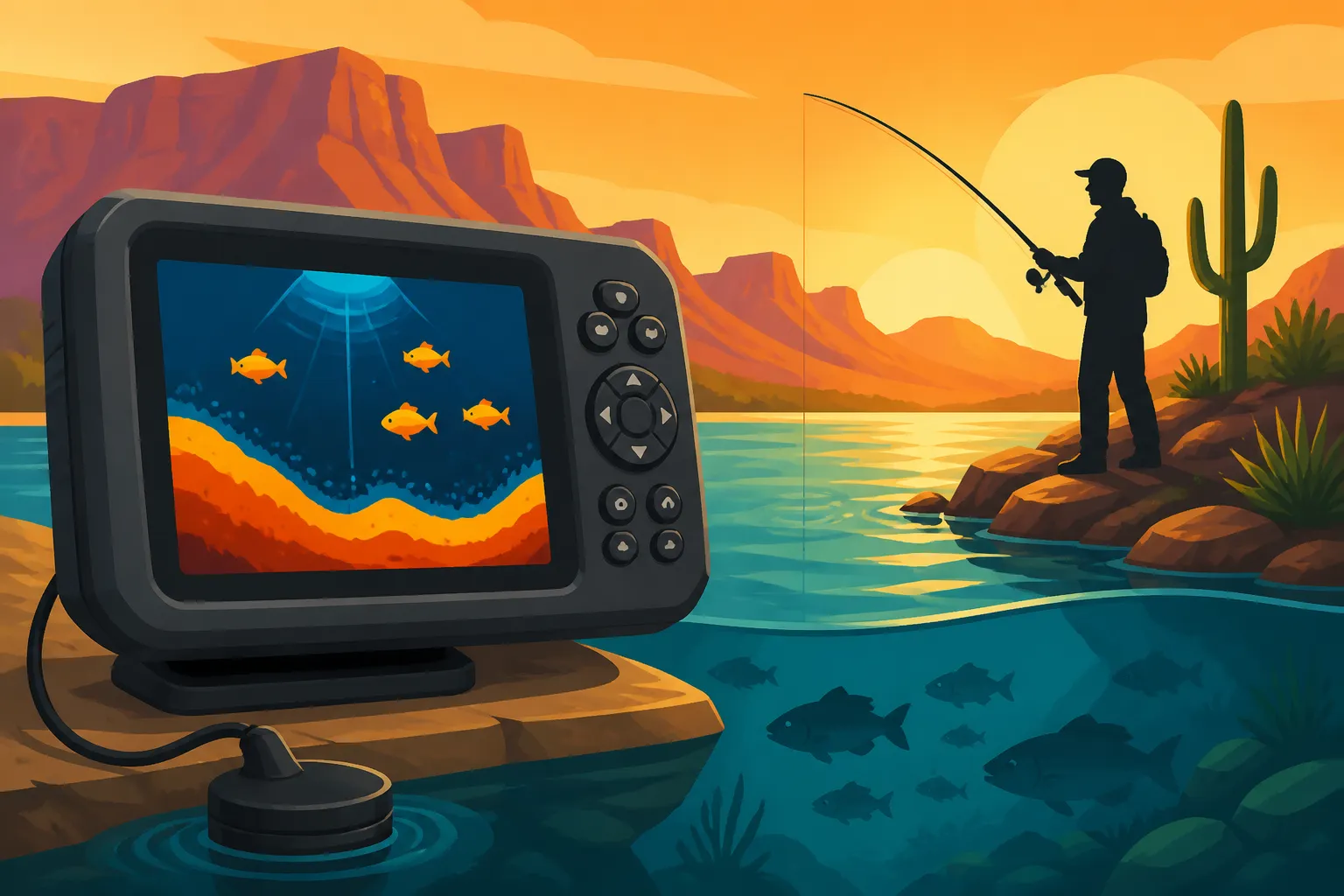
This category is truly the MVP for shore anglers, and it’s where most of you will find your best solution. These devices are compact, often battery-powered, and incredibly user-friendly. The most popular versions feature a small, often spherical or oval-shaped transducer that you simply cast out into the water with your fishing rod. The transducer then wirelessly transmits sonar data to your smartphone or a dedicated display unit, showing you depths, structure, and fish targets.
Think about the convenience: no complicated wiring, no heavy batteries, just a device that fits in your tackle bag. When you arrive at a new spot, you can quickly deploy it, scan the area, and get immediate feedback. Brands like Deeper and Lowrance offer excellent castable options that are perfect for exploring new waters or dissecting a favorite spot from shore. This means you can easily move from one cove to another on Canyon Lake, or explore different stretches of the Salt River, all while having a clear picture of what’s beneath the surface. For beginners looking to get into the game, these are often the most accessible and effective tools. Beginner Fishing Techniques for Arizona Desert Lakes become much more productive with one of these.
Mounted/Fixed Fish Finders for Shore Scenarios
While primarily designed for boats, there are niche scenarios where a more traditional, fixed fish finder setup could be adapted for shore use. This usually involves mounting the transducer to a portable stand or tripod that can be placed in the water, and then running the display unit to a power source (like a portable marine battery) on shore. This setup is less common for casual shore fishing due to its bulk and complexity, but it might appeal to dedicated bank anglers who frequent the same productive spots and want maximum sonar power.
For instance, if you regularly fish a specific pier or dock at Lake Havasu, and have a way to securely mount a transducer and power a display, a more robust unit might offer superior resolution and depth penetration compared to a castable model. However, the trade-offs in portability are significant. You're trading convenience for power, which isn't always the right choice for the fluid, on-the-go nature of most shore fishing. These setups are definitely more involved and require a greater investment in both gear and time.
Smartphone Integration and User-Friendly Apps
One of the coolest advancements in fish finder technology for shore anglers is the seamless integration with smartphones and tablets. Many castable fish finders operate by creating their own Wi-Fi or Bluetooth signal, which your phone connects to. A dedicated app then displays all the sonar information in an easy-to-understand format. This eliminates the need for a separate, expensive display unit and leverages the device you likely already carry with you.
The apps themselves are often intuitive, allowing you to easily read depth, mark waypoints, view bottom contour, and even log catches. Some even offer GPS mapping features, allowing you to create your own bathymetric maps of the areas you scan from shore. This level of detail and convenience is a huge win for shore anglers. It democratizes access to sophisticated sonar technology, making it affordable and approachable. Plus, software updates mean your device can improve over time without needing new hardware. Just remember to keep your phone charged, especially during those long Arizona summer days when Heat Safety Tips for Summer Fishing in Arizona are paramount.
Key Features to Look for in a Shore Fishing Fish Finder
When you’re ready to invest in a fish finder for your shore fishing adventures, it’s easy to get overwhelmed by all the technical jargon. Don't worry, we're going to break down the most important features you should prioritize to ensure you get a device that genuinely helps you catch more fish from the bank.
Portability and Ease of Deployment
This is arguably the most critical feature for shore fishing. You’re not dealing with a boat, so bulk, weight, and complicated setups are definite no-gos. A truly great shore fishing fish finder should be light enough to carry in a backpack, quick to set up, and easy to retrieve.
Look for models that are compact, can withstand accidental drops (because it happens!), and are designed for quick deployment and retrieval. Castable units, as discussed, excel here. They're designed to be thrown and reeled back in, often with minimal effort. If you opt for a more traditional portable setup, ensure the transducer and display are easily attached and detached, and that the entire system can be moved from one spot to another without a major production. Remember, the easier it is to use, the more likely you are to actually bring it with you and benefit from its capabilities. This ties directly into making your Shore Fishing Techniques for Beginners more effective.
Sonar Technology: What Really Matters
While high-tech sonar features like Side Imaging or Down Imaging are incredible for boat fishing, they aren't always practical or necessary for shore fishing. For shore-bound anglers, the most important sonar technologies are traditional 2D sonar and CHIRP (Compressed High-Intensity Radiated Pulse) sonar.
- 2D Sonar: This is your bread and butter. It provides a straightforward view of what's beneath the transducer, showing depth, structure, and fish arches. Most castable units use excellent 2D sonar.
- CHIRP Sonar: This is an upgrade from traditional 2D. Instead of sending a single frequency pulse, CHIRP sends a range of frequencies, resulting in much clearer, more detailed images, better target separation, and improved depth penetration. This means you can distinguish individual fish from structure more easily and get a clearer picture of the bottom.
- Beam Angle: Also important is the sonar beam angle. A wider beam covers more area, which can be useful for scanning a large section quickly. A narrower beam offers more detail and better target separation directly beneath it. Many fish finders offer multiple beam angles, allowing you to switch based on what you’re trying to achieve – wide for general scanning, narrow for detailed inspection of a specific spot.
Don't get bogged down by features designed for deep-sea or high-speed boat applications. Focus on clear, reliable 2D and CHIRP sonar with good target separation.
Battery Life and Charging Options
There’s nothing worse than your fish finder dying just as the bite turns on! Since you’ll likely be away from conventional power sources while shore fishing, long battery life is crucial. Look for devices that offer several hours of continuous operation on a single charge.
Consider models that recharge quickly and can be easily topped up using portable power banks, especially if you plan extended trips or multiple days out on the water. Many modern portable fish finders use standard USB charging, which makes them compatible with a wide range of power sources. Checking reviews for real-world battery performance is always a good idea. Having reliable power ensures your invaluable scouting tool is ready when you need it most, whether you're at a Community Park Lakes in Phoenix or a more remote spot.
Durability for the Outdoors
Arizona's fishing environments can be tough on gear. From scorching summer sun to rocky banks, your equipment needs to be able to take a beating. Look for fish finders that are built to last. This means a rugged, waterproof housing for the transducer and, if it has one, for the display unit.
Check for an IP (Ingress Protection) rating, with IPX7 or higher indicating good water resistance – meaning it can withstand immersion. Impact resistance is also important; transducers get bounced around, and even dropped, especially when casting. A robust build ensures your investment holds up against the elements and the rigors of frequent outdoor use. You don't want to buy a delicate piece of electronics that can't handle a little dust or a splash when you’re out on Lake Pleasant.
Top Considerations for Using a Fish Finder from Shore in Arizona
Having the best gear is only half the battle; knowing how to use it effectively in real-world scenarios makes all the difference. Arizona's unique fishing environments, from the deep clear lakes to the muddy rivers, present their own set of challenges and opportunities for shore anglers using a fish finder.
Dealing with Obstacles and Snags
One of the most common frustrations for shore anglers is dealing with snags. You cast out, feel a tug, and boom – you’re hung up on a submerged rock, tree branch, or old fishing line. A fish finder can actually help you mitigate this problem by allowing you to identify potential snag areas before you cast.
When scanning an area, pay close attention to the bottom contour and any marked structure. If you see a dense brush pile or a rocky outcropping, you can then adjust your casting angle or retrieve depth to avoid getting hung up. Conversely, if you want to fish that structure (because fish love it!), the fish finder can help you pinpoint the edges, allowing you to get close without casting directly into the thickest part. This kind of intel is invaluable for preserving your tackle and keeping your focus on catching fish, rather than untangling lines. You'll want to equip yourself with the Essential Tackle Box Setup for Arizona Beginners for these situations.
Adapting to Different Shorelines (Rocky, Sandy, Grassy)
Arizona offers a variety of shorelines, each with its own fishing characteristics. A fish finder can help you adapt your strategy to maximize success, no matter if you're on a rocky point at Saguaro Lake, a sandy beach at Lake Havasu, or a grassy bank along a community pond.
- Rocky Shorelines: These often mean steep drop-offs and plenty of underwater structure (boulders, ledges). Use your fish finder to locate these features and identify how quickly the depth changes. Fish will often hold along these transitions.
- Sandy Shorelines: These can seem barren, but a fish finder might reveal subtle humps, depressions, or even scattered rock. Scan for these anomalies, as they can be key holding areas. Also, look for temperature changes or baitfish schools that might be cruising over the sand.
- Grassy/Vegetated Banks: While visible weeds are obvious, a fish finder can show you submerged vegetation lines or open pockets within dense grass beds. These pockets are often prime ambush points for bass and other predatory fish.
By understanding the unique underwater profile of each shoreline type through your fish finder, you can tailor your approach, selecting the right lures and techniques for that specific environment. It's about knowing your terrain, even when you can't see it.
Maximizing Your Range and Accuracy
The effectiveness of your shore fishing fish finder largely depends on its range and how accurately it can paint a picture of the underwater world. For castable units, maximizing your casting distance is key. Practice your casting to get your transducer out to those deeper, farther-out spots where fish might be holding.
Once your transducer is deployed, slowly reel it back in, allowing it to scan the water column and transmit data. Don't just cast and retrieve quickly; a slow, steady retrieve gives the sonar time to paint a more complete and accurate picture. Also, be mindful of environmental factors like strong winds or heavy currents, which can affect the transducer's drift and therefore the accuracy of your readings. How Water Clarity Affects Lure Choice can also affect how fish react to your presentation, which you'll learn through the sonar. Try to cast upwind or upcurrent, letting the elements help carry your transducer to the desired location, rather than fighting against them.
Pairing with Your Fishing Strategy
A fish finder isn't a magic bullet; it's a tool. Its true power comes from how you integrate the information it provides into your overall fishing strategy. It can help you confirm suspicions, rule out unproductive water, and identify new patterns.
For example, if your fish finder consistently shows schools of baitfish congregated around a particular underwater hump, that's where you should focus your efforts for predatory fish like bass or stripers. If you see a lone, large fish arch near a submerged tree, you know exactly where to cast your jig or worm. Use the depth and temperature readings to adjust your retrieve depth or choose lures that run at the fish's preferred level. This combination of technology and angling intuition is what separates successful anglers from those who merely hope for a bite. It empowers you to refine your approach, understand fish behavior better, and ultimately, put more fish in the net. Whether you're trying How to Fish Deep Structure in Summer Heat or just finding the best spots on your local lake, a fish finder significantly boosts your potential.
| Fish Finder Type | Pros for Shore Fishing | Cons for Shore Fishing | Best Use Case |
|---|---|---|---|
| Castable (Smartphone) | Highly portable, easy to use, budget-friendly, good for scouting | Limited range, can be affected by phone battery, smaller screen on phone | Scouting new spots, casual shore fishing, quick checks |
| Castable (Dedicated) | Portable, dedicated screen, good battery life, durable | Higher cost than smartphone models, still limited range vs. boat units | Regular shore anglers, those who prefer not to use their phone |
| Portable (Transducer on Pole) | Good for docks/piers, better sonar power/detail than castable | Less mobile, requires power source, transducer submerged on a pole | Fixed locations, specific detailed scanning from a stationary point |
Disclaimer
This article is for general informational purposes only and does not constitute professional advice. Laws, prices and regulations vary by location and change over time. Consult a qualified professional for guidance on your specific situation.