Best Rod Length for Casting Topwater Lures
There's nothing quite like the explosive strike of a bass on a topwater lure. That heart-stopping splash and tug can be one of the most exciting moments in fishing, especially when you're out on the shimmering waters of an Arizona lake, watching the sun rise or set over the desert landscape. But if you've ever struggled to make your popper dance just right, or felt like your walking bait wasn't "walking" as it should, you know the frustration. Often, the unsung hero (or culprit) in these scenarios is your fishing rod, specifically its length. This guide is here to dive deep into how choosing the best rod length can absolutely transform your topwater game, helping you get those thrilling blow-ups consistently.
Unpacking the Magic of Topwater Fishing and Rod Dynamics
Topwater fishing isn't just a technique; it's an art form. It requires a specific finesse, a rhythm between angler and lure that can entice even the most stubborn fish to break the surface. But before we talk about how long your rod should be, let's briefly touch on what makes topwater fishing so special and how your rod's overall dynamics play into it.
Imagine standing on the bank of Roosevelt Lake early in the morning, the air still cool before the desert heat really kicks in. You cast a popper near a submerged brush pile, hoping for a hungry largemouth. The way you twitch that rod, pause, and twitch again—that's what makes the lure splash and gurgle like a struggling baitfish. Or perhaps you're working a Zara Spook in the open water of Lake Havasu, trying to get that side-to-side "walk-the-dog" action that drives striped bass wild. Every single one of these actions is heavily influenced by the rod you're holding.
Why Topwater Strikes Are So Addictive
Let's be real, seeing a fish erupt from the water to attack your lure is an unparalleled thrill. It’s visual, it’s loud, and it’s often unexpected. This direct interaction at the surface creates an adrenaline rush that keeps anglers coming back for more. Whether it’s the subtle gulp of a frog being inhaled in thick vegetation or the violent explosion of a striped bass on a popper, topwater fishing offers a unique connection to the hunt. It requires precision, patience, and the right tools to present your bait in the most natural, irresistible way possible. Best Bass Fishing Techniques for Arizona Lakes often highlight topwater as a prime method during certain seasons.
Rod Action: The Backbone of Topwater Performance
Before we zoom in on length, understanding rod action is fundamental. Action refers to where along the blank a rod flexes when pressure is applied.
- Fast Action: These rods bend mostly at the tip. They are super sensitive, allowing you to feel every subtle twitch of your lure and any delicate bite. The stiff backbone provides excellent hook-setting power. For topwater, a fast action rod can be great for working smaller, lighter baits that require precise, subtle movements.
- Moderate Action: These rods bend in the top half of the blank. They offer a good balance of sensitivity and forgiveness, allowing for longer casts and providing a little more cushion during a fight, which can prevent hooks from tearing out. Many topwater techniques, especially those requiring a wider "walk" or a more parabolic cast, shine with a moderate action.
- Slow Action: These rods bend throughout the entire blank, almost to the handle. While less common for aggressive topwater presentations, they excel with baits that require a softer lob cast or when maximum lure-holding ability during the fight is needed for lighter line.
For most topwater applications, you'll find anglers gravitate towards fast or moderate-fast actions. The snappy tip gives you the control needed to manipulate surface lures effectively, while still having enough backbone to drive a hook home through a fish's bony mouth.
The Critical Role of Rod Length for Topwater Success
Now, let's get to the heart of the matter: rod length. This isn't just about how far you can cast, although that's a big part of it. It's about how the rod balances, how it feels in your hands when you're working a lure, and ultimately, how effective you are at getting those thrilling topwater strikes. The difference of a foot or even six inches can drastically change your success rate.
Anglers often agonize over line choices, lure colors, and retrieve speeds, but rod length for topwater is a detail that's often overlooked, despite its huge impact. Think about it: a shorter rod gives you a different lever than a longer one, influencing everything from casting accuracy to how you impart action to your lure.
Shorter Rods: Precision and Maneuverability
When we talk about "shorter" rods for topwater, we're generally looking at lengths under 6 feet, 6 inches. These rods are kings of precision and tight quarters.
- Advantages:
- Accuracy: Shorter rods are easier to control, allowing for pinpoint casts around docks, overhanging trees, or tight pockets in heavy cover. If you're fishing a smaller community pond or a stream where accuracy is paramount, a shorter rod is your best friend. Imagine needing to land a popper right next to a lily pad at Tempe Town Lake Arizona Fishing Guide – a shorter rod gives you that control.
- Lure Manipulation: They excel at working baits that require a lot of wrist action, like small poppers or walk-the-dog baits where you need to snap the rod tip down quickly. The shorter lever means less effort for a more immediate response from the lure. This can reduce fatigue over a long day of twitching.
- Maneuverability: If you're fishing from a kayak or a small boat, or dealing with a lot of shoreline vegetation, a shorter rod is much easier to handle without bumping into things or getting tangled.
- Disadvantages:
- Limited Casting Distance: This is the most obvious trade-off. You simply won't get the same bombing casts you would with a longer rod.
- Less Leverage: Fighting larger, stronger fish, especially in open water, can be more challenging with a shorter rod as you have less leverage to turn their heads.
- Ideal Scenarios:
- Fishing small creeks or rivers with tight casting windows.
- Targeting fish under docks or heavy cover at urban lakes like those in the Community Park Lakes in Phoenix.
- Kayaking or float tubing where space is at a premium.
- Working smaller poppers or chuggers that require precise, subtle twitches.
Medium Rods: The All-Around Workhorses
Rods in the 6-foot, 6-inch to 7-foot, 2-inch range are often considered the sweet spot for many topwater applications. They offer a fantastic blend of qualities.
- Advantages:
- Versatility: These rods strike a great balance between casting distance and accuracy. You can still make reasonably precise casts, but you gain significant distance compared to shorter rods. This makes them ideal for a wide variety of Arizona waters, from the smaller arms of Canyon Lake to the open bays of Bartlett.
- Lure Control: They handle most topwater baits well, from medium-sized poppers to walk-the-dog lures, and even smaller buzzbaits. The length allows for a good "sweep" when walking a bait, without constantly dipping your rod tip into the water.
- Improved Hook-Setting: The slightly longer length provides better line pickup on the hook set, which is crucial for topwater as fish often boil on the lure rather than fully engulfing it on the first strike.
- Disadvantages:
- While they are versatile, they might not be the absolute best for extreme scenarios (e.g., ultra-tight cover or maximum distance casting).
- Ideal Scenarios:
- General topwater fishing on most Arizona lakes and reservoirs.
- Working medium-sized poppers, prop baits, and walk-the-dog lures.
- Anglers who want one rod that can handle multiple topwater techniques without feeling specialized.
- Many anglers find excellent all-around medium topwater rods available at retailers like Bass Pro Shops, offering a good starting point for a dedicated topwater setup.
Longer Rods: Maximum Reach and Distance
Stepping up to rods 7 feet, 3 inches and longer brings a focus on casting distance and covering a lot of water.
- Advantages:
- Epic Casting Distance: This is where longer rods truly shine. If you need to cast across a wide flat, reach distant boils, or keep your boat far from spooky fish, a long rod will deliver. This is particularly useful on expansive lakes like Lake Pleasant Arizona Fishing Guide or when targeting schooling fish.
- Faster Line Pickup: The extra length means you pick up more line with each sweep of the rod, which is beneficial for managing slack line during long casts and getting a quicker, more effective hook set on a fish that hits at a distance.
- Better Lure Walk (Sometimes): For larger walk-the-dog baits, a longer rod can sometimes make it easier to achieve that wide, sweeping action without having to lean over the boat or dip your rod tip excessively.
- Disadvantages:
- Reduced Accuracy in Tight Spots: Trying to place a lure precisely under a low-hanging branch with an 8-foot rod can feel like trying to thread a needle with a broomstick.
- Fatigue: Constantly working a topwater lure with a very long rod can be more physically demanding over time, especially if the rod is not well-balanced.
- Maneuverability Issues: In boats with limited space or areas with lots of obstructions, a long rod can be cumbersome.
- Ideal Scenarios:
- Fishing wide-open water for schooling fish (like striped bass hitting topwater).
- Using large buzzbaits or prop baits that are designed to cover a lot of water.
- Shore Fishing Techniques for Beginners who need to cast far from the bank to reach deeper water or structure.
- Working large walk-the-dog baits where a wide, deliberate glide is desired.
- If you're looking for specialized long-casting rods, online retailers like Amazon often have a wide selection, allowing you to compare features and lengths.
Matching Rod Length to Specific Topwater Lures and Scenarios
To help you decide, let's break down how different topwater lures and fishing situations often dictate the optimal rod length. Remember, these are guidelines, not unbreakable rules – personal preference always plays a role!
The Topwater Lure-to-Rod Length Cheat Sheet
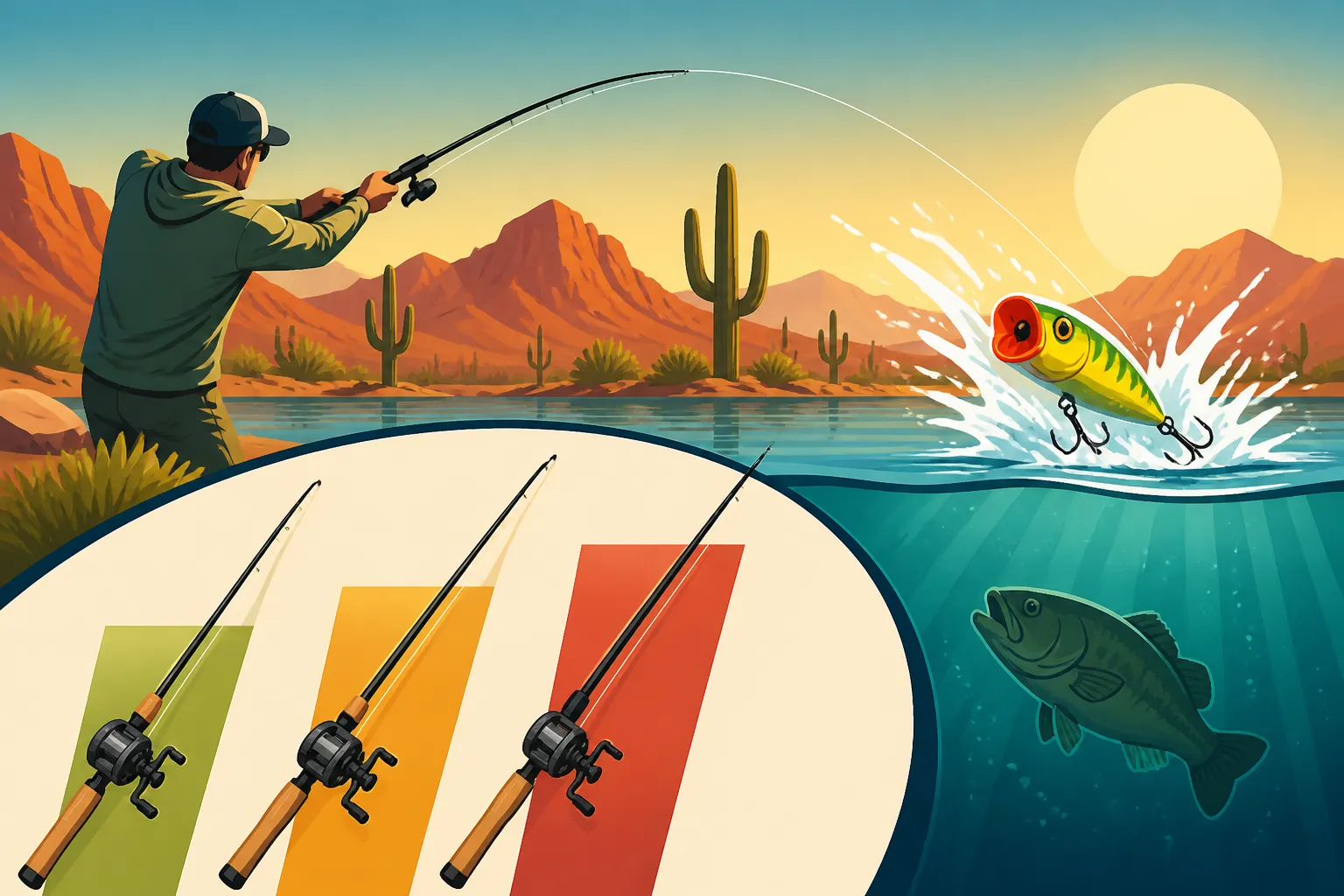
| Lure Type | Common Rod Length Range | Why This Length Works |
|---|---|---|
| Poppers & Chuggers | 6'0" – 6'10" | Shorter lengths allow for precise, sharp downward twitches to create splashes. |
| Walk-the-Dog Baits | 6'8" – 7'4" | Medium-long provides good balance for "walking" with wrist snaps, good casting. |
| Buzzbaits | 7'0" – 7'6" | Longer length aids casting distance and quick retrieve, takes up slack efficiently. |
| Prop Baits | 6'6" – 7'2" | Versatile range for both casting distance and working the retrieve. |
| Frogs (Surface) | 7'0" – 7'6" (Heavy Power) | Longer for casting heavy baits, strong backbone for hooksets in thick cover. |
| Flukes/Soft Jerkbaits (Weightless, near surface) | 6'8" – 7'2" | Good for twitching action and moderate casting distance. |
Considerations for Different Arizona Fishing Scenarios
Your fishing environment in Arizona will also heavily influence your rod choice.
Boat Fishing vs. Bank Fishing
- Boat Fishing: If you're in a boat, you generally have more freedom to choose a rod length based purely on the lure and technique. You can move closer to cover for accurate short casts or position yourself for long casts over open water. However, if you're in a smaller vessel like a kayak, you might lean towards slightly shorter rods for easier handling. Kayak Fishing Techniques for Desert Lakes often advise a slightly shorter rod for better maneuverability.
- Bank Fishing: When you're fishing from shore, casting distance becomes critically important. Often, fish are holding further out, or you need to reach structure that's not immediately accessible. This is where longer rods (7'0" to 7'6" or even longer) really shine. They help you cover more water and get your lure out to those untouched spots. Shore Fishing Spots in Arizona often require that extra reach.
Open Water vs. Heavy Cover
- Open Water: For vast, open stretches of water like those found on Lake Powell or the main channels of the Colorado River, longer rods are a clear advantage. They allow you to make those long casts to breaking fish or to cover expansive flats quickly. When fishing for striped bass, for instance, covering water quickly can be key to finding a "boil." How to Fish for Striped Bass often mentions covering lots of water.
- Heavy Cover: Think about fishing around dense cattails, submerged trees, or thick lily pads. Here, accuracy trumps distance. A shorter rod will help you skip a lure under a low branch or drop it precisely into a small opening in the vegetation without getting tangled on every cast. Even when using a frog, which usually takes a longer rod, you'd want enough control to accurately place it in tight pockets.
More Than Just Length: Rounding Out Your Topwater Setup
While rod length is crucial, it's just one piece of the puzzle. To truly optimize your topwater experience in Arizona, consider these other factors:
Rod Power: Matching the Lure and the Fish
Rod power refers to the amount of force it takes to bend the rod, ranging from ultra-light to heavy.
- Medium-Heavy to Heavy Power: For most topwater bass fishing in Arizona, especially with larger lures or in areas where you expect bigger fish, a medium-heavy or heavy power rod is typically preferred. This gives you the backbone to cast heavier lures, drive big hooks home, and turn a powerful fish away from cover. This is particularly true if you're targeting the robust bass found in lakes like Roosevelt. Best Rods for Bass in Arizona will almost always recommend a medium-heavy power.
- Medium Power: For smaller topwater baits, like diminutive poppers or walk-the-dog lures, a medium power rod can offer a more balanced feel and better action.
Line Selection: The Unsung Hero of Topwater
Your fishing line is critical for topwater success because it affects how your lure sits on and interacts with the water.
- Braided Line: This is a favorite among topwater anglers for its zero stretch, which translates to incredible sensitivity and immediate hook sets. It also floats, which is ideal for surface lures. The lack of stretch means less "give" when a fish strikes at a distance. If you're using a leader, fluorocarbon or monofilament can be tied to your braid. Best Line for Bass Fishing often recommends braid for topwater.
- Monofilament Line: Mono floats, which is good for topwater, and has some stretch, which can be forgiving when a fish strikes violently, helping to prevent the hook from tearing out. However, its stretch means less direct contact with the lure and a slightly delayed hook set compared to braid.
- Fluorocarbon Line: Generally, fluorocarbon sinks, making it less ideal for pure topwater applications. While sometimes used as a short leader for braid to reduce visibility, it's typically avoided for main lines when working lures on the surface.
Reel Type and Gear Ratio: Speed and Control
- Baitcasting Reels: These are overwhelmingly preferred for most topwater techniques, especially for bass. They offer greater casting control, power, and the ability to handle heavier lines and lures.
- High Gear Ratio (7.1:1 or higher): A fast retrieve ratio is incredibly beneficial for topwater. It allows you to quickly pick up slack line after a cast or a twitch, helping you maintain constant contact with your lure. This also means you can quickly reel in a fish that's running towards you after a strike, preventing slack line that could lead to a lost fish.
- Spinning Reels: While less common for dedicated topwater bass setups, spinning reels are perfectly suitable for lighter topwater presentations, especially if you're using lighter lines or smaller lures. They are often a great choice for beginners. Best Fishing Reels for Beginner Anglers in Arizona can help you explore options.
Personal Comfort and Ergonomics
Ultimately, the "best" rod length is also highly personal. What feels good in your hands, how you cast, and your physical build all play a role. If a rod feels awkward or heavy after an hour of twitching, you'll get fatigued, and your fishing experience will suffer. It's often worth visiting a local tackle shop, like Bass Pro Shops, to physically hold different rods, feel their balance, and even practice a few casting motions (without a lure, of course!). This hands-on experience can be invaluable.
Finding the perfect topwater rod length is about more than just numbers; it's about optimizing your entire setup for the thrilling experience of a surface strike. It's about empowering you to make that popper sing, that walking bait glide, and that buzzbait hum across the water, tempting Arizona's fish into an unforgettable fight. Don't be afraid to experiment, and you'll soon discover the rod length that unlocks your topwater potential.
Disclaimer
This article is for general informational purposes only and does not constitute professional advice. Laws, prices and regulations vary by location and change over time. Consult a qualified professional for guidance on your specific situation.