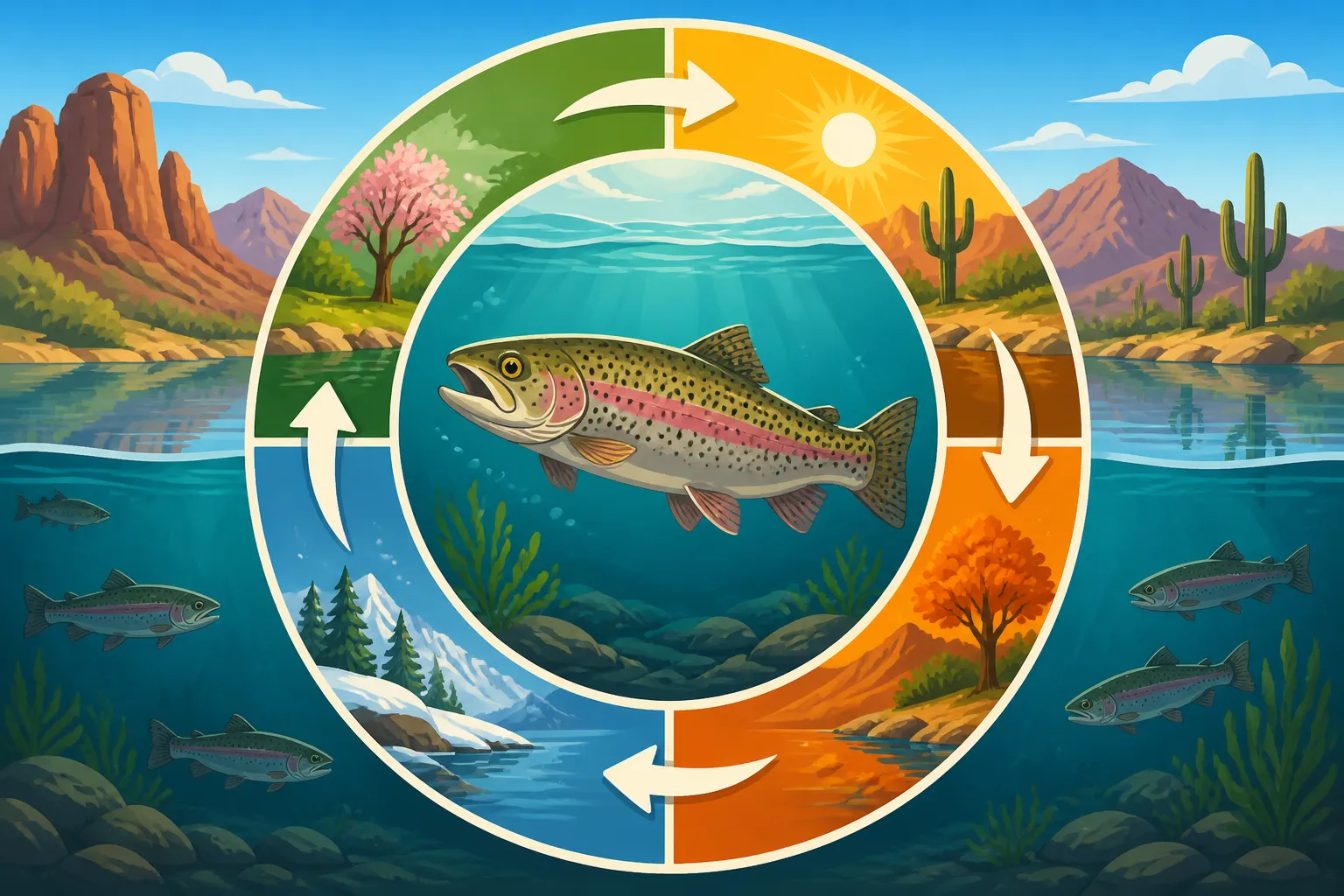
Seasonal Movement Patterns of Trout in Stocked Lakes
Trying to consistently catch trout in Arizona's stocked lakes can feel like a guessing game, especially when their locations seem to shift with no rhyme or reason. Anglers often struggle because they don't account for how temperature, food, and environmental changes push these fish around throughout the year. This comprehensive guide will illuminate the seasonal movement patterns of trout in stocked Arizona waters, giving you the insights needed to find them, no matter the time of year.
The Nuances of Trout Behavior in Stocked Waters
It's easy to assume all trout behave the same way, but those in stocked Arizona lakes have a different playbook than their wild counterparts. They're often raised in hatcheries, accustomed to a steady diet and a confined environment, which means their initial reactions and subsequent movements in a new lake can be quite distinct. Understanding these unique behaviors is crucial for consistent success.
Immediate Post-Stocking Behavior
When trout are first introduced into an Arizona lake, it's often a chaotic scene. They've just been transported, handled, and released into a vast, unfamiliar world. Their first instinct is typically to scatter. They might swim around quite erratically, trying to find cover, or sometimes, they'll school up tightly in a defensive measure. For the first few days, they're often disoriented and a bit stressed. This immediate phase can be a mixed bag for anglers; sometimes they're easy pickings due to their disorientation, but other times they're completely shut down. The key is that they haven't yet settled into a routine or established specific feeding patterns related to their new environment. You'll often find that the Arizona Game and Fish Department (AZGFD) will announce stocking schedules, and those first few days can be a frenzy. However, as the initial shock wears off, they'll start to seek out more suitable habitats.
Impact of Water Temperature and Oxygen
The single most critical factor influencing trout movement in Arizona's diverse climates is water temperature and its direct correlation with dissolved oxygen. Trout are cold-water fish; they thrive in water temperatures generally between 45 and 65 degrees Fahrenheit. As water temperatures rise above this range, their metabolic rate increases, they become stressed, and their ability to absorb oxygen from the water decreases. In the scorching Arizona summers, this becomes a major challenge.
Lakes will stratify during warmer months, meaning distinct layers of water form. The top layer, or epilimnion, is warm and rich in oxygen but often too hot for trout. Below that is the thermocline, a transitional layer where temperature drops rapidly. Finally, the hypolimnion is the coldest, deepest layer, but it can become depleted of oxygen (anoxic) due to decaying organic matter. Trout will actively seek out the "comfort zone" where temperatures are ideal and dissolved oxygen levels are sufficient. This usually means they'll be found in the thermocline or the upper parts of the hypolimnion. If a lake becomes too warm throughout its entire water column, or if the deep water becomes anoxic, stocked trout simply won't survive, which is why Arizona's trout stocking program is highly seasonal, as detailed in our guide on Trout Stocking Season in Arizona.
Trout Movement Through Arizona's Seasons
Arizona's seasons dramatically dictate where trout can be found. Unlike areas with consistently cold water, our desert environment creates distinct periods of migration within a single lake, often driven by the sun's intensity. Understanding these shifts is paramount to adapting your fishing strategy.
Spring: Spreading Out and Shallow Foraging
As winter loosens its grip and spring arrives in Arizona, the fishing scene for trout really starts to warm up, both literally and figuratively. After potentially being confined to deeper, more stable waters during the colder months, trout begin to feel the pull of warming temperatures. The sun's rays, still mild enough, start to penetrate the upper layers of the water, stimulating insect activity and plant growth. This creates a prime opportunity for trout to move out of the deep.
In spring, you'll often find trout actively spreading out from their wintering areas. They move into shallower flats, coves, and areas with submerged vegetation. These spots offer a few key advantages:
- Abundant Food: Warmer water sparks insect hatches—think midges, mayflies, and caddisflies. Minnows and other small baitfish also become more active. Trout, with their metabolism picking up, are looking to feed aggressively after a period of slower activity.
- Comfortable Temperatures: Early spring water temperatures are often ideal across a broader range of the water column. The lake hasn't stratified significantly yet, so trout have more options for finding their comfort zone. They can cruise the shallows without the stress of overheating.
- Cover and Structure: Shallow areas often provide more natural cover in the form of rocks, fallen trees, and weed beds. This gives trout ambush points for feeding and protection from predators.
During this time, anglers will find success using a variety of techniques, from casting small spinners and spoons from shore to fly fishing with emerger and nymph patterns in calmer coves. The best time of day in spring can be quite flexible, from mid-morning to late afternoon, as the temperatures are generally agreeable.
Summer: Retreating to Cooler Depths
Ah, summer in Arizona – beautiful for hiking, but notoriously challenging for trout fishing in many low-elevation lakes. As the relentless Arizona sun beats down, surface water temperatures can soar well into the 80s or even 90s, making life unbearable for trout. This forces a dramatic shift in their movement patterns.
During summer, trout retreat to the deepest, coolest parts of the lake. This phenomenon, known as "thermal refuge," is their survival mechanism. They will seek out:
- Deep Pockets and Drop-offs: Anywhere the lake bottom plunges quickly to significant depths is a prime candidate. Think ledges, underwater canyons, or areas near dam structures.
- The Thermocline: This is the critical layer where the water temperature rapidly transitions from warm to cold. Trout will often suspend themselves right in or just below the thermocline, finding that sweet spot of cooler water with adequate dissolved oxygen.
- Spring-fed Areas: If a lake has any natural springs feeding into it, these spots will introduce colder, oxygen-rich water, creating small havens for trout. However, these are often isolated and difficult to find without specialized equipment.
For anglers, this means focusing on deep-water techniques like trolling with downriggers, using heavy jigging spoons, or bottom fishing with bait like PowerBait or worms. Shore fishing becomes incredibly difficult in many lakes, as the trout are simply too far out and too deep to reach effectively. For specific depths and locations, a good fish finder is invaluable. Our guide on Best Fish Finders for Bass Fishing in Arizona offers some excellent advice that translates well to trout finding too.
Fall: Renewed Activity and Feeding Frenzies
Fall is a glorious time for trout fishing in Arizona. As the scorching summer heat begins to subside and nights grow cooler, the lake water starts to cool down as well. This seasonal change, often called "turnover" in some lakes, where the stratified layers mix, revitalizes the entire ecosystem and re-energizes the trout.
With cooler water, trout become much more active and aggressive. Their metabolism, which was suppressed by the summer heat, kicks into high gear. They sense the impending cold of winter and instinctively begin a feeding frenzy to pack on fat reserves.
- Return to Shallows: As the surface temperatures become more comfortable, trout will once again move into shallower areas, coves, and points, similar to their spring patterns. They're not as sensitive to light as in summer, and the shallows often hold abundant food sources.
- Chasing Baitfish: In fall, you'll often see trout actively chasing baitfish near the surface, especially during low light conditions. Look for splashing or "boils" as trout aggressively feed.
- Broader Distribution: With more uniform and agreeable temperatures throughout the water column, trout can be found across a wider range of depths, making them more accessible to both boat and shore anglers.
This is an excellent time for casting lures, fly fishing with streamer patterns, or drifting live bait. Early mornings and late afternoons are particularly productive, but even midday can be good on overcast days. Understanding the Arizona Fishing Seasons Explained will further highlight why fall is a prime time for many species, including trout.
Winter: Consistent, Deep-Water Patrolling
Winter fishing for trout in Arizona's stocked lakes can be fantastic, especially in areas that don't completely freeze over. While the temperatures are cold, they are often stable, which can make trout behavior more predictable.
In winter, trout will typically return to the deeper, more stable sections of the lake. However, this isn't necessarily due to extreme cold, but rather for stability and to follow available food sources.
- Stable Depths: Trout will often suspend at mid-depths or patrol deeper ledges and points where water temperatures are consistent. They're looking for areas that offer thermal stability, protecting them from rapid surface temperature fluctuations.
- Slower Metabolism: Their metabolism slows down considerably in colder water, meaning they don't need to feed as frequently or as aggressively. This often translates to more subtle bites.
- Focus on Forage: While not as active, they will still follow baitfish schools or concentrate around areas where invertebrate life is sustained.
Anglers targeting winter trout should focus on slower presentations. Light line, small baits, and slow retrieves are often the most effective. Techniques like vertical jigging, drop-shotting, or slow trolling can pay off. It's also a great time for fishing from piers and other shore access points that drop off quickly into deeper water. The Best Time of Day to Fish for Bass in Winter often applies to trout too, as morning sun can warm shallow areas slightly, bringing fish in.
Here's a quick summary of typical seasonal movements:
| Season | Typical Depth | Activity Level | Preferred Habitat | Effective Techniques |
|---|---|---|---|---|
| Spring | Shallow to Mid-depths | High, aggressive | Flats, coves, submerged vegetation | Spinners, spoons, flies (emergers), bait |
| Summer | Deepest, thermocline | Low, lethargic | Deep pockets, ledges, spring-fed areas | Trolling, deep jigging, bottom bait |
| Fall | Shallow to Mid-depths | High, feeding frenzy | Coves, points, baitfish schools | Casting lures, streamers, drift bait |
| Winter | Mid-depth to Deep | Moderate, slower | Stable deep water, ledges | Vertical jigging, drop-shot, slow trolling, bait |
Key Factors Influencing Trout Location
Beyond the overarching seasonal changes, several specific environmental and biological factors constantly influence where trout choose to spend their time in stocked lakes. Understanding these micro-factors can give you a significant edge on any given day.
Food Sources and Forage Availability
Trout, like all fish, are driven by their stomachs. Their movement patterns are often dictated by where their next meal is coming from. In stocked lakes, the primary food sources can vary, and knowing what's available and where it congregates is vital.
- Insects and Invertebrates: A major part of a trout's diet, especially in areas with aquatic vegetation or rocky bottoms, consists of aquatic insects (nymphs, larvae) and other invertebrates (scuds, worms). Trout will move to areas where these food sources are abundant, such as weed lines, rocky outcrops, or muddy bottoms where chironomids burrow. When insects hatch, trout will often rise to the surface to feed, creating visible rings and splashes that signal their presence.
- Baitfish: Many stocked lakes also contain populations of baitfish like threadfin shad or minnows. Trout, especially larger ones, will actively hunt these schools. If you can locate schools of baitfish, you're likely to find predatory trout nearby. Using electronics like a fish finder (you can find many great options on Amazon) can help you pinpoint these schools, which often appear as clouds or arches on the screen.
- Stocking Truck Leftovers: Immediately after stocking, trout might still be somewhat reliant on the food they were fed in the hatchery. Over time, they adapt to natural forage, but knowing the typical diet of stocked trout can inform your bait selection. PowerBait, for instance, is often effective because it mimics the pellet food they were raised on.
Shelter, Structure, and Shade
Trout are also constantly seeking refuge, whether from predators, harsh sunlight, or strong currents. The physical characteristics of a lake's bottom and shoreline provide crucial shelter and structure.
- Submerged Structure: This includes underwater rock piles, ledges, old creek channels, and standing timber. These features offer ambush points for feeding and protection. Trout will often hold tightly to structure, using it as a current break or a hiding spot. Understanding how to fish around Submerged Timber Spots at Roosevelt Lake can give you an advantage, as these principles apply broadly to other lakes.
- Shade: In Arizona's intense sunshine, shade is a premium. Trout will often congregate in shaded areas, such as under overhanging trees, along steep canyon walls, or even beneath docks and boat ramps. These spots offer a cooler, darker environment where they feel more secure. In the summer, any form of shade, no matter how small, can hold fish.
- Current Breaks: While many stocked lakes are relatively still, rivers and the tailwaters below dams can have significant currents. Trout will position themselves just out of the main flow, in "current breaks," where they can expend less energy but still ambush food being swept downstream.
Angler Pressure and Disturbance
One factor often overlooked, especially in popular, easily accessible stocked lakes, is angler pressure. Stocked trout, after experiencing the initial chaos of release and then the constant barrage of lines, hooks, and boats, can become incredibly wary.
- Shy Fish: Heavily pressured trout will often become "hook-shy" or "line-shy." They might move to deeper water, become more nocturnal, or simply refuse to bite common offerings. This is especially true for the larger, more experienced holdover trout.
- Timing is Key: In pressured waters, fishing during off-peak hours (very early morning, late evening, or weekdays) can significantly increase your chances. Trout might move into shallower, more accessible areas when there are fewer disturbances.
- Presentation Matters: When fishing pressured trout, your presentation needs to be impeccable. Lighter line, smaller baits, natural colors, and subtle movements often work best. Stealth becomes your most valuable tool. This is particularly relevant for urban fishing environments; if you're fishing at one of the Community Lake Locations in Phoenix, expect competition and adjust your tactics accordingly.
Practical Tips for Locating Trout Year-Round
Armed with an understanding of how seasons and environmental factors dictate trout movement, you can develop more effective strategies. It's not just about what bait you use, but where and how you present it.
Reading the Water for Clues
Successful trout anglers are observant. They don't just cast blindly; they actively "read" the water for any signs of fish presence or favorable conditions.
- Surface Activity: Look for rising trout, which create subtle rings on the water, indicating they're feeding on insects. Sometimes, especially in fall, you might see more aggressive splashes or "boils" as trout chase baitfish.
- Water Clarity and Color: Clear water often means fish are more cautious, requiring lighter lines and more natural presentations. Murky water, on the other hand, can offer cover, making trout bolder, but also means they rely more on scent and vibration, so louder or smellier baits might be better.
- Wind and Waves: A light chop on the water surface can be beneficial. It breaks up the light, making it harder for trout to see you, and it can also concentrate baitfish or insect larvae along wind-blown shorelines. However, heavy wind can make fishing difficult and push fish deeper.
- Bottom Contour and Structure: If you're on a boat with a fish finder, pay close attention to depth changes, ledges, and submerged humps. These are classic trout holding areas. For shore anglers, observing the shoreline's contours can give clues about the underwater structure. A steep bank on shore often indicates a quick drop-off underwater. You can often find detailed maps of lake contours on the AZGFD website or through apps.
Adjusting Your Approach by Season
The beauty of trout fishing in Arizona is that it demands adaptability. What works in April might be completely ineffective in August.
- Spring Adaptations: Focus on covering water. Trout are spreading out, so casting and retrieving various lures like spoons, inline spinners (like those from Panther Martin or Rooster Tail), or small crankbaits can help you locate active fish. Don't be afraid to fish closer to shore and explore shallow coves. Consider using a slip bobber rig for trout to present bait at varying depths.
- Summer Adaptations: Go deep, or go home! This is the time for precision. Utilize heavier sinking lures, drop-shot rigs, or bottom fishing techniques with power bait or natural offerings. If you're trolling, use downriggers or lead-core line to get your lure to the exact depth of the thermocline. Early mornings and late evenings are the only times trout might venture shallower in canyon lakes. If you're looking for more tips, our guide on Can You Catch Trout in July in Arizona? dives deeper into summer strategies.
- Fall Adaptations: Embrace the feeding frenzy. Trout are aggressive, so flashy lures, larger spoons, or even topwater presentations (if baitfish are active on the surface) can be effective. This is also a fantastic time for fly fishing with streamers and nymph patterns as trout actively feed on insects.
- Winter Adaptations: Slow and subtle is the name of the game. Trout are in a lethargic state. Use small jigs, slow-trolled minnow imitations, or static bait presentations with minimal weight. Focus on areas with stable depths and cover. If the sun comes out, a slightly warmer afternoon can sometimes bring them up a bit, but generally, consistent depth is key. Many anglers find the slower retrieve of a jig to be perfect for this time of year, especially when fishing from shore at places like Tempe Town Lake, a popular urban fishing spot. Remember, even during the "off-season" for some species, understanding When to Fish Arizona Lakes by Month will always help you find success with trout.
By integrating these seasonal insights and practical tips, your chances of consistently locating and catching trout in Arizona's stocked lakes will dramatically improve. It's about thinking like a trout and anticipating their next move based on the ever-changing conditions.
Disclaimer
Fishing conditions and regulations in Arizona can change. Always check the latest Arizona Game and Fish Department (AZGFD) regulations before heading out. This guide is for informational purposes only and does not constitute official legal advice. Enjoy your time on the water, and fish responsibly!