Green Sunfish Identification in Arizona
Have you ever reeled in a sunfish in Arizona and thought, "Now, what kind of sunfish is this, really?" It's a common feeling among anglers, especially with so many similar-looking panfish finning around our desert lakes and streams. This guide is here to cut through the confusion and give you the definitive lowdown on how to confidently identify a Green Sunfish in Arizona, making your time on the water more informed and enjoyable.
Why Accurately Identifying Green Sunfish is Important for Arizona Anglers
Catching a fish is always exciting, but there's a unique satisfaction that comes from knowing exactly what you've landed. In Arizona, where our waters hold a surprising diversity of species, being able to accurately identify your catch, especially common ones like the Green Sunfish, elevates your angling experience and your understanding of the local ecosystem.
Beyond Just "A Sunfish": The Angler's Perspective
It's easy to just call any small, pan-shaped fish a "sunfish" and move on. After all, when they're flopping in your hand, a lot of them look pretty similar at first glance. But that generic classification often leads to missed opportunities for understanding the water you're fishing. Are you consistently catching one specific type of sunfish over another? This can tell you a lot about the health of the habitat, the food sources available, and even the best techniques to use. Knowing the difference between a Green Sunfish and a Bluegill, for instance, can help you fine-tune your approach for more consistent bites. You might be surprised at how much more you appreciate your catch when you can confidently put a name to it. If you're looking to broaden your knowledge of these feisty fighters, our Panfish and Sunfish Guide for Arizona offers a great overview of the various species you might encounter.
Beyond personal satisfaction, accurate identification contributes to a broader understanding of fish populations. While Green Sunfish aren't typically subject to stringent regulations like some other species, recognizing them helps you appreciate their role in the food web. They're often prolific, serving as an important food source for larger predatory fish like bass and catfish. Their presence can be an indicator of a thriving, if sometimes overpopulated, panfish community. For responsible anglers, knowing your fish is simply good practice, allowing you to better observe and appreciate the aquatic world around you.
Refining your fishing techniques also comes into play with proper identification. Green Sunfish, as we'll discuss, have certain behavioral traits and preferred habitats that differ subtly from their sunfish cousins. If you're consistently targeting what you think is a Bluegill but keep catching Green Sunfish, you might be using the wrong bait or fishing in slightly the wrong spot. Learning their specific habits, which starts with identification, can help you become a more versatile and successful angler. It turns a casual outing into a more focused and rewarding pursuit, enabling you to adapt your strategy on the fly.
Finally, for many of us who cherish our time outdoors, fishing is about more than just catching fish; it's about connecting with nature. Being able to identify the species you encounter, whether it's a bird, a plant, or a fish, deepens that connection. It makes you a better observer and fosters a greater respect for the natural environment. So, next time you're out, take a moment to really look at that fish in your hand. Knowing it's a Green Sunfish, with its unique traits and habitat, adds another layer of appreciation to every cast and every catch.
Green Sunfish as a Unique Arizona Sporting Fish
Green Sunfish might not always get the same glory as a trophy bass, but they are undeniably a unique and often underestimated sporting fish in Arizona. These little fighters are known for their feisty nature and aggressive bite, which makes them incredibly fun to catch, especially for beginners or when you just want consistent action. Unlike some other panfish that can be a bit more finicky, Green Sunfish are rarely shy, readily attacking a variety of baits and lures with enthusiasm. This makes them a fantastic target for teaching kids how to fish or for those days when you simply want to feel a tug on the line without too much effort.
Their prevalence and accessibility further solidify their role as a unique Arizona sporting fish. You'll find Green Sunfish in an astonishing array of waters across the state, from the serene backwaters of the Salt River to almost every community fishing lake in Phoenix and Tucson. They thrive in conditions that might be less hospitable to more sensitive species, often tolerating warmer water and varied habitat types. This means you don't always need specialized gear or a remote wilderness trek to find them; a simple walk to your local urban pond can often yield plenty of Green Sunfish action.
The role they play in Arizona's community fishing programs is also noteworthy. These programs often stock various sunfish species, and Green Sunfish contribute significantly to providing accessible angling opportunities for everyone. They help create vibrant, fish-filled environments close to urban centers, making fishing a viable and enjoyable pastime for countless families. It's a testament to their hardiness and willingness to bite that they are such a staple in these popular, easy-to-reach locations.
Ultimately, accurate identification of a Green Sunfish adds to the satisfaction of the catch because you understand the specific characteristics of what you've landed. Knowing it's a Green Sunfish, with its unique blend of toughness, aggressive spirit, and widespread presence, lets you appreciate it for what it is – a truly enjoyable and accessible sporting fish in the diverse aquatic landscape of Arizona. It's not just "another sunfish," but the Green Sunfish, a small but mighty emblem of our state's angling opportunities.
Unmistakable Physical Traits: A Closer Look at Green Sunfish
When you're trying to tell one sunfish from another, it really comes down to paying attention to the details. Green Sunfish have several key physical characteristics that, once you know what to look for, make them quite distinct from their cousins in Arizona's waters.
Body Shape, Scales, and Distinctive Color Palette
Let's start with their overall look. The Green Sunfish (Lepomis cyanellus) has a body shape that's robust and somewhat elongated or football-shaped compared to the more disc-like or round bodies of some other sunfish, like the Bluegill. While still a panfish, it often appears a bit stockier and less compressed from side to side. They don't typically grow very large, usually ranging from 4 to 7 inches, but they can be quite chunky for their size.
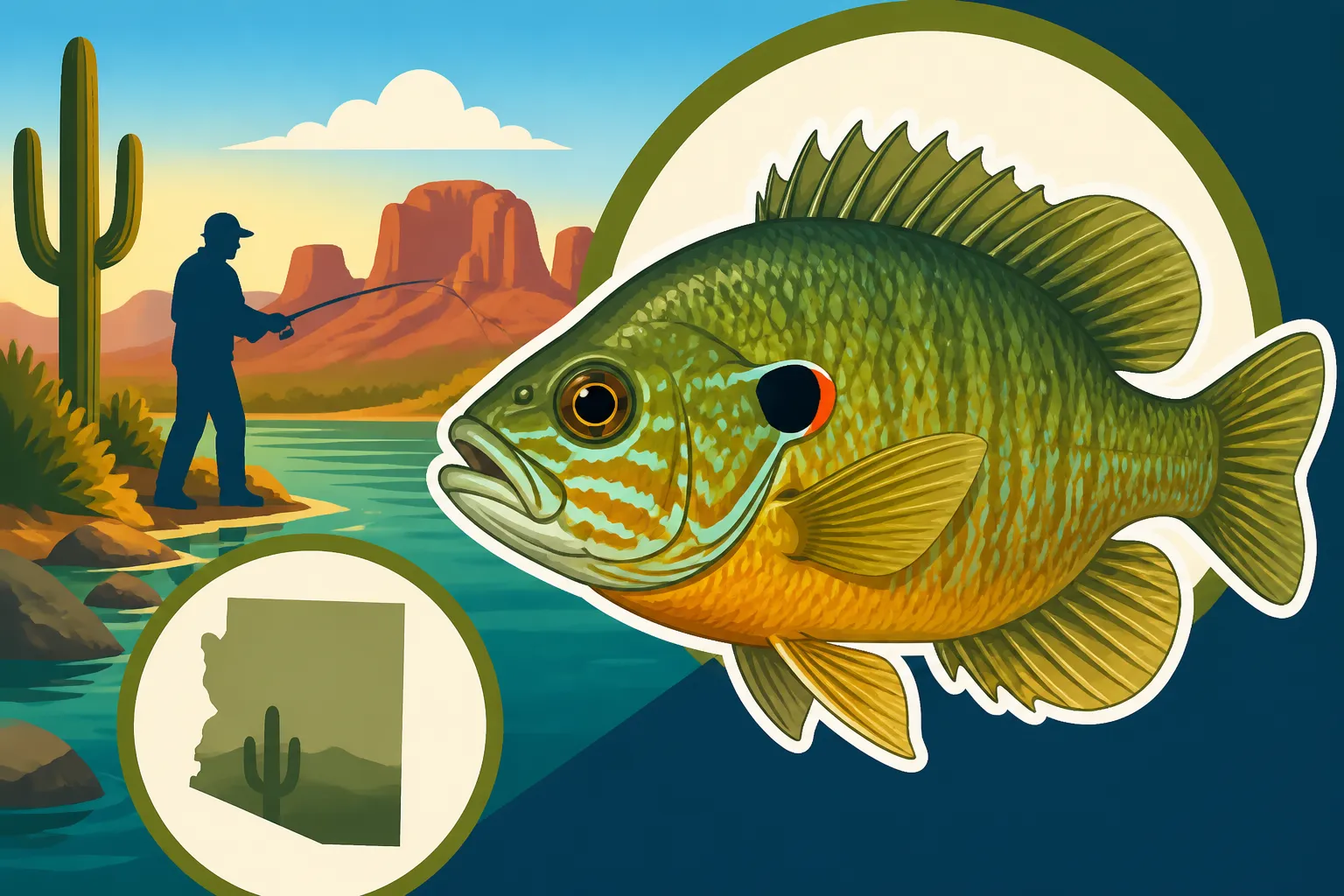
Now for the really fun part: their color! Their backs are typically a vibrant blue-green, sometimes appearing almost olive, fading into a yellowish or greenish-yellow belly. What truly sets them apart are the scattered iridescent blue or green spots and several distinct, wavy, bright blue or turquoise lines on their operculum (that's their gill cover) and cheeks. These iridescent markings can shimmer beautifully in the sunlight, giving them a jeweled appearance. It's like nature decided to paint them with little neon streaks, making them truly eye-catching.
The nuances of their coloration can vary quite a bit depending on where they live, the water clarity, and even their mood. Fish from clear, rocky streams might have more vibrant blues and greens, while those from murky, weedy ponds might appear darker and more subdued, leaning towards olive or brown. However, those wavy blue lines on the face are almost always present to some degree, making them a consistent identifier. Their scales are relatively large and rough to the touch, providing a good armored plating for these tough little fish.
When you're looking at a Green Sunfish in hand, try to observe how the light catches those blue lines and spots. Sometimes, in low light, they can be harder to discern, but a quick splash of water or a turn in the sun will often reveal their characteristic shimmer. This unique blend of a robust body and an intricate, iridescent color pattern is a primary indicator you've landed a Green Sunfish, rather than a similar species like a Bluegill. For more on distinguishing common panfish, check out our guide on Bluegill vs Sunfish Identification.
Key Anatomical Markers: Fins and Mouth
Beyond their dazzling colors, the fins and mouth of a Green Sunfish offer some of the most reliable identification clues. Let's talk about the dorsal fin first. The dorsal fin (the one on their back) is typically continuous, meaning it's one long fin rather than two separate ones, though it might have a slight notch. The most prominent feature here is often a dark, sometimes black, spot located on the posterior (rear) part of the soft-rayed dorsal fin. This spot might also have a lighter, often white or orange, margin around it, making it stand out.
But perhaps the most critical and consistent identifier for the Green Sunfish is its mouth. They have a surprisingly large mouth for a sunfish, and this is a key trait. If you close its mouth and gently press the corner of its jaw, you'll notice that the upper jaw extends back to at least the middle of the eye, and often even beyond the back edge of the eye. This is a crucial distinction from a Bluegill, which has a much smaller mouth that typically doesn't reach past the front edge of the eye. If you can fit your pinky finger into the fish's mouth without too much effort, it's very likely a Green Sunfish. This large mouth contributes to their aggressive feeding habits and their ability to consume larger prey items than other sunfish.
Their pectoral fins (the ones on the side, behind the gills) are relatively short and rounded, often not extending much past the eye when folded back. The caudal fin (tail fin) is typically slightly emarginate (forked) or almost straight, not deeply forked like some other fish species. The opercular flap, sometimes called the "ear flap," on a Green Sunfish is usually quite small, rigid, and entirely black or dark. While it lacks the distinct red or orange margin of a Redear Sunfish, or the long, flexible "ear" of a Bluegill, its small, dark appearance is another piece of the puzzle. Looking at these features together – especially the large mouth and the dorsal fin spot – gives you a clear roadmap to identifying a Green Sunfish.
Distinguishing Green Sunfish from Their Arizona Sunfish Cousins
Arizona waters are home to a variety of sunfish, and while they all share some family resemblances, there are clear distinctions that help you tell a Green Sunfish apart from its common relatives like Bluegill and Redear Sunfish. This can save you a lot of head-scratching moments out on the water.
Side-by-Side Comparison with Bluegill and Redear Sunfish
The most common mix-up often happens between Green Sunfish and Bluegill. Both are widespread and popular targets for anglers, and their general shape can be similar, especially when they're small. However, the differences are significant once you know what to look for. The easiest way to tell them apart is by looking at their mouths. Green Sunfish have that noticeably larger mouth we just discussed, where the jaw extends back to at least the middle, or even the back, of the eye. Bluegill, on the other hand, have a much smaller, more delicate mouth that rarely extends past the front edge of the eye. Think of a Bluegill as having a "puckered" mouth.
Another key difference lies in their bodies and "ear flaps." Bluegill generally have a more distinctively rounded, disc-like body shape compared to the Green Sunfish's slightly more elongated form. The Bluegill's opercular flap (ear flap) is typically long, flexible, and entirely black, sometimes with a very thin, pale margin. The Green Sunfish's ear flap is usually smaller, more rigid, and also black, but it often lacks the elongated, flexible quality of the Bluegill's. You'll also notice the coloration difference: while Green Sunfish have those iridescent blue lines on their face, Bluegill often have vertical bars or a more speckled pattern on their sides, and typically lack the prominent blue facial markings. For a full breakdown, our Bluegill vs Sunfish Identification article is a fantastic resource.
Now, let's consider the Redear Sunfish. These are another popular panfish in Arizona, often stocked in community lakes. Again, the ear flap is your best friend here. Redear Sunfish get their name from the distinctive red or orange margin around the posterior edge of their opercular flap. This reddish "ear" is a dead giveaway that you're looking at a Redear, not a Green Sunfish. Redears also tend to have a slightly more compressed, deeper body shape than Green Sunfish, often appearing larger and thicker. They typically lack the wavy blue lines on the face that are so characteristic of the Green Sunfish, instead having a more uniform, olive-green or brassy coloration with some darker spots. Their mouths are also smaller than a Green Sunfish's, more similar to a Bluegill's in size. You can delve deeper into this species with our Redear Sunfish Identification in Arizona guide.
These subtle differences in mouth size, body shape, and especially the characteristics of the ear flap and facial markings, are your best tools for distinguishing these sunfish species. It's not about one single trait, but rather a combination of them that provides a positive identification. The more you practice looking for these details, the easier and quicker it will become out on the water, helping you confidently identify your catch.
Using a Simple Checklist for Positive Identification
To make on-the-water identification easier, I recommend using a simple mental checklist. It helps you systematically evaluate the fish in your hand and quickly narrow down the possibilities. This approach focuses on the most prominent and reliable features, ensuring you don't overlook a key detail.
Here’s a quick mental checklist:
- Mouth Size: Does the corner of the mouth extend past the middle of the eye when closed? If yes, it's likely a Green Sunfish. If not, it's probably a Bluegill or Redear.
- Facial Markings: Are there distinct, wavy, iridescent blue or turquoise lines on the gill cover and cheeks? If yes, Green Sunfish. Bluegill might have speckles or bars, Redear usually have more uniform color.
- Dorsal Fin Spot: Is there a prominent dark spot (often with a lighter margin) on the rear of the soft dorsal fin? This is very common in Green Sunfish, though some other sunfish can have a less defined one.
- Ear Flap (Operculum): Is the flap small, rigid, and entirely dark? If it has a bright red/orange margin, it's a Redear. If it's long and flexible, it's a Bluegill.
You don't need a field guide tattooed on your arm, but having a general idea of these key points will make all the difference. Many anglers find it helpful to look at charts or diagrams online before heading out, to familiarize themselves with what each species should look like. Focus on looking at multiple features, not just one. Sometimes a fish's color can be misleading due to habitat, diet, or even stress. But the anatomical features – mouth size and fin characteristics – are generally more consistent.
Practice truly makes perfect here. The more fish you catch and examine, the more intuitive these identifications will become. Don't be afraid to take a quick photo of your catch if you're unsure, and then reference it later. Over time, you'll develop an angler's eye for detail, and telling a Green Sunfish from its kin will be second nature, adding another layer of expertise to your Arizona fishing adventures.
Here's a quick comparison table to help visualize the differences:
| Feature | Green Sunfish | Bluegill | Redear Sunfish |
|---|---|---|---|
| Body Shape | Robust, slightly elongated, "football-shaped" | Rounded, deep, very compressed, "disc-like" | Deep, compressed, similar to Bluegill but often larger |
| Mouth Size | Large; jaw extends to middle or past eye | Small; jaw rarely extends past front of eye | Small; jaw rarely extends past front of eye |
| Facial Markings | Wavy, iridescent blue/turquoise lines on cheeks | Vertical bars or speckles, no strong blue lines | No strong blue lines; more uniform coloration |
| Ear Flap | Small, rigid, entirely black | Long, flexible, entirely black | Distinctive red/orange margin on rear of black flap |
| Dorsal Fin | Dark spot on soft dorsal, often with pale margin | Dark spot usually less pronounced, sometimes absent | No prominent dark spot |
| Common Color | Blue-green back, yellowish belly | Olive/dark blue back, yellowish/orange belly | Olive/brassy back, lighter belly |
Where and How to Hook a Green Sunfish in Arizona
One of the most appealing aspects of Green Sunfish is their widespread availability and their willingness to bite, making them a fantastic target for anglers of all skill levels across Arizona. Knowing where they like to hang out and what they're likely to strike at will significantly improve your chances of a successful outing.
Ideal Habitats and Common Arizona Locales
Green Sunfish are true survivors and incredibly adaptable, which is why you can find them in such a diverse range of aquatic environments throughout Arizona. They thrive in small ponds, larger reservoirs, slow-moving rivers, and even irrigation canals. Unlike some more finicky fish, they can tolerate slightly warmer, murkier water, and areas with varying oxygen levels, making them ubiquitous in many parts of the state.
When you're looking for Green Sunfish, think shallow water and cover. They absolutely love areas with submerged vegetation like lily pads, cattails, or dense weed beds. These spots provide both ambush points for hunting smaller prey and protection from larger predators. You'll also find them congregating around structural elements such as downed trees, submerged brush piles, rock formations, and especially docks and pier pilings. These structures offer shade and hiding places, making them irresistible to Green Sunfish. If you're fishing in urban areas, our guides on Community Park Lakes in Phoenix and Community Park Lakes in Tucson will point you to prime spots where these fish are often abundant.
Consider places like Tempe Town Lake, various neighborhood parks with fishing ponds, the lower Salt River, and even the calmer coves of larger lakes like Lake Pleasant or Roosevelt Lake. In these locations, focus your efforts on the shallower banks, especially those with some sort of cover. During warmer parts of the day, they might move slightly deeper to find cooler water or more substantial shade, but generally, they're accessible from the bank without needing a boat. Look for areas where the sun hits the water early in the morning or late in the afternoon, as they'll be actively feeding in those periods. Their hardiness means they’re often one of the most reliable catches, no matter where you cast your line in Arizona.
Simple, Effective Baits and Tackle for Green Sunfish
The beauty of fishing for Green Sunfish is that you don't need a complicated setup or expensive gear. Their aggressive nature means they're not particularly picky, and they're usually eager to bite. This makes them an ideal target for beginners or anyone looking for a relaxed, fun day of fishing.
When it comes to bait, live options are almost always a surefire hit. A small piece of nightcrawler or red worm is practically irresistible to a Green Sunfish. You can also have great success with crickets, grasshoppers, or even small mealworms. Just thread a small piece onto a tiny hook, add a bobber a foot or two above it, and you're good to go. The bobber will help you detect even the slightest nibble. These natural baits are usually easy to find at any local bait shop, or if you're feeling adventurous, you can sometimes find them under rocks or in your garden!
For those who prefer artificial lures, Green Sunfish are still very accommodating. Tiny spinners (like a Rooster Tail or Panther Martin in sizes 0 or 1), small jigs (1/32 to 1/16 ounce) tipped with a piece of plastic or a Gulp! bait, and even micro-sized crankbaits can elicit aggressive strikes. The key is to keep the lures small and present them slowly around cover. Many of these excellent, affordable lures can be found easily on Amazon, allowing you to stock up without breaking the bank. For a more comprehensive look at what works in Arizona, our Best Baits and Lures for Arizona Fishing offers excellent advice.
Your tackle setup can be as simple as an ultralight or light action spinning rod and reel combo. A 5 to 6-foot rod with a light action is perfect for casting small baits and feeling those subtle (or not-so-subtle!) bites. Spool your reel with 2 to 4-pound test monofilament line, which is strong enough for these panfish but light enough for good casting distance and sensitivity. Small hooks, typically sizes 8 to 12, are ideal for their mouths. A small tackle box, like many available on Amazon, filled with these basic items, along with a few small sinkers and bobbers, is all you really need for a fantastic day of Green Sunfish fishing. Consider reading up on Essential Tackle Box Setup for Arizona Beginners for more guidance on getting started.
Disclaimer
This article is for general informational purposes only and does not constitute professional advice. Laws, prices and regulations vary by location and change over time. Consult a qualified professional for guidance on your specific situation.