Arizona License Coverage on the Nevada Side of Lake Mead
One of the most common headaches for anglers in Arizona, especially those eyeing the incredible waters of Lake Mead, is figuring out just which state's fishing license covers what. It's easy to get confused when a massive body of water like Lake Mead straddles two state lines, leaving many wondering if their Arizona fishing license is valid on the Nevada side or vice-versa. This guide will meticulously break down the specifics of Arizona's fishing license coverage on the Nevada portion of Lake Mead, ensuring you can cast your line with confidence and avoid any unwelcome surprises.
Understanding Lake Mead's Inter-State Waters
Lake Mead, a colossal reservoir formed by the Hoover Dam on the Colorado River, is an angler's paradise, teeming with striped bass, largemouth bass, channel catfish, and more. But its sheer size and unique geographical position, acting as a natural boundary between Arizona and Nevada, create a unique challenge for fishermen. You might be fishing in what feels like one continuous body of water, but legally, you're constantly crossing state lines.
The Arizona-Nevada Border Dilemma on Lake Mead
Imagine you're out on the water, reeling in a trophy striper, and suddenly realize your boat has drifted a few hundred yards. Are you still legal? The Arizona-Nevada border isn't always clearly marked on the water, leading to understandable confusion. Historically, this meant anglers often had to purchase two separate fishing licenses – one for Arizona and one for Nevada – if they intended to fish both sides of the lake or if they weren't absolutely sure where the invisible line lay. This was not only an added expense but a logistical nightmare, requiring careful navigation and constant awareness of your precise location. It put a real damper on the spontaneity of a good fishing trip, forcing you to consult GPS or charts more than you’d like.
The frustration of constantly monitoring your position, coupled with the potential for hefty fines if you inadvertently crossed into "illegal" waters, was a significant barrier for many anglers. This was especially true for those unfamiliar with the specific geographic nuances of Lake Mead or those who simply wanted to explore its vastness without feeling constrained by an invisible border. The idea of having to carry multiple licenses just to fish one lake felt redundant and unnecessarily complex to many passionate fishermen.
Reciprocity Agreements: What They Are and Why They Matter
Thankfully, states often recognize the impracticality of requiring two licenses for boundary waters and enter into what are called "reciprocity agreements." These agreements essentially mean that under certain conditions, a fishing license from one state can be honored in specific waters of a neighboring state. For Lake Mead, such an agreement exists between Arizona and Nevada, simplifying the lives of countless anglers. These agreements are vital because they promote seamless recreational opportunities, reduce administrative burdens for both state wildlife agencies and fishermen, and encourage tourism. Without reciprocity, fishing on shared lakes would be far more complicated, discouraging cross-state travel for recreational purposes.
Such agreements aren't just about convenience; they reflect a shared understanding among state wildlife agencies that natural resources like fish populations don't adhere to political boundaries. Managing these shared fisheries effectively requires cooperation. Reciprocity allows anglers to focus on the joy of fishing rather than the stress of boundary navigation. It acknowledges that the fish swim freely between state waters, and so should the anglers, within reason and under clearly defined terms. For instance, you’ll find similar arrangements for other shared waterways, such as the Colorado River, which borders Arizona and California. To delve deeper into how these agreements work, you might want to read our guide on Out-of-State Angler Rules in Arizona.
Arizona's Reciprocity with Nevada on Lake Mead
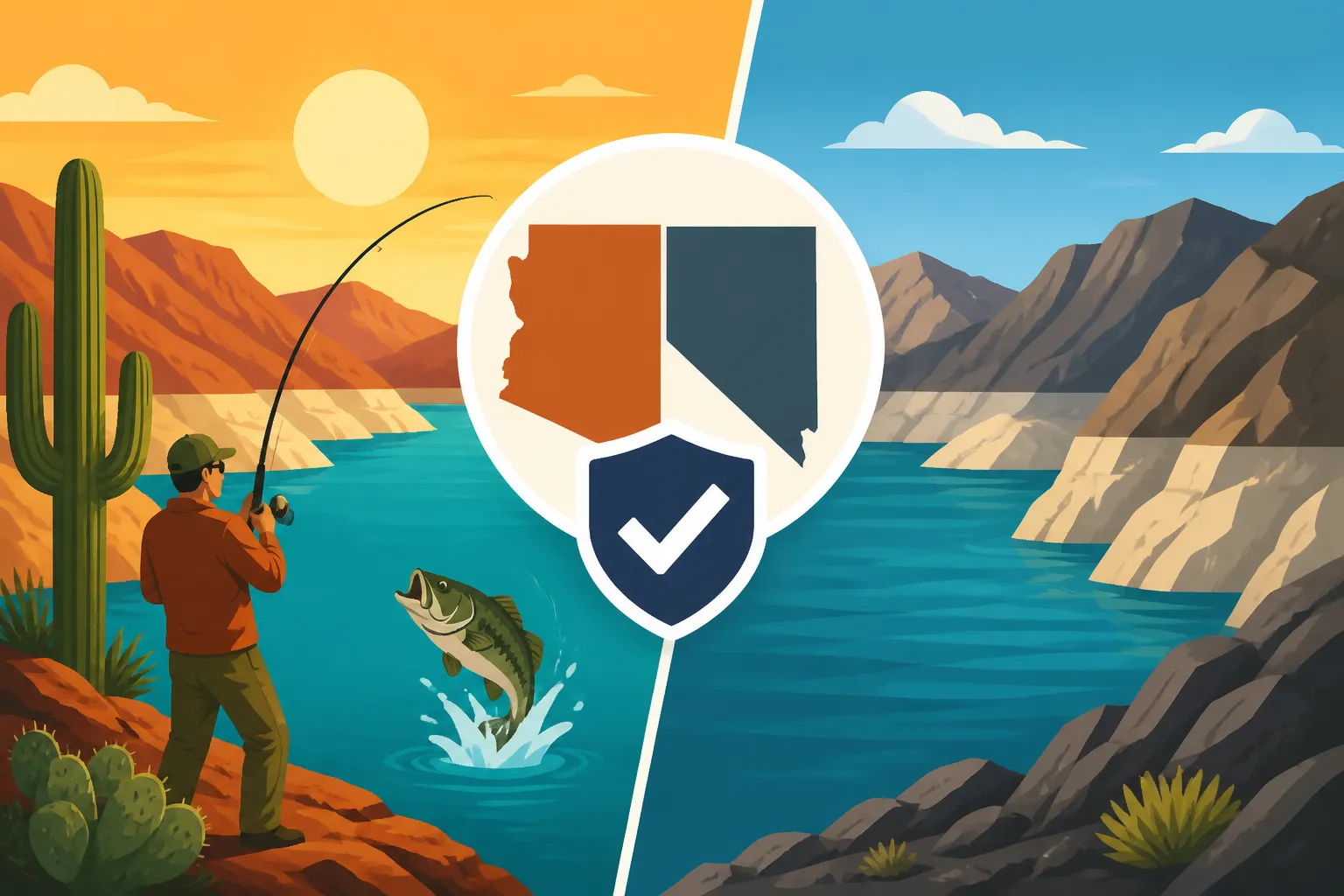
The good news for Arizona anglers is that there is a long-standing reciprocal agreement in place with Nevada for Lake Mead. This means your Arizona fishing license can be valid on certain portions of the Nevada side of Lake Mead, and vice-versa, without needing to purchase a separate Nevada license. However, understanding the precise terms of this agreement is absolutely crucial to ensure you remain compliant with the law. It’s not a blanket pass for all Nevada waters, nor does it override every local regulation.
Specifics of the Arizona-Nevada Reciprocal Agreement
Under the reciprocal agreement between the Arizona Game and Fish Department (AZGFD) and the Nevada Department of Wildlife (NDOW), a valid Arizona fishing license allows you to fish in all navigable waters of Lake Mead, even those portions that geographically fall within Nevada. This is a huge benefit for anyone planning a fishing trip to this iconic reservoir. The operative phrase here is "navigable waters," meaning the main body of the lake where boats can operate. This agreement simplifies things immensely, allowing you to chase those schooling stripers or explore remote coves without the constant worry of crossing an invisible state line and facing penalties for not having the correct license.
This agreement, however, has some important caveats. It specifically applies to Lake Mead itself. It does not extend to other Nevada waters, such as Lake Mohave, Lake Havasu, or any inland lakes or rivers within Nevada. For those waters, a separate Nevada fishing license would be required. It’s critical to remember this distinction. Your Arizona license is your ticket to Lake Mead's vast fishing grounds, but don't assume it grants you access to every body of water just because it's in the same vicinity or fed by the same river system. Think of it as a specific passport for Lake Mead, not a visa for the entire state of Nevada. You can find more comprehensive details on general licensing requirements in our Arizona Fishing License Guide.
What an Arizona License Covers and Doesn't Cover
Let's break down the practical implications of holding an Arizona fishing license when on Lake Mead:
What an Arizona License Covers on Lake Mead:
- Main Lake Body: Your Arizona resident or nonresident fishing license is valid for fishing anywhere on Lake Mead's main body, regardless of whether you are technically in Arizona or Nevada waters. This includes all bays, coves, and channels connected to the main lake.
- Shoreline Fishing: If you're fishing from the shoreline on the Nevada side, provided you are within the boundary of Lake Mead's main waters, your Arizona license covers you. This is a huge relief for bank anglers who want to explore different access points.
- Boating and Bank Access: You can launch your boat from either an Arizona or Nevada access point and fish the entirety of Lake Mead with just your Arizona license, adhering to the specific rules of the state from which you launched (e.g., boat registration).
What an Arizona License Doesn't Cover on Lake Mead (or Nearby Areas):
- Nevada Inland Waters: Any lake, river, or stream not part of the main Lake Mead body but located entirely within Nevada state lines requires a Nevada fishing license. This includes popular areas like the upper Colorado River within Nevada, beyond the defined reciprocal zone.
- Other Border Waters Beyond Lake Mead: While Lake Mead has this agreement, other shared waters like Lake Mohave or Lake Havasu have their own specific rules. For example, while there are agreements for Lake Mohave and Lake Havasu as well, they might have slightly different stipulations regarding their reciprocal zones. Always verify for each specific body of water you plan to visit.
- State-Specific Regulations (Bag/Length Limits): Crucially, while your license is valid, you must always adhere to the fishing regulations (bag limits, length limits, allowed tackle, etc.) of the state in which you are physically fishing at that moment. This is a point of frequent misunderstanding. If you're on the Nevada side, you must follow Nevada's fish limits and regulations for species like striped bass, largemouth bass, and catfish. If you drift into Arizona waters, you switch to Arizona's rules. This often requires carrying both states' regulation booklets or having digital access to them. Many anglers find it helpful to download the latest regulations from both AZGFD and NDOW websites, or even purchase a waterproof physical copy. Online retailers like Amazon often carry various fishing guides and accessories that can help you stay organized with regulations.
To illustrate this complex, yet vital, point, consider this table:
| Feature | Arizona Fishing License (on Lake Mead) | Nevada Fishing License (on Lake Mead) |
|---|---|---|
| Coverage Area | All navigable waters of Lake Mead (AZ & NV portions) | All navigable waters of Lake Mead (AZ & NV portions) |
| Valid for | Residents & Nonresidents holding a current AZ license | Residents & Nonresidents holding a current NV license |
| Required for | Taking any fish from Lake Mead | Taking any fish from Lake Mead |
| Does NOT Cover | Inland Nevada waters (e.g., beyond Lake Mead's main body) | Inland Arizona waters (e.g., beyond Lake Mead's main body) |
| Regulation Adherence | Must follow Nevada's regulations when in Nevada waters. | Must follow Arizona's regulations when in Arizona waters. |
| Specific Example: | Catch a striper in NV side, follow NV length/bag limit. | Catch a striper in AZ side, follow AZ length/bag limit. |
| Additional Permits (e.g.) | Required National Park Service entrance/vessel permits still apply to both. | Required National Park Service entrance/vessel permits still apply to both. |
This table clearly highlights that while the license grants access, the rules you follow depend on your exact location on the lake. For a complete understanding of Arizona's rules, be sure to check out our Arizona Fishing Regulations Explained article.
Navigating Lake Mead: Permits, Regulations, and Best Practices
While the reciprocal license agreement on Lake Mead is incredibly convenient, it doesn't mean you can throw caution to the wind. There are still additional permits, regulatory differences, and best practices you need to be aware of to ensure a smooth, legal, and enjoyable fishing experience. Ignoring these details could still lead to fines or a ruined trip, even with a valid Arizona license in hand.
Additional Permits Beyond Your State License
Beyond your state fishing license, there’s one major additional requirement for fishing on Lake Mead: the National Park Service (NPS) permit. Lake Mead is managed by the Lake Mead National Recreation Area, which is part of the National Park Service system. This means that anyone recreating within the recreation area, including anglers, must pay an entrance fee or possess an applicable pass. This could be a single-use entrance fee for your vehicle, an annual pass for the Lake Mead NRA, or a national interagency pass like the "America the Beautiful" pass.
Furthermore, if you are operating a motorized vessel on Lake Mead, you might also need a separate NPS vessel permit. This permit ensures that your boat meets certain safety and environmental standards for operation within the National Recreation Area. These fees and permits are separate from your state fishing license and are mandatory regardless of which state's license you hold. They are federal requirements that apply to everyone using the park. It’s a good idea to check the official Lake Mead National Recreation Area website well in advance of your trip for the most up-to-date information on entry fees and boat permits. You can often purchase these permits online or at visitor centers upon arrival. Having everything sorted beforehand prevents delays and ensures you can hit the water without any last-minute hassles. For more general information about permits, consider our guide on Arizona Fishing Season Dates and Limits.
Key Regulatory Differences to Watch Out For
This is where many anglers get tripped up! While your Arizona license is valid for access, the regulations themselves change depending on which side of the invisible state line you're fishing. Arizona and Nevada have their own distinct fishing regulations, which can differ significantly in terms of bag limits, length limits, and even tackle restrictions for specific species.
For example, Nevada might have a stricter slot limit for largemouth bass, meaning fish within a certain size range must be immediately released, while Arizona might have a simpler daily bag limit. The daily creel limit for striped bass could also vary between the two states, or the minimum keeper size for channel catfish might be different. Even something as seemingly minor as the legality of certain types of bait or methods could differ.
It’s your responsibility as an angler to know and follow the regulations of the state you are currently fishing in. This means if you drift from the Arizona side into Nevada waters, you are now subject to Nevada's rules for any fish you catch or possess. The best way to manage this is to:
- Carry both states' current regulation booklets or have them readily accessible on your phone. The AZGFD and NDOW websites are excellent resources for the most current information. Many anglers even print out summaries of key differences.
- Use a GPS-enabled fish finder or navigation app on your phone to identify your exact location relative to the state line. Many modern fish finders, even those you can purchase easily on Amazon, come with mapping capabilities that show state borders on large lakes.
- Default to the stricter regulation if you are ever in doubt, especially concerning bag and length limits. This is the safest approach to avoid a violation.
Remember, ignorance of the law is not an excuse. Game wardens from both Arizona and Nevada patrol Lake Mead and are empowered to enforce their respective state's regulations within their jurisdiction, even with the reciprocal license agreement in place. Familiarizing yourself with these nuances is key to a stress-free experience. Our article on Fishing Bag and Possession Limits Explained offers a deeper dive into how these limits work generally.
Practical Tips for Anglers on Boundary Waters
Fishing on a massive boundary water like Lake Mead requires a bit more preparation, but it’s absolutely worth it for the incredible angling opportunities. Here are some practical tips to ensure you have a fantastic and legal trip:
- Download or Carry Both Regulation Booklets: As mentioned, having the most current Arizona and Nevada fishing regulations on hand is non-negotiable. Many anglers keep a physical copy and also save digital versions on their phones for quick reference.
- Utilize GPS and Mapping: Whether it's a dedicated marine GPS unit, a mapping feature on your fish finder, or a reliable app on your smartphone, use technology to help you stay aware of your location relative to the state line. Apps like Navionics or even Google Maps with satellite view can be surprisingly helpful for identifying landmarks or understanding the lay of the land near the border.
- Know Your Target Species' Rules for Both States: Before you even leave the dock, research the bag and length limits for the fish species you plan to target in both Arizona and Nevada waters. If you're primarily after striped bass, know their specific regulations for both sides.
- Consider a Multi-State Fishing License (If Available): While Lake Mead has a reciprocity agreement, some anglers who fish other border waters extensively might find it beneficial to explore options for combination licenses if they exist for specific situations. However, for Lake Mead, the single-state license with reciprocity is typically sufficient.
- Dress for the Arizona Climate: Regardless of which side of Lake Mead you're on, you're in the desert. Always bring plenty of water, wear sun protection (hats, sunglasses, long-sleeved shirts), and be prepared for rapidly changing weather conditions, especially during the monsoon season. Items like high-quality fishing shirts and wide-brimmed hats can be easily found on Amazon and make a huge difference in comfort.
- Check Launch Ramp Conditions: Water levels on Lake Mead can fluctuate significantly. Always check the current conditions of launch ramps and access points before heading out. Some ramps might be closed or difficult to use at lower water levels.
- Respect the Environment: Pack out everything you pack in. Dispose of fishing line and trash properly. Practice responsible catch and release when appropriate, especially for native species or if you exceed your possession limits for the state you're in. This helps ensure the longevity of the fishery for everyone. If you're new to fishing in Arizona, you might want to look into our Arizona Fishing Rules for Beginners for more foundational knowledge.
Why This Reciprocity is Crucial for Anglers
The Arizona-Nevada reciprocal agreement for Lake Mead isn't just a bureaucratic formality; it's a cornerstone of responsible fisheries management and angler satisfaction in the region. Without it, the experience of fishing on such a vast and productive body of water would be significantly diminished, creating unnecessary barriers and frustrations.
Seamless Fishing Experience Across State Lines
Imagine the alternative: having to pull up your lines, motor to a specific, often unmarked, state line, and then resume fishing after confirming your legal status. Or worse, having to constantly worry that a particularly strong gust of wind or an unnoticed drift has moved you into an area where your license isn't valid. This kind of constant anxiety would detract immensely from the peace and enjoyment that fishing is supposed to provide.
The reciprocity agreement eliminates this mental burden. It allows anglers to focus on the chase, the fight, and the beauty of Lake Mead's expansive waters. You can follow schools of striped bass wherever they lead, explore any promising coves or structures, and simply enjoy the freedom of the open water. This seamless experience encourages more people to get out and enjoy fishing, fostering a greater connection to nature and the sport. It acknowledges that fish don't carry passports, and neither should the anglers pursuing them across an arbitrary line on a map. For those looking to explore more of Arizona's stunning fishing opportunities without border concerns, consider our guide on the Best Fishing Lakes in Arizona.
Avoiding Costly Violations and Confusion
Beyond convenience, the reciprocal agreement serves a critical purpose in preventing accidental violations. Without it, many anglers, particularly those new to the area or occasional visitors, would inevitably cross state lines unknowingly, putting them at risk of fines, confiscation of gear, or even more severe legal consequences. Fishing without a valid license in the correct jurisdiction is a serious offense that can carry significant penalties.
By establishing clear guidelines for license validity across state lines, the AZGFD and NDOW have created a more user-friendly system that minimizes confusion and reduces the likelihood of unintentional lawbreaking. While you still need to be diligent about regulations in effect for the specific state waters you are in, the fundamental question of "Is my license even valid here?" is largely resolved for Lake Mead. This clarity allows enforcement officers to focus on more significant violations rather than chasing down honest anglers who simply misjudged their position. It's a proactive measure that benefits both the fishing public and the agencies tasked with managing these precious natural resources. Understanding these rules protects your wallet and your peace of mind, allowing you to focus on the joy of the catch. For a sobering look at what happens when rules are broken, see our piece on Fishing Violation Fines and Penalties in Arizona.
Disclaimer
The information provided in this article is intended for general guidance only and is subject to change. While we strive to provide accurate and up-to-date information, fishing regulations and license requirements can be modified by state agencies at any time. It is always the angler's responsibility to consult the official Arizona Game and Fish Department (AZGFD) and Nevada Department of Wildlife (NDOW) websites or their current regulation booklets for the most current and authoritative information before heading out to fish.