Do You Need an Anchor for Kayak Fishing?
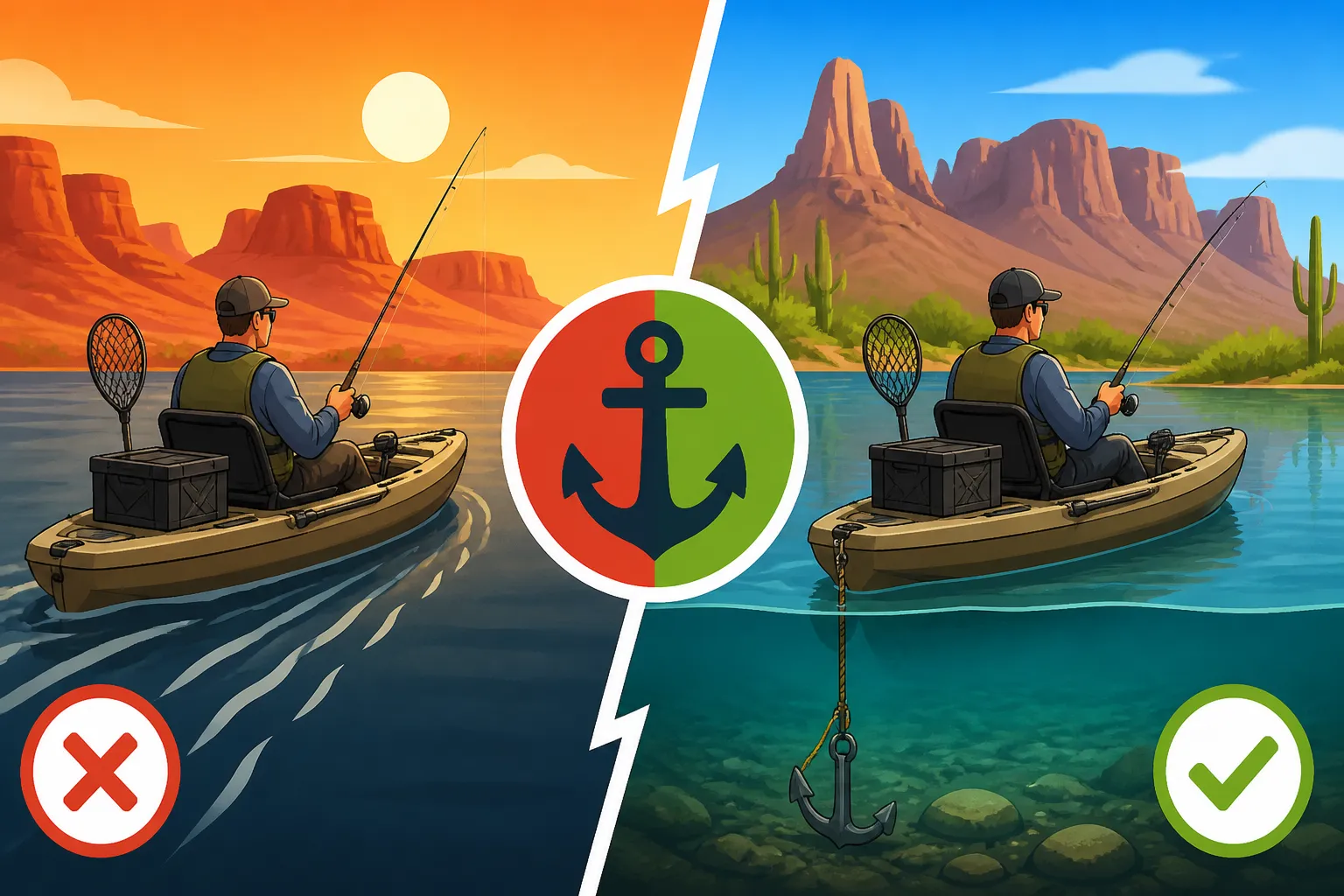
It’s a common scenario for kayak anglers: you’re paddling along, finally find that perfect submerged structure where you know the bass are hiding, you cast your line… and then a gust of wind, or a gentle current, pushes you right off your spot. Frustrating, right? You spend more time repositioning than actually fishing! This guide is going to dive deep into whether an anchor is truly a necessity for kayak fishing, exploring the different types, when they’re most useful in Arizona’s diverse waters, and how to set up an effective system to keep you dialed in on those fish.
The Wobble Woes: Why Stability is a Kayak Angler's Challenge
Let's be honest, fishing from a kayak is an amazing experience – the stealth, the access to skinny water, the connection to nature. But it also comes with its own unique set of challenges, especially when it comes to staying put. Unlike a big bass boat with a trolling motor or a substantial hull to cut through the chop, a kayak is inherently lightweight and easily influenced by external forces.
The Impact of Wind and Current
Arizona's desert lakes, while beautiful, can be notoriously windy, especially as the day heats up or when afternoon breezes kick in. Picture yourself on Lake Pleasant, trying to hold a specific depth over a deep ledge, only to be constantly pushed around by the breeze. It's not just annoying; it makes precise lure presentation nearly impossible. Similarly, if you venture into river systems like the Lower Salt River, even a mild current can have your kayak drifting downstream faster than you can say "fish on!" You want to work a certain eddy or a specific seam where trout might be holding, but without a way to anchor, you're constantly fighting the river's flow. Is Kayak Fishing Safe on Windy Desert Lakes? is a good resource if you often deal with breezy conditions.
Holding Your Position for Precision Fishing
Many effective fishing techniques rely on being able to hold a precise position. Think about dropping a soft plastic right into a brush pile for largemouth bass at Roosevelt Lake, or vertically jigging for crappie over deep timber at Bartlett Lake. If your kayak is constantly moving, that precision goes right out the window. Live bait presentations, which often require a slower, more deliberate approach, also suffer when your boat isn't stationary. An anchor allows you to pinpoint your casts and keep your bait in the strike zone longer, dramatically increasing your chances of success. It's about giving yourself the best possible advantage, especially when the bite is subtle or localized.
Essential Anchor Types for Kayak Fishing
When you think of an "anchor," you might picture a heavy, multi-pronged metal behemoth designed for large vessels. But for kayaks, the game is a little different. Kayak anchors are designed to be relatively lightweight, compact, and efficient, perfectly suited for smaller craft.
Folding Grapnel Anchors
These are probably the most common type of anchor you'll see on kayaks, and for good reason. A folding grapnel anchor features four flukes that fold inward, making it incredibly compact for storage. When deployed, the flukes open up to grip the bottom. They are fantastic for a variety of bottom types, from rocky lakebeds to silty river bottoms.
- Pros: Versatile, compact, relatively inexpensive. They bite well into mud, sand, or even snag on rocks effectively.
- Cons: Can get snagged easily on heavy cover, requiring a break-away anchor system or a bit of finesse to retrieve. You need to carry enough chain and rope to ensure it functions properly.
- Ideal Use: General lake fishing, holding over structure like rock piles or ledges. You can find these readily at most outdoor retailers like Bass Pro Shops or even online at Amazon.
Stakeout Poles or Shallow Water Anchors
If you primarily fish in shallower waters, a stakeout pole or a dedicated shallow water anchor system is an absolute game-changer. These are essentially stout poles, usually made of fiberglass or aluminum, that you manually push into the lake or riverbed to hold your kayak in place. They’re designed for depths typically less than 8-10 feet, although some longer models exist.
- Pros: Silent, quick to deploy and retrieve, no rope management, less likely to get permanently snagged. Excellent for sight fishing in clear, shallow areas.
- Cons: Limited to shallow water, can be bulky to store if not designed specifically for kayaks, not effective on hard rock bottoms or extremely soft, soupy mud.
- Ideal Use: Targeting bass in shallow coves, fishing community lakes like those in Phoenix or Tucson, or wading flats in rivers. If you're exploring the shallows of Saguaro Lake or Canyon Lake, this type of anchor really shines.
Drift Chutes (Sea Anchors)
Now, this one is a bit different because it's not designed to hold your kayak in a fixed spot, but rather to slow its drift. A drift chute, also known as a sea anchor or drift sock, is a parachute-like device that deploys in the water, creating drag. It's incredibly useful for controlling your speed when drifting across large flats or along expansive shorelines, allowing you to thoroughly fish an area without being swept too quickly by wind or current.
- Pros: Excellent for controlled drifts, helps maintain boat position relative to a fishing zone, can be retrieved relatively easily.
- Cons: Does not stop your kayak entirely, not suitable for stationary fishing.
- Ideal Use: Drifting for crappie at Roosevelt Lake, covering a large bass flat with a crankbait, or slowly working a stretch of river for trout.
When an Anchor Becomes Your Best Fishing Buddy
While you can technically fish from a kayak without an anchor, there are definitely situations where it transforms your fishing experience from a struggle into a success.
Battling Wind and Current
Let's face it, Arizona's weather can be unpredictable. One minute it's dead calm, the next you're fighting a stiff breeze across Lake Havasu. Trying to cast accurately or present a bait naturally when you're constantly being pushed off course is incredibly frustrating. An anchor allows you to lock into position, whether it's battling a relentless crosswind that's trying to push you into the reeds or holding steady against the current of the Colorado River. This stability helps you focus on your fishing technique, rather than on paddling to maintain position. If you're ever wondering How to Anchor a Kayak for Still Fishing, a proper anchor system is the first step.
Targeting Specific Structure and Depths
Fish, especially bass, crappie, and catfish, are often associated with specific structures: submerged timber, rock piles, ledges, or brush. To effectively fish these spots, you need to be able to sit right on top of them or make repeated casts to the same area. Without an anchor, you'll constantly drift past, making it tough to work a small jig or a worm precisely. Imagine trying to drop shot for smallmouth bass on a deep underwater hump at Lake Powell; an anchor ensures your bait stays directly over the fish, maximizing your strike window.
Vertical Presentations and Live Bait Fishing
Techniques like vertical jigging, drop-shotting, or fishing with live bait almost demand a stationary platform. When you're trying to keep a lure directly below you or letting a minnow swim naturally on a Carolina rig, any boat movement can negatively impact the presentation. An anchor is invaluable here, especially when you've located a school of fish on your fish finder and need to stay on top of them. It lets you fine-tune your bait depth and movement without fighting your kayak's drift.
Comparing Kayak Anchor Options
Here's a quick look at the main anchor types and their best applications for Arizona kayak fishing:
| Anchor Type | Best For | Pros | Cons | Typical Weight/Size |
|---|---|---|---|---|
| Folding Grapnel | General lake fishing, varied bottoms, wind | Versatile, compact, good grip | Can snag, requires rope management | 1.5 – 3 lbs anchor, 30-50 ft rope |
| Stakeout Pole | Shallow water (under 10 ft), quiet approach | Silent, quick, no rope, easy to deploy | Limited depth, ineffective on hard bottoms | 6 – 10 ft pole, no rope |
| Drift Chute | Controlled drifting, covering large areas | Slows drift, conserves energy | Does not hold stationary | Compact when stored, no fixed weight |
Building Your Kayak Anchor System for Arizona Waters
Having an anchor is one thing, but setting up an efficient and safe anchor system for your kayak is another. It's not just about tossing a weight overboard; it's about making it work for you on the water.
Choosing the Right Anchor Weight and Rope
For most fishing kayaks, a 1.5 to 3-pound folding grapnel anchor is sufficient. You don't need excessive weight because a kayak has a relatively small profile. The key is often the scope – the ratio of your anchor line length to the water depth. A good rule of thumb is a 5:1 or even 7:1 scope, especially in windy or current-heavy conditions. This means if you're in 10 feet of water, you'll want to deploy 50 to 70 feet of rope.
For rope, braided nylon or polypropylene are common choices. Nylon has some stretch, which can help absorb shock in rougher water, while polypropylene floats, which can be useful if you accidentally drop the line. Always opt for at least 30-50 feet of rope, with more if you plan to fish deeper areas like parts of Lake Powell or the deeper sections of Roosevelt Lake. Don't forget a couple of feet of chain between your anchor and rope; this helps the anchor lay flat and bite into the bottom more effectively. Best Kayak Anchors for Still Fishing has more details on specific options.
The Essential Anchor Trolley System
This is arguably the most crucial piece of rigging for a kayak anchor. An anchor trolley is a simple system of pulleys and a continuous loop of rope or cord that runs along one side of your kayak, from bow to stern. Your anchor line attaches to this loop. This allows you to deploy your anchor from either the bow or the stern of your kayak without having to physically reach either end.
- Safety First: The primary benefit of an anchor trolley is safety. If your anchor gets snagged on something immovable or if a sudden storm rolls in, you can quickly release the anchor line by simply unclipping it from your trolley. Trying to paddle forward or backward to free a snagged anchor, especially in current or wind, can be dangerous and lead to capsizing. Always have a quick-release mechanism. Boating Safety Gear Requirements in Arizona emphasize this for all watercraft.
- Optimal Positioning: A trolley allows you to adjust your anchoring point. If the wind shifts, you can easily slide your anchor point to the bow to face into the wind, minimizing kayak swing. If you're fishing a shoreline and want to cast parallel to it, you can move your anchor point to the stern, allowing you to cast freely without the anchor line interfering. Many Best Kayak Fishing Accessories kits include trolley components.
Secure Attachment and Easy Storage
Make sure you have a proper cleat or jam cleat installed on your kayak to secure your anchor line. This keeps the line from slipping and allows for quick adjustments. When you're on the move, you'll want a tidy way to store your anchor and line. Some anglers use small mesh bags that clip to their kayak, while others use dedicated anchor boxes. The goal is to keep it contained, prevent tangles, and ensure it's out of the way until you need it, but quickly accessible for deployment. For those long days in the sun, remember to also pack essentials like sun protection as covered in Best Sun Protection for Desert Fishing.
Conclusion: Anchor Up for Better Kayak Fishing!
So, do you need an anchor for kayak fishing? While you can get by without one in perfectly calm conditions or if you're just casually paddling around, for serious fishing in Arizona's diverse and often challenging waters, an anchor is far more than a luxury – it's an essential tool. It provides stability, allows for precision casting and presentation, and dramatically improves your effectiveness on the water.
Whether you opt for a versatile folding grapnel, a silent stakeout pole for the shallows, or a drift chute for controlled movement, incorporating a well-thought-out anchor system, especially with an anchor trolley, will make your kayak fishing trips more enjoyable, more productive, and significantly safer. So, stop fighting the elements and start anchoring up on those fish!
Disclaimer
This article is for general informational purposes only and does not constitute professional advice. Laws, prices and regulations vary by location and change over time. Consult a qualified professional for guidance on your specific situation.