Best Trolling Motor Size for a Bass Boat
Choosing the right trolling motor size for your bass boat can feel like a real puzzle. You want enough power to maneuver effectively against wind and current, but you don't want to overspend or weigh down your boat unnecessarily. This guide will walk you through the essential factors to consider, helping you match the perfect trolling motor to your bass boat for optimal performance on Arizona's diverse waters.
The Crucial Role of Trolling Motors on a Bass Boat
For any serious bass angler, a trolling motor isn't just a luxury; it's an absolute necessity. It allows for stealthy approaches to fishing spots, precise boat positioning, and silent navigation through prime areas without spooking the fish. Unlike your main outboard motor, a trolling motor is designed for slow, controlled movement and subtle adjustments, which are paramount when you're trying to work a brush pile or follow a submerged channel.
Think about fishing on Roosevelt Lake. You've found a promising cove with some standing timber, but a light breeze is trying to push you off your line. Your main engine is too loud and too powerful for those delicate adjustments. This is where your trolling motor shines, silently holding you in position or allowing you to creep along the treeline, presenting your lure exactly where you want it. It's about precision and control, which directly translates to more successful fishing.
Why Size Matters for Performance and Efficiency
The size of your trolling motor, primarily measured by its thrust rating, directly impacts its ability to control your boat. Too small, and you'll constantly be fighting the elements, draining your battery faster and frustrating your efforts. Too large, and you might have paid for more power than you truly need, potentially adding unnecessary weight and costing more upfront. It's a balance of power, battery life, and overall cost-effectiveness.
Imagine trying to hold your position on a windy day on Lake Pleasant with a trolling motor that's simply underpowered. You'd be constantly adjusting, your battery would die quickly, and you'd likely miss out on prime fishing time because you're struggling with boat control. Conversely, a perfectly sized motor gives you effortless control, allowing you to focus entirely on fishing. Best Boats for Arizona Lakes often have specific recommendations for their ideal trolling motor setup.
Understanding Trolling Motor Thrust: What Do Those Numbers Mean?
When you look at trolling motors, the first thing you'll notice is a "thrust" rating, usually expressed in pounds (lbs). This isn't horsepower; it's a measure of the pushing or pulling power the motor can generate. The higher the thrust, the more powerful the motor and the greater its ability to move or hold your boat.
Thrust is directly related to voltage. Most trolling motors operate on 12-volt, 24-volt, or 36-volt systems. Generally, a 12-volt system will offer thrust ratings up to around 55 lbs, a 24-volt system can go up to 80 lbs, and a 36-volt system can push beyond 100 lbs. More voltage means more power potential and typically more thrust. This voltage requirement is a critical consideration for your boat's battery setup, which we'll discuss shortly.
How Thrust Relates to Your Boat's Weight and Length
A general rule of thumb for determining minimum thrust is to take your boat's fully loaded weight (boat, motor, gear, passengers) and divide it by 100. This gives you a baseline thrust in pounds. So, if your bass boat and all its contents weigh 2,500 pounds, you'd want a minimum of 25 pounds of thrust. However, this is just a starting point, and most anglers opt for significantly more power than the bare minimum to handle real-world conditions.
Another common guideline involves boat length. For every 400 pounds of boat weight, you need about 5 pounds of thrust. For boat length, a good starting point is often 2 pounds of thrust per foot of boat length. Again, these are minimums. On a blustery day on Canyon Lake, you'll be thankful for extra thrust beyond these basic calculations.
Key Factors for Sizing Your Trolling Motor Correctly
While general thrust-to-weight ratios provide a baseline, many other real-world factors influence the ideal trolling motor size for your bass boat. Ignoring these can lead to an underperforming setup, regardless of what the basic formulas suggest.
Boat Size and Weight
This is perhaps the most obvious factor. A longer, heavier bass boat will require more thrust to move and control than a shorter, lighter one. Remember to calculate your fully loaded weight. This includes not just the boat and its main engine, but also fuel, fishing gear, anchors, coolers, livewells full of water, and the weight of everyone on board.
For example, a sleek 18-foot fiberglass bass boat might weigh around 1,500 pounds dry, but once you add a full tank of gas, a powerful outboard, two anglers, a livewell full of water, and all your tackle, that weight could easily swell to 2,500-3,000 pounds or more. This heavier load demands a more robust trolling motor. Don't forget to account for any additional accessories like Best Fish Finders for Bass Fishing in Arizona or extra batteries, which add to the overall mass.
Water Conditions: Wind, Current, and Choppy Water
Arizona lakes, especially the larger ones like Lake Powell or Roosevelt Lake, can get incredibly windy, and even smaller urban lakes can develop a chop. Wind and strong currents are the biggest enemies of an underpowered trolling motor. If you frequently fish in open, exposed waters or areas with noticeable current (like parts of the Colorado River), you'll want to lean towards a higher thrust motor.
Imagine fishing in the spring at Bartlett Lake when a sudden afternoon gust kicks up. A 50-pound thrust motor might struggle to hold an 18-foot bass boat against that wind, forcing you to use maximum power, which drains batteries rapidly. A 70-80 pound thrust motor, however, would likely handle it with less effort, conserving battery life and allowing for more precise boat control. If you often fish during Arizona's Arizona Monsoon Season Fishing Guide, you know how quickly conditions can change.
Fishing Style and Technique
Your preferred fishing style also plays a significant role. If you primarily "spot lock" or hold your boat over a specific piece of structure for extended periods, you'll benefit from a motor with ample power to maintain that position efficiently. If you prefer to troll long distances at a consistent slow speed, a more powerful motor will do so with less strain.
Anglers who consistently fish heavy cover, pitching and flipping into tight spots, need instant, responsive power to make quick, precise adjustments. Those who mainly cast to open water might not need quite as much raw power but will still appreciate the ability to cover water smoothly.
Battery Life and System Voltage
More thrust generally means more power consumption, which requires a robust battery system.
A 12-volt trolling motor typically uses one deep-cycle battery and usually tops out around 55 lbs of thrust.
A 24-volt system requires two deep-cycle batteries wired in series and can provide thrust levels of 70-80 lbs.
A 36-volt system needs three deep-cycle batteries and can offer 100 lbs of thrust or more.
The more batteries you have, the more weight you add to your boat and the more space they consume. However, a higher voltage system running at a lower power setting can be more efficient than a lower voltage system running at maximum power, potentially giving you longer run times. This is a crucial trade-off: do you prioritize lighter weight and simplicity (12V) or extended run time and maximum power (24V or 36V)? For a full day of fishing on a large lake like San Carlos Lake, ample battery life is non-negotiable.
Matching Your Trolling Motor to Your Bass Boat
Now that we've covered the factors, let's put it all together to help you make an informed decision.
Thrust Guidelines Based on Boat Type and Conditions
While exact figures vary, this table offers a general guideline for choosing trolling motor thrust based on your bass boat's size and common fishing conditions in Arizona:
| Boat Length (Feet) | Fully Loaded Weight (lbs) | Primary Conditions | Recommended Minimum Thrust (lbs) | Recommended Voltage System |
|---|---|---|---|---|
| 16-17 | 1,500 – 2,200 | Calm lakes, light wind | 55-70 | 12V or 24V |
| 18-19 | 2,200 – 2,800 | Moderate wind/current, larger lakes | 70-80 | 24V |
| 20-21 | 2,800 – 3,500 | Open water, windy conditions, strong current | 80-100 | 24V or 36V |
| 22+ | 3,500+ | Large reservoirs, frequent heavy wind/current | 100+ | 36V |
These are guidelines. Always err on the side of slightly more thrust if you are frequently in challenging conditions.
Shaft Length Considerations
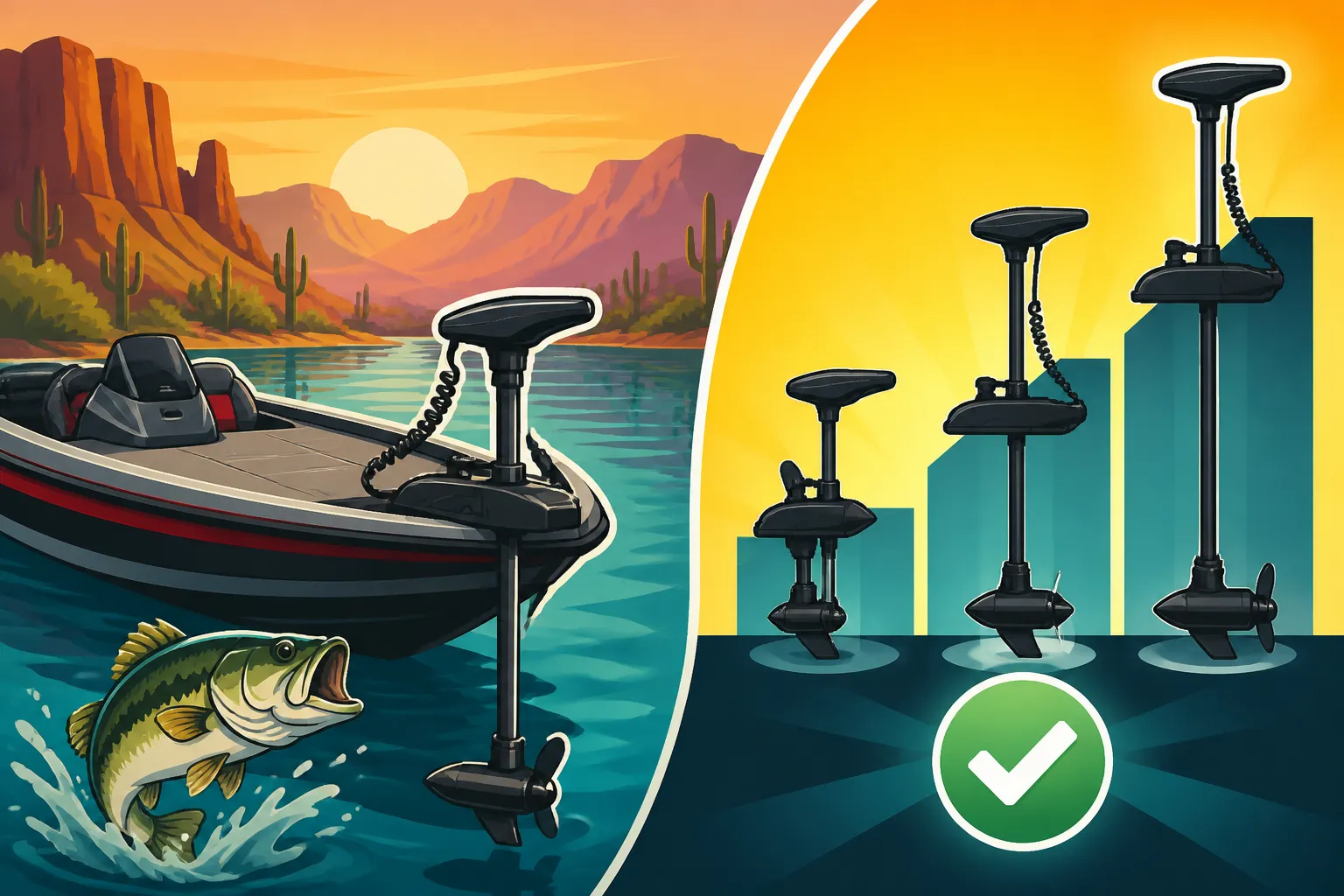
Beyond thrust, shaft length is another critical dimension. The shaft length determines how deep the propeller sits in the water. Too short, and your propeller will come out of the water in choppy conditions, losing thrust. Too long, and it can drag or become cumbersome.
To calculate the ideal shaft length, measure the distance from where the trolling motor mounts on the bow to the waterline. Add about 12-18 inches to this measurement. For example, if your measurement from the mounting surface to the waterline is 20 inches, a 42-inch shaft (20 + 12-18 inches = 32-38 inches, so 42 inches is a good standard size) would generally be appropriate.
Most bass boats will fall into the 45-60 inch shaft length range. If you fish a lot on big, open lakes where chop is common, leaning towards a slightly longer shaft can be beneficial.
Bow Mount vs. Transom Mount
Most bass boats exclusively use bow-mount trolling motors because they offer superior control and maneuverability from the front of the boat, especially for casting and precise boat positioning. Transom-mount motors are more common on smaller, tiller-steer boats, inflatables, or as secondary propulsion. For a dedicated bass boat, a bow-mount is almost always the answer.
Where to Research and Buy
When you're ready to explore specific models, there are excellent resources available. Large outdoor retailers like Bass Pro Shops offer a wide range of trolling motors from top brands, allowing you to see them in person and talk to knowledgeable staff. Online platforms like Amazon also provide extensive selections, often with detailed customer reviews and specifications that can help you compare models and features right from your couch. Don't forget to check out the warranties and return policies of any vendor before making a purchase.
Avoiding Common Mistakes and Maximizing Performance
Even with all this information, it's easy to make a few missteps when choosing a trolling motor. Here are some pointers to ensure you get the most out of your investment.
Don't Underpower Your Boat
The most common mistake anglers make is buying a trolling motor that is just barely adequate. While it might save you a little money upfront, the frustration of fighting wind and current, rapidly draining batteries, and poor boat control will quickly diminish your enjoyment on the water. It's almost always better to have a bit more thrust than you think you need rather than not enough.
Consider the worst-case scenario: a blustery afternoon on a sprawling reservoir. If your motor can handle those conditions, it will cruise effortlessly on calm days. Many anglers upgrade their trolling motors because they initially underestimated the power needed for their specific boat and fishing locations.
Consider Propeller Design and Weedlessness
Not all propellers are created equal. Some are designed for maximum thrust, others for speed, and many are specifically engineered to be "weedless," meaning they can cut through vegetation without getting tangled. In Arizona, where many lakes have abundant submerged grass and reeds, a weedless prop design can save you immense frustration and keep you fishing effectively.
When researching motors, pay attention to the propeller design. Many manufacturers highlight their weedless capabilities. You'll thank yourself when navigating through the thick hydrilla at Alamo Lake.
Factor in Technology and Features
Modern trolling motors come packed with incredible technology that can greatly enhance your fishing experience. Features like GPS-enabled "spot lock" (which holds your boat precisely in one spot), integrated transducers for your fish finder, autopilot capabilities, and even wireless remote controls are common.
While these features don't directly impact "size," they do influence which model you choose and can sometimes sway your thrust decision. For example, if you rely heavily on spot lock in windy areas, a motor with robust GPS anchoring and higher thrust will perform better and be more reliable. How to Read a Fish Finder for Bass can be greatly enhanced by a trolling motor with an integrated transducer.
Power Management and Charging
Once you've chosen your motor, proper battery maintenance and charging are paramount. Always use deep-cycle marine batteries designed for trolling motors. Invest in a good quality onboard charger that can charge all your batteries simultaneously and efficiently. Never let your batteries fully discharge, as this can shorten their lifespan. After every fishing trip, recharge your batteries.
A well-maintained battery system ensures your perfectly sized trolling motor performs at its best, giving you maximum run time and consistent power throughout your day on the water. Fishing License Renewal Rules in Arizona and other regulations aside, getting your gear right is key to an enjoyable trip.
Disclaimer
This article is for general informational purposes only and does not constitute professional advice. Laws, prices and regulations vary by location and change over time. Consult a qualified professional for guidance on your specific situation.